Complete chronology
Full overview and deeper context for every journey step.
1965–1980s
Leningrad Upbringing
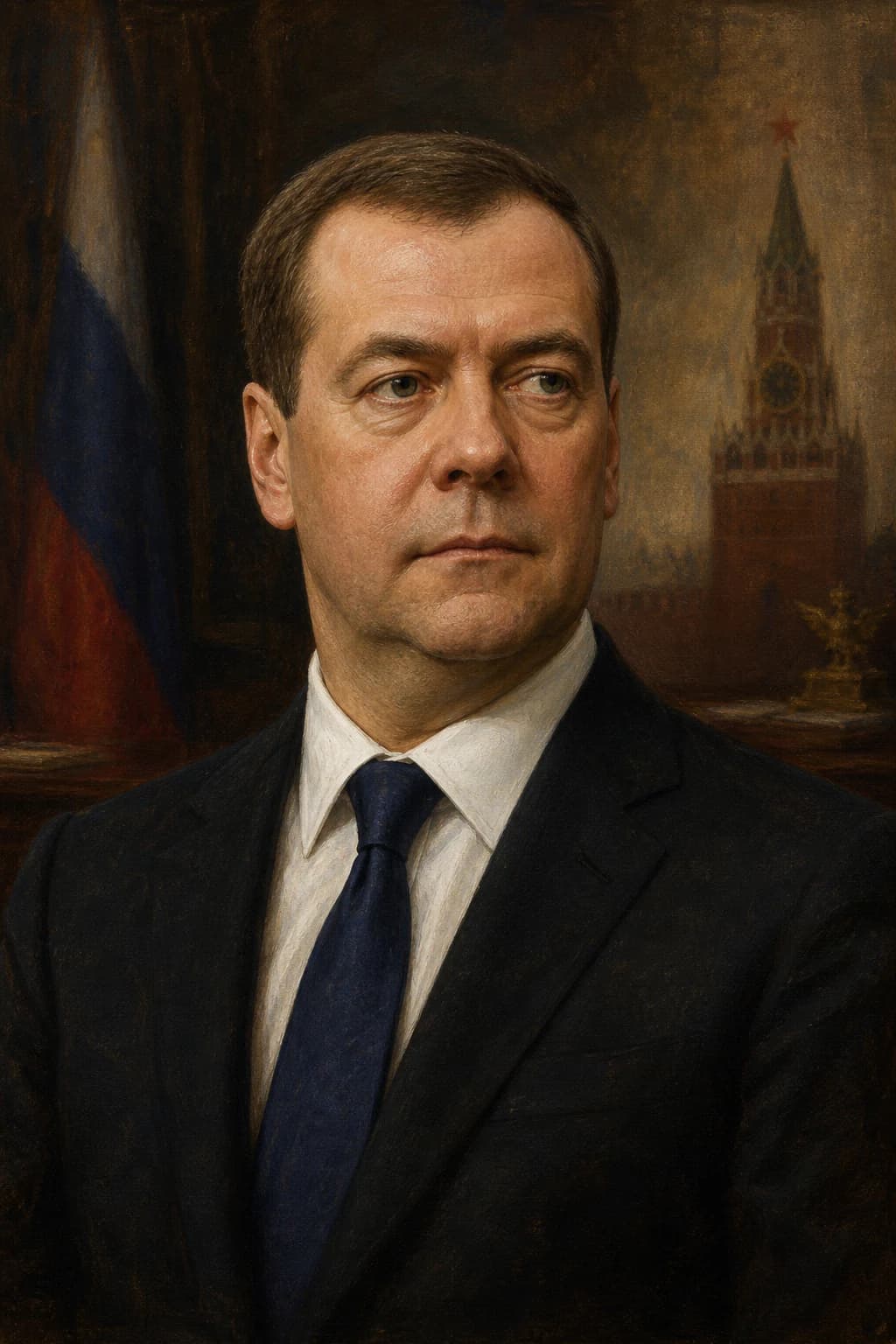
Dmitry Anatolyevich Medvedev was born in Leningrad on 14 September 1965, a generation after the Second World War and a generation before the Soviet collapse. Unlike many earlier Russian leaders, his origins were academic rather than industrial, military or party-bureaucratic. He studied law at Leningrad State University, later connected with the intellectual and political circles around Anatoly Sobchak, the reformist mayor of post-Soviet St Petersburg. This legal background shaped his public image for years. Medvedev could sound technocratic, procedural and modernising, speaking the language of institutions, courts, digital development and economic diversification. That image later made him useful in a political system that wanted to appear renewed without surrendering control.
His legal and academic background allowed him to represent modern governance within an increasingly centralised state.
1990s
St Petersburg Networks
The decisive network in Medvedev's rise was formed in St Petersburg after the Soviet Union began to unravel. Working in the orbit of Anatoly Sobchak, he encountered Vladimir Putin, another figure moving from local administration toward national power. Medvedev's role was not that of a mass politician. He was a lawyer, adviser and administrator, someone who could manage legal and corporate questions in a chaotic post-Soviet environment. The 1990s taught his generation that politics, property and state authority were being rebuilt at the same time. Medvedev emerged from this world as a loyal, competent specialist trusted by the circle that would later dominate Moscow.
His path to national power began through personal trust inside the St Petersburg network that shaped Putin's Russia.
1999–2005
Kremlin Ascent
When Putin moved from St Petersburg networks into the Russian presidency, Medvedev followed into the central state. He worked in the presidential administration and became Kremlin Chief of Staff in 2003. He also held senior roles connected to Gazprom, the energy giant that symbolised the fusion of state power and strategic resources in post-Soviet Russia. These positions gave him experience at the intersection of politics, law, corporate governance and national wealth. He was not a security-service veteran like many influential Putin allies, which helped him appear more liberal and civilian. Yet his rise depended on loyalty to Putin and on the consolidation of authority that defined the early 2000s.
He became the polished civilian face of a system increasingly organised around presidential power.
2005–2008
Chosen Successor
In 2005, Medvedev became First Deputy Prime Minister, overseeing national priority projects in areas such as health, education, housing and agriculture. These portfolios helped present him as a domestic moderniser concerned with living standards rather than geopolitical confrontation. By 2007, it was clear that Putin, barred by term limits from immediately serving another consecutive presidential term, had chosen Medvedev as the preferred successor. The arrangement revealed how Russian succession had changed. The election mattered, but the decisive endorsement came from inside the ruling system. Medvedev's candidacy reassured elites that Putin's influence would continue while allowing Russia to maintain constitutional form.
His succession was designed to combine legal continuity with political loyalty.
2008–2012
President of Russia
Medvedev became President of Russia on 7 May 2008. Putin moved to the premiership, creating the so-called tandem that defined Russian politics for the next four years. Medvedev spoke of modernisation, legal reform, technological development and reducing Russia's dependence on raw materials. He also used a more liberal tone than Putin, raising hopes among some Russians and foreign observers that he might gradually open the system. Yet the central question never disappeared: how much power did Medvedev truly hold, and how much was he stewarding a structure built by Putin? His presidency operated inside boundaries set by the political order that had elevated him.
His presidency tested whether a softer style could change a system built around harder power.
2008–2011
War and Modernisation
Only months into Medvedev's presidency, Russia fought a brief war with Georgia in August 2008 over South Ossetia and Abkhazia, after which Moscow recognised both as independent states. The conflict sharpened relations with the West and showed that the Medvedev era would not mean geopolitical softness. At home, he promoted modernisation projects, championed technology and spoke against legal nihilism, arguing that Russia needed stronger rule of law. The Skolkovo innovation project became one symbol of that ambition. Yet corruption, controlled media, constrained opposition and the dominance of state-linked power networks limited the depth of change. Medvedev's reform language was real, but the system's incentives remained stronger than his rhetoric.
He spoke the language of modernisation while governing within structures that resisted genuine accountability.
2011–2012
Putin Returns
The defining moment of Medvedev's presidency came when he announced in 2011 that Vladimir Putin would return as presidential candidate, while Medvedev would head the government. For many Russians who had taken his modernising language seriously, the decision felt like confirmation that the presidency had been temporary custodianship rather than independent leadership. Protests followed the parliamentary elections later that year, exposing frustration with managed politics and the absence of genuine competition. Medvedev left the presidency in May 2012, succeeded by Putin, and immediately became Prime Minister. The transition preserved constitutional sequence while making the hierarchy unmistakable.
The managed handover revealed the limits of his independence more clearly than any policy speech could.
2012–2020
Prime Minister
As Prime Minister from 2012 to 2020, Medvedev became the head of government under Putin's restored presidency. His premiership coincided with major strains: protests at home, the annexation of Crimea in 2014, war in eastern Ukraine, Western sanctions, falling oil prices and a tightening political atmosphere. Medvedev often appeared less central than Putin in the public drama of Russian power, yet he remained one of the system's most senior figures. His government managed budgets, social policy and economic pressures while Russia's political direction became more confrontational. In January 2020, after Putin proposed constitutional changes, Medvedev's government resigned, clearing the way for a reshuffle.
His premiership kept him close to power, but rarely at the visible centre of it.
2020–present
Hardline Afterlife
After resigning as Prime Minister, Medvedev became Deputy Chairman of Russia's Security Council in 2020, a position created within the upper architecture of national-security politics. In the years that followed, especially after Russia's full-scale invasion of Ukraine in February 2022, his public voice changed dramatically. The politician once marketed as a modernising lawyer became known for combative, nationalist and often extreme statements directed at Ukraine and the West. Historians will judge whether this reflected personal conviction, political positioning, or the incentives of a wartime authoritarian system. His career remains significant because it exposes a central feature of Putin-era Russia: the ability to change tone, office and ideology while remaining inside the same structure of loyalty and power.
His transformation from liberal-sounding moderniser to hardline loyalist mirrors the broader trajectory of the Putin system.