People

Vasco da Gama

Vasco da Gama was a Portuguese navigator who reached India by sea in 1498. His voyages around Africa opened the Carreira da India and reshaped global trade and empire.

Born
1460 CE
Died
1524 CE
Role
Portuguese explorer

Portuguese explorer (1460–1524)

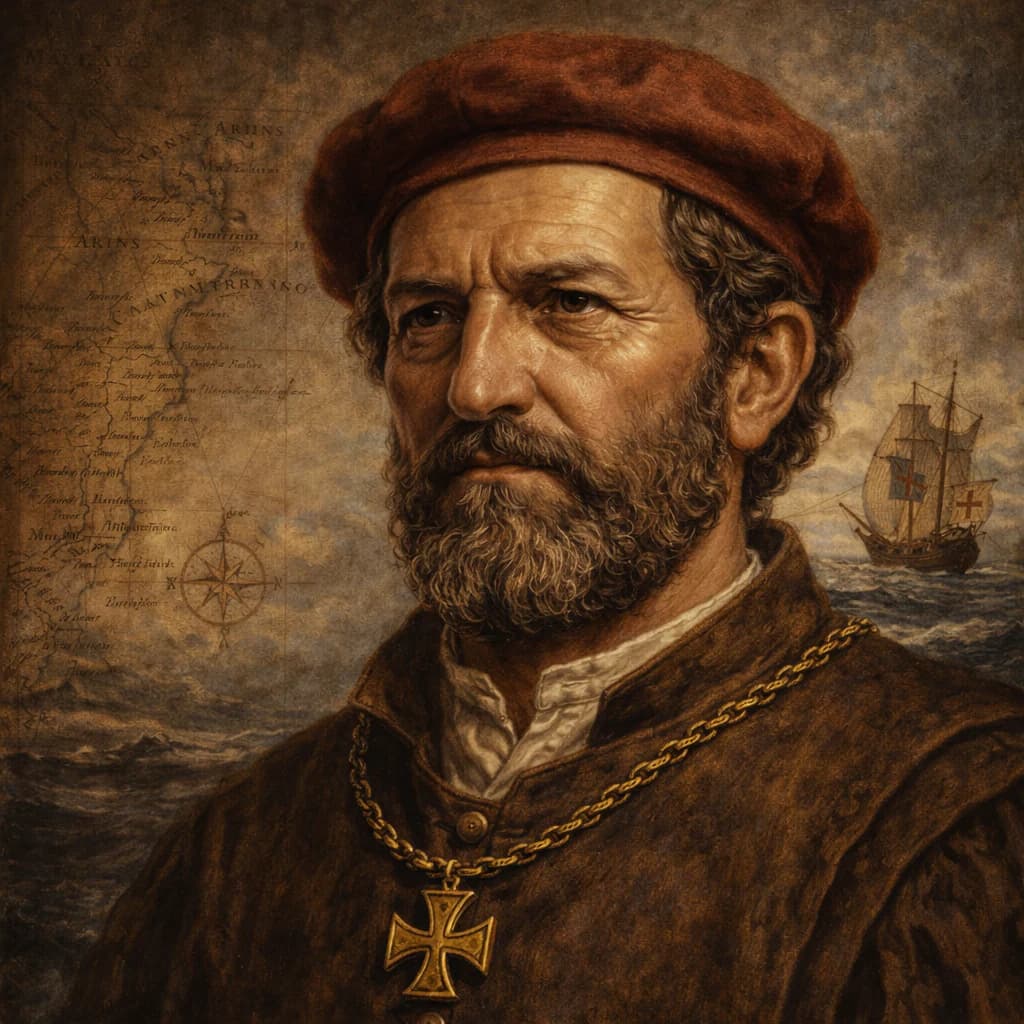
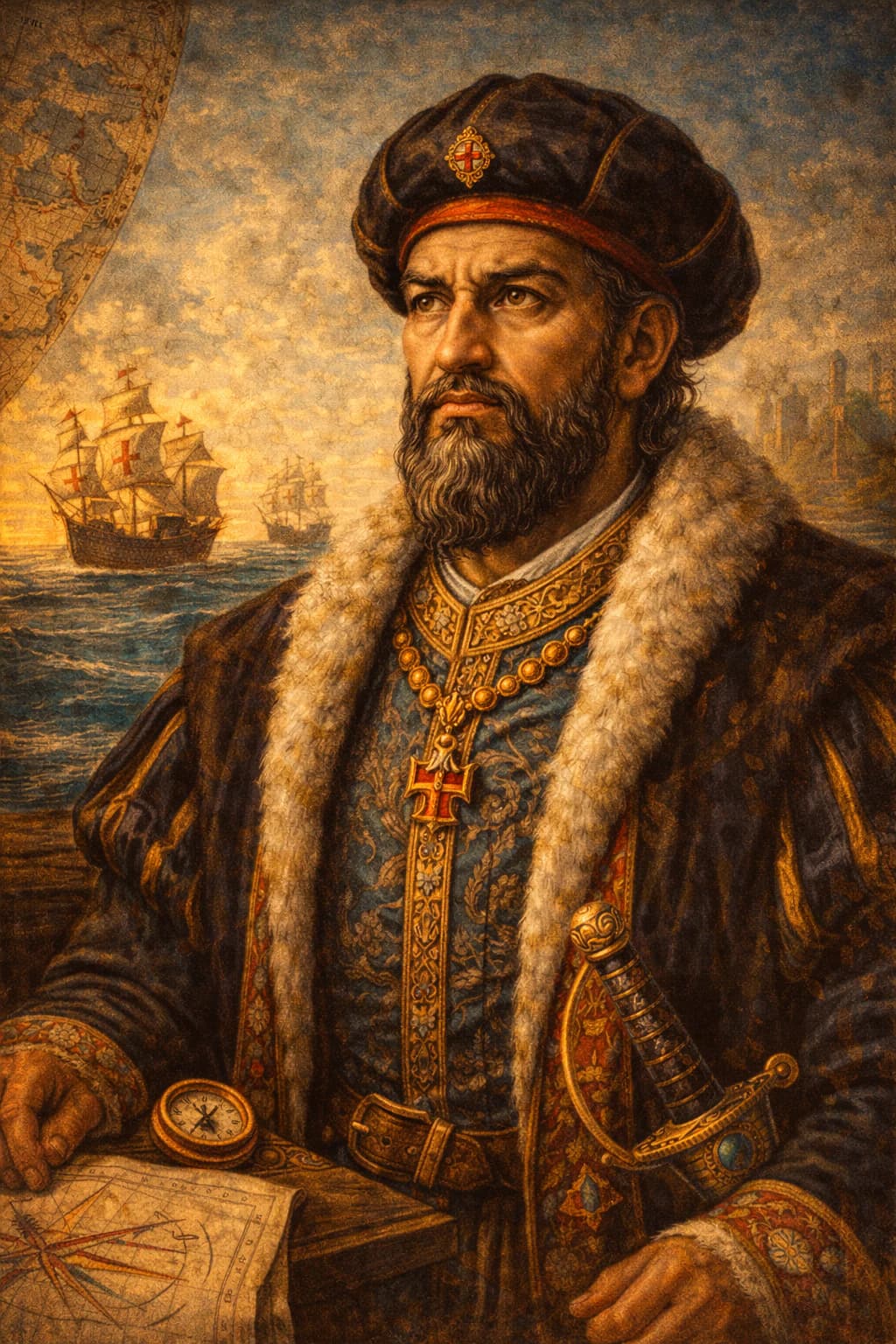
AI-generated portrait of Vasco da Gama in 15th-century Portuguese explorer attire
AI-assisted historical reconstruction

An illustrative reconstruction based on historical context. It is not a photograph or documentary likeness. Image policy

Quick answer

Vasco da Gama was a Portuguese navigator who reached India by sea in 1498. His voyages around Africa opened the Carreira da India and reshaped global trade and empire.

Born
1460 CE
Died
1524 CE
Role
Portuguese explorer
Years
1460-1524 CE
Facts

Vasco da Gama timeline facts

Selected specifics from this profile's life story.

1460
Coastal upbringing

Vasco da Gama was born into the minor nobility of Sines around 1460, in a Portugal already committed to Atlantic and African exploration.

1497–1498
Rounding southern Africa

Da Gama sailed down the Atlantic, rounded the Cape of Good Hope and used East African ports and pilots to cross the Indian Ocean.

1502–1503
Second expedition

On his second voyage in 1502, da Gama returned with a war fleet, using terror and naval force to impose Portuguese claims.

1524
Enduring legacy

Da Gama's legacy is global and double-edged: navigational breakthrough, Portuguese empire, maritime capitalism and violent disruption of Indian Ocean worlds.

Life Journey

The sea road to India and the violent birth of a trade empire

Follow the story in a more continuous narrative, with a reading mode that matches how much depth you want.

Complete chronology

1460

Coastal upbringing

Da Gama's world was shaped by a century of Portuguese maritime ambition. Since the age of Prince Henry the Navigator, Portuguese captains had pushed down the west coast of Africa, seeking gold, slaves, Christian allies and eventually a route to the spice markets of Asia. Vasco's father, Estevao da Gama, served the crown, and the family belonged to the lower nobility: privileged enough for royal service, not powerful enough to be secure without achievement. Growing up near the coast, Vasco inherited a culture in which navigation, warfare, commerce and crusading language were tightly connected.

1480s

Royal service begins

The route da Gama would complete was built by many earlier voyages. Bartolomeu Dias had rounded the Cape of Good Hope in 1488, proving that the Atlantic and Indian Oceans connected by sea. Portuguese pilots, cartographers and royal officials gathered winds, currents and coastal intelligence piece by piece. Da Gama's own early service is less well documented than his famous expedition, but he had a reputation for toughness and loyalty. King Manuel I needed a commander who could represent royal authority, endure uncertainty and enforce Portuguese interests when diplomacy failed. Da Gama was selected for a mission with commercial, religious and geopolitical stakes.

1497

Voyage assignment

The expedition that left Lisbon in July 1497 aimed to bypass the Venetian, Arab and other intermediary networks through which Asian spices reached Europe. It was not simply a voyage of curiosity. Pepper, cinnamon, cloves and other goods promised enormous profit, and direct access could make Portugal a major commercial power. The fleet sailed with gifts, interpreters, religious hopes and artillery. Its knowledge was partial; its confidence was high. Da Gama's task was to transform decades of reconnaissance into a working oceanic connection between Portugal and India. Failure would have meant dead crews and wasted royal investment. Success would redraw the map of trade.

1497–1498

Rounding southern Africa

The outward voyage required more than hugging the African coast. Portuguese pilots used the volta do mar, swinging into the Atlantic to catch favourable winds before turning back toward southern Africa. After rounding the Cape, da Gama moved up the east African coast through a Swahili trading world already connected to Arabia, Persia, India and East Africa. Encounters at Mozambique, Mombasa and Malindi mixed suspicion, diplomacy and misunderstanding. From Malindi, a pilot helped guide the fleet across the monsoon route to India. The voyage was therefore both a Portuguese achievement and an entry into an existing Indian Ocean system far older than European arrival.

1498

Arrival in India

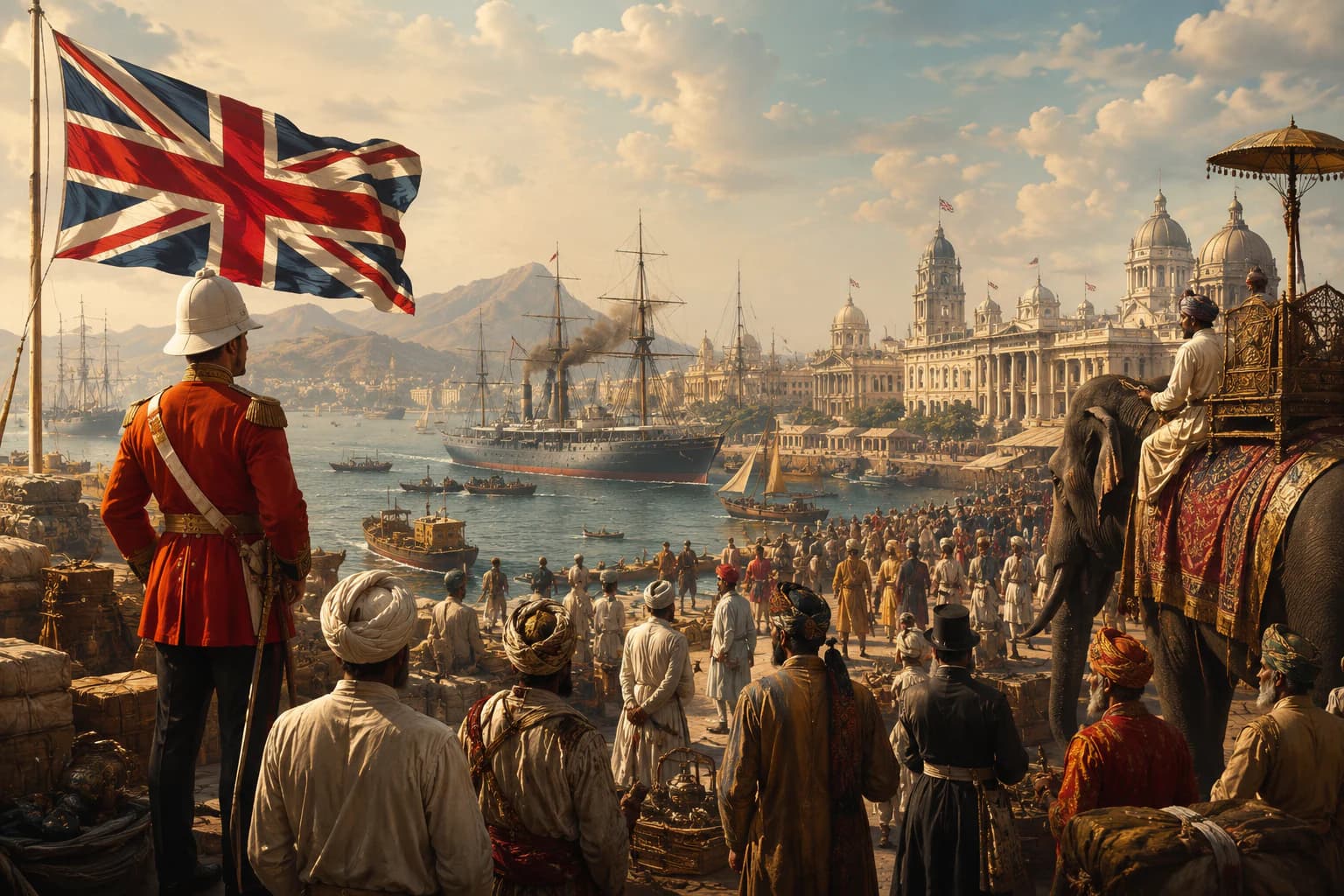
Da Gama's arrival at Calicut was world-changing, but not immediately triumphant in the way Portuguese memory later preferred. Calicut was a sophisticated commercial city ruled by the Zamorin and connected to Muslim, Hindu, Jain and other trading communities. The Portuguese gifts looked unimpressive beside Indian Ocean standards, and da Gama misunderstood the scale and etiquette of the market he had entered. He wanted spices, treaties and prestige; local merchants saw undercapitalised newcomers with armed ships. The voyage's importance lay less in immediate profit than in proof. Europe could now reach India by sea around Africa, and Portugal would return with more force.

1499

Return and recognition

The return crossing was devastating. Scurvy, exhaustion and delays killed many of the crew, including da Gama's brother Paulo soon after reaching the Azores. Yet the expedition had achieved the essential strategic result. It returned with information, samples of goods and confirmation that the sea road worked. Manuel I rewarded da Gama and immediately planned stronger follow-up voyages. The route became the Carreira da India, the long imperial lifeline linking Lisbon, the Cape, East Africa and the Indian Ocean. Da Gama's fame rested on endurance and proof, not on a smooth diplomatic success.

1502–1503

Second expedition

The second voyage exposed the violent logic of Portuguese expansion. Da Gama came not as a tentative visitor but as an armed enforcer seeking tribute, trading privileges and control over shipping. His fleet attacked rivals and used spectacular cruelty, most notoriously against the Miri, a ship carrying Muslim pilgrims and merchants. Such actions were meant to frighten Indian Ocean powers into recognising Portuguese naval power. They also revealed that the new route would not simply add Europeans to existing trade. Portugal aimed to redirect commerce through cannon, passes, fortresses and intimidation.

1524

Viceroy appointment

By the time da Gama returned as viceroy, the Portuguese Estado da India had forts, fleets, officials and enemies across the Indian Ocean. Royal authority was difficult to enforce at such distance, and private profit often competed with imperial discipline. Da Gama was chosen because his name carried founding authority and because he had a reputation for severity. He arrived determined to reform abuses and restore control, but his final administration was brief. He died at Cochin in December 1524, only months after taking office. His body was later returned to Portugal, where memory turned him into a national emblem.

1524

Enduring legacy

Vasco da Gama changed history by making the Europe-India sea route operational. The result enriched Portugal, weakened older trade patterns, intensified European competition and helped create a new age of oceanic empire. But the language of discovery can hide what followed. The Indian Ocean was not empty, isolated or waiting; it was a dense commercial world into which Portugal forced itself with armed ships. Da Gama's voyages connected continents in new ways while also inaugurating coercive systems of trade control, religious hostility and colonial violence. His biography matters because it marks both a navigational achievement and a harsher global order.

Continue in context

Connected stories

Move from the profile into the wider events and settings this figure belongs to.

Tertiary paths

Content note

This profile is written for educational use and connects to related Stories of History pages. The main portrait is an AI-assisted historical reconstruction, included as an illustrative aid rather than documentary evidence. Image policy

References

Sources & Further Reading

Reliable reference works, archives and reading paths connected to this profile.

Further reading

  1. Encyclopaedia Britannica, Search results for Vasco da Gama,” accessed June 2026.Open source
  2. WorldCat, Books and library holdings for Vasco da Gama,” accessed June 2026.Open source

Primary sources

  1. Library of Congress, Search results for Vasco da Gama,” accessed June 2026.Open source

Reviewed claim sources

Loading reviewed claim sources...

A weekly route through history

Find out first about the latest published stories, feature notes and occasional Premium offers in one weekly email.