People

Trajan

Trajan was Roman emperor from 98 to 117. His reign brought the conquest of Dacia, major public works, expansion into the east and Rome's greatest territorial extent.

Born
53 CE
Died
117 CE
Role
Roman emperor

Roman emperor (53–117)

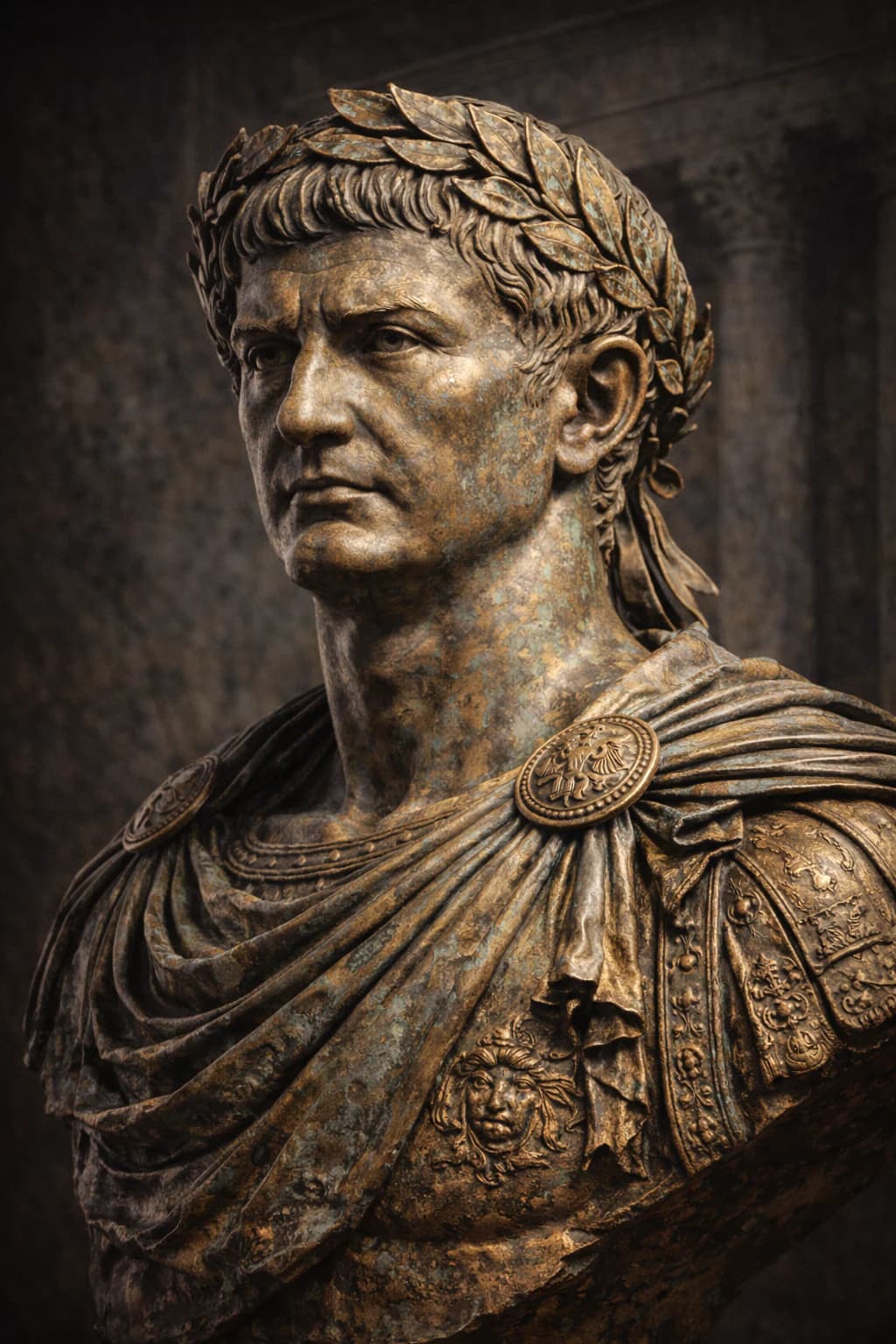
AI-generated portrait of Trajan in Roman imperial armour
AI-assisted historical reconstruction

An illustrative reconstruction based on historical context. It is not a photograph or documentary likeness. Image policy

Quick answer

Trajan was Roman emperor from 98 to 117. His reign brought the conquest of Dacia, major public works, expansion into the east and Rome's greatest territorial extent.

Born
53 CE
Died
117 CE
Role
Roman emperor
Years
53-117 CE
Facts

Trajan timeline facts

Selected specifics from this profile's life story.

53–70
Provincial roots

Born in Italica in Hispania Baetica in AD 53, Trajan came from a provincial senatorial family closely tied to Roman military service.

98–101
Early reforms

As emperor, Trajan cultivated senatorial respect, administrative competence and the image of a ruler who combined authority with civic restraint.

113–117
Eastern campaigns

In his final years, Trajan invaded the Parthian sphere, annexing Armenia and Mesopotamia and briefly pushing Rome to its widest reach.

After 117
Enduring reputation

Trajan was remembered as optimus princeps, the best emperor, a benchmark for military success, civic generosity and senatorial respect.

Life Journey

Provincial soldier, optimus princeps, and Rome's imperial high point

Follow the story in a more continuous narrative, with a reading mode that matches how much depth you want.

Complete chronology

53–70

Provincial roots

Trajan's origins mattered because they showed how far the Roman imperial elite had widened. He was born in Italica, in modern Spain, into a family that had entered the senatorial order and served the empire with distinction. His father, Marcus Ulpius Traianus, was a successful general and governor, giving Trajan access to the networks of command without making him a dynastic heir. Earlier emperors had been rooted more directly in Italy and the Julio-Claudian or Flavian centres of power. Trajan represented a maturing empire in which provincial aristocrats could become Roman to the core and rise to the summit.
70–90s

Military ascent

Trajan's career unfolded across the military-administrative ladder that held the empire together. He served as legionary commander, praetor, consul and governor, learning the frontier world where imperial authority was tested by logistics, discipline and soldier loyalty. His reputation was not built on literary brilliance or court intrigue but on command. That mattered after the assassination of Domitian in 96, when the elderly Nerva struggled to secure military confidence. Rome needed a successor acceptable to senators but trusted by legions. Trajan was exactly that kind of figure: aristocratic enough for the political elite, martial enough for the army.

97–98

Chosen successor

Nerva's adoption of Trajan was both a political rescue and a constitutional performance. The principate still preferred to disguise monarchy beneath Roman forms, and adoption allowed emperors to present succession as choice rather than hereditary accident. In reality, Nerva needed Trajan because the army did not love him. By naming a respected commander as heir, he bought stability. Trajan did not rush theatrically to Rome when Nerva died in 98; he remained on the Rhine to settle frontier affairs before entering the capital. The gesture signalled confidence and discipline. The new emperor was not a court creature. He arrived as a commander already in control.

98–101

Early reforms

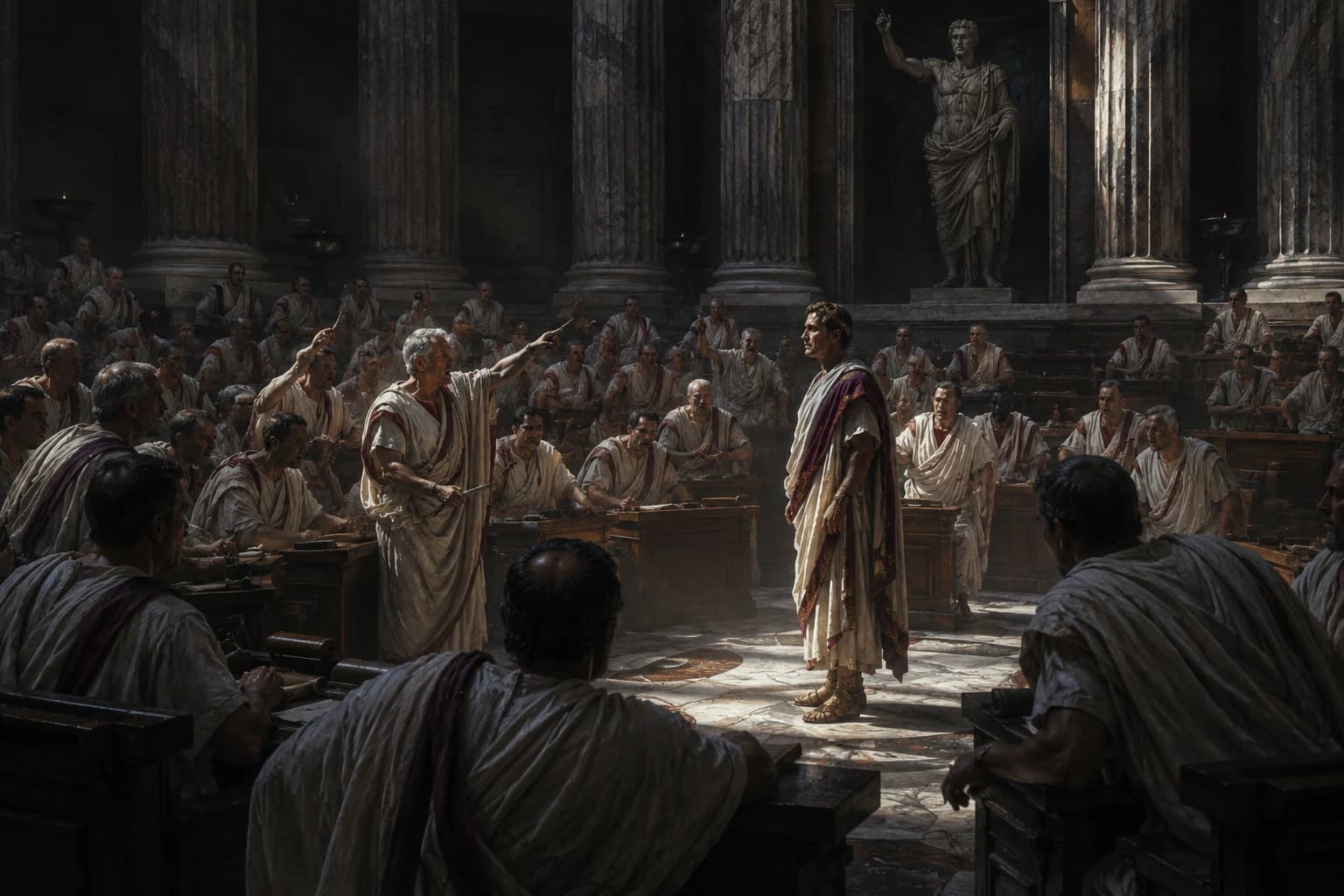
Trajan understood that imperial power worked best when domination looked like cooperation. After Domitian's tense relationship with the Senate, Trajan presented himself as civil, accessible and respectful of aristocratic dignity. Pliny the Younger's Panegyric celebrates this idealised image: the emperor as first citizen, not tyrant. The reality was still autocracy, but style mattered. Trajan maintained imperial control while reassuring senators that their honour was safe. He also strengthened administration, supported the alimenta welfare programme for children in Italian communities and projected a moral image of energetic service. This political calm gave him room for the wars and building programmes that defined the reign.

101–106

Dacian wars

Dacia had humiliated and troubled Rome under Domitian, and Trajan made it the central test of his military reign. The first war forced Decebalus into submission; the second destroyed his kingdom. The campaigns demanded bridge-building, mountain warfare, siegecraft and sustained frontier logistics. Victory brought gold, slaves, land and a new province, but also a powerful story of imperial revenge and order restored. Trajan's Column in Rome turned the campaigns into carved political memory, presenting the emperor as disciplined commander and the army as an instrument of civilisation. Behind the monument lay violence, deportation and annexation on a vast scale.

100s

Public works expansion

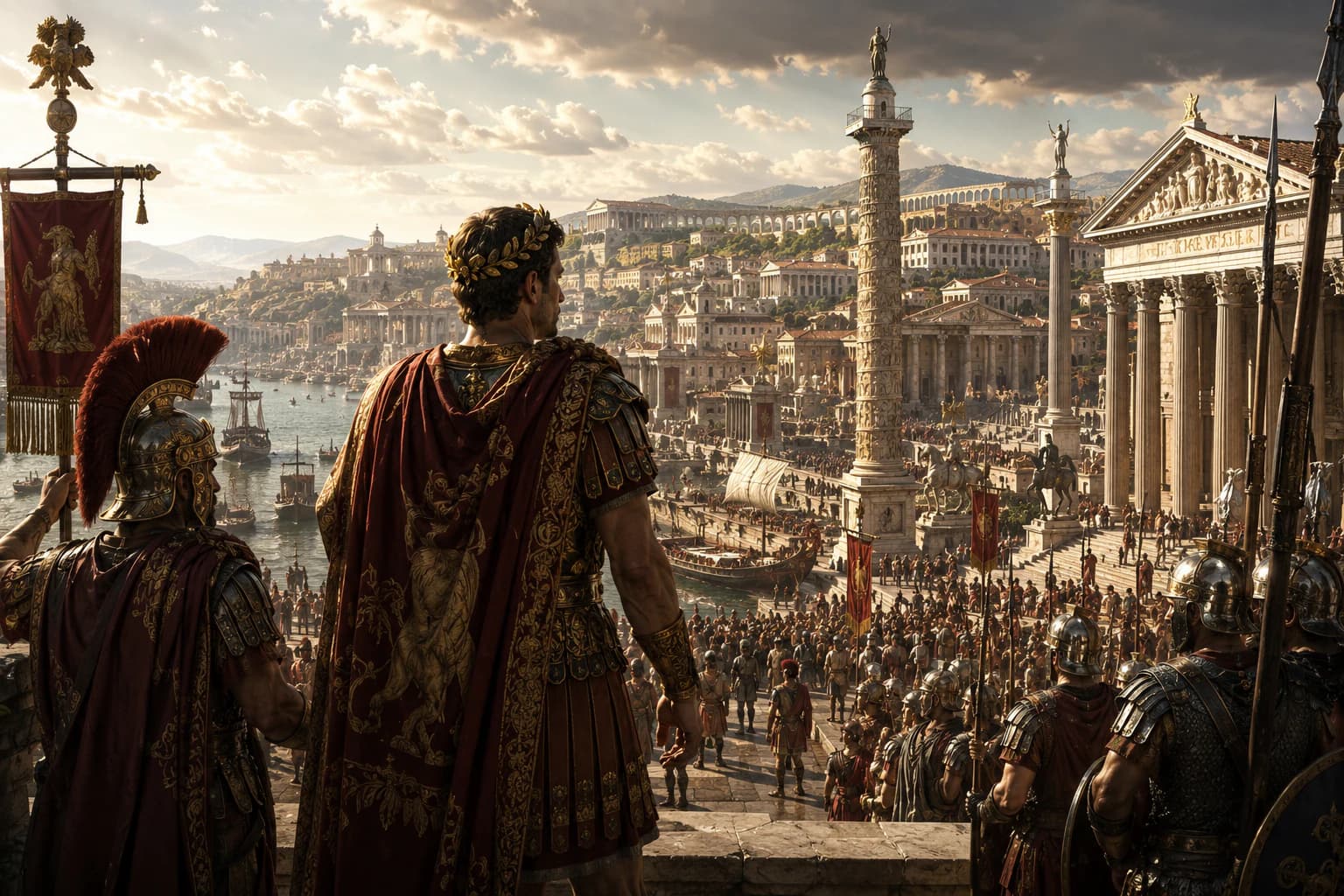
Trajan's rule was visible in stone, brick and concrete. In Rome, his Forum, Basilica Ulpia, markets and column created one of the capital's most spectacular imperial landscapes. Across the empire, roads, bridges, harbours and public buildings strengthened movement, trade and military readiness. The harbour at Portus improved Rome's grain supply; works on the Danube and in the provinces tied frontier and centre together. Roman building was never merely generous. It made power useful, beautiful and unavoidable. Trajan's reputation as optimus princeps, the best ruler, rested partly on this ability to turn conquest into public splendour.

113–117

Eastern campaigns

Trajan's eastern campaigns were spectacular and unstable. The Parthian succession crisis offered an opening, and Trajan moved through Armenia and Mesopotamia, reaching the Persian Gulf in symbolic triumph. New provinces were proclaimed, and for a moment the Roman map looked larger than ever. But the geography that made the victories glorious also made them fragile. Revolts broke out, supply lines stretched, and Rome lacked the settled administrative base needed to hold the conquests securely. The eastern adventure revealed the limit hidden inside Trajan's success: an emperor could march beyond the old frontiers faster than the state could digest what he won.

117

Final years

Trajan fell ill before he could stabilise the eastern settlement. His death at Selinus in Cilicia left both a succession question and a strategic question. Had he clearly adopted Hadrian, or was the adoption arranged at the end by Plotina and others around the imperial household? Ancient suspicion cannot be resolved with certainty, but Hadrian's accession succeeded. The new emperor quickly abandoned many of Trajan's eastern gains, choosing defensible frontiers over maximal expansion. That decision did not erase Trajan's glory, but it showed that his last victories were not sustainable policy. The empire would remember the high-water mark while quietly retreating from it.

After 117

Enduring reputation

Trajan's legacy was unusually durable. Later senators and historians treated him as a standard against which emperors could be judged: strong without seeming cruel, generous without seeming weak, victorious without abandoning civil dignity. The formula wished later rulers to be luckier than Augustus and better than Trajan. Modern judgment is more cautious. His wars were destructive, his eastern conquests overextended Rome, and his glory depended on imperial violence. Yet his reign did represent a peak in Roman confidence: provincial integration, military success, administrative stability and monumental public culture all converged. Trajan became the emperor Rome wanted to remember itself as having deserved.

Continue in context

Connected stories

Move from the profile into the wider events and settings this figure belongs to.

Tertiary paths

Content note

This profile is written for educational use and connects to related Stories of History pages. The main portrait is an AI-assisted historical reconstruction, included as an illustrative aid rather than documentary evidence. Image policy

References

Sources & Further Reading

Reliable reference works, archives and reading paths connected to this profile.

Further reading

  1. Encyclopaedia Britannica, Search results for Trajan,” accessed June 2026.Open source
  2. WorldCat, Books and library holdings for Trajan,” accessed June 2026.Open source

Primary sources

  1. Library of Congress, Search results for Trajan,” accessed June 2026.Open source

Reviewed claim sources

Loading reviewed claim sources...

A weekly route through history

Find out first about the latest published stories, feature notes and occasional Premium offers in one weekly email.