People

Hadrian

Hadrian was Roman emperor from 117 to 138 CE. He consolidated the empire after Trajan, built Hadrian's Wall in Britain, rebuilt the Pantheon, patronised Greek culture, and left a complex legacy shaped by stability and repression.

Born
76 CE
Died
138 CE
Role
Roman emperor

Roman emperor (76–138)

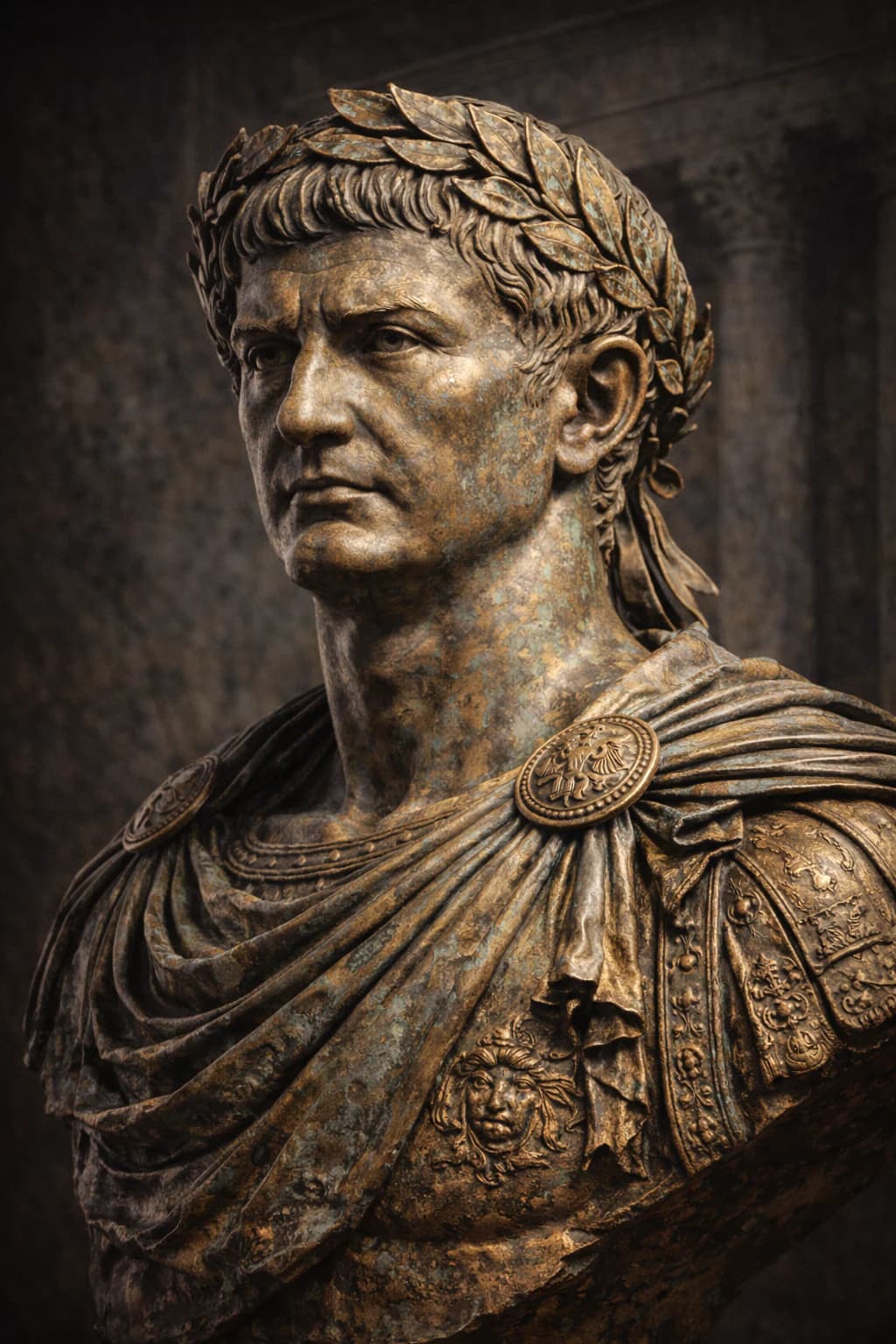
AI-generated portrait of Hadrian in Roman imperial armour
AI-assisted historical reconstruction

An illustrative reconstruction based on historical context. It is not a photograph or documentary likeness. Image policy

Quick answer

Hadrian was Roman emperor from 117 to 138 CE. He consolidated the empire after Trajan, built Hadrian's Wall in Britain, rebuilt the Pantheon, patronised Greek culture, and left a complex legacy shaped by stability and repression.

Born
76 CE
Died
138 CE
Role
Roman emperor
Years
76-138 CE
Facts

Hadrian timeline facts

Selected specifics from this profile's life story.

76
Provincial roots

Hadrian was born in 76 CE into a senatorial family from Italica in Roman Hispania, a provincial background that placed him inside Rome's elite without making Rome itself his whole world.

117
Becoming emperor

Hadrian became emperor in 117 after Trajan's death, though the adoption that legitimised his succession was surrounded by suspicion and court intrigue.

120s–130s
Cultural patronage

Hadrian travelled more widely than most emperors, patronising cities, rebuilding monuments such as the Pantheon, and presenting Greek culture as part of imperial unity.

138 and beyond
Lasting influence

Hadrian died in 138 after arranging the succession that brought Antoninus Pius and Marcus Aurelius, leaving an empire more defended, more administered, and more visibly imperial.

Life Journey

A ruler who reshaped an empire’s limits

Follow the story in a more continuous narrative, with a reading mode that matches how much depth you want.

Complete chronology

76

Provincial roots

Publius Aelius Hadrianus was born into the Roman governing class at a time when provincial families were becoming central to imperial power. His roots lay in Italica in Hispania Baetica, the same wider Spanish connection that had helped produce Trajan. That mattered. Hadrian was not an outsider to Rome, but he grew up with a provincial imagination, aware that the empire was more than the capital, the Senate, and the Italian aristocracy. His family status gave him education, military opportunity, and access to patrons; his geography gave him a wider sense of what Roman rule had become. Later, as emperor, he would govern like a man who understood the empire as a network of provinces, frontiers, armies, cities, languages, and local elites. Rome remained the centre of legitimacy, but Hadrian's career began in the world Rome had made beyond Italy.
80s–90s

Education and training

Hadrian lost his father while still young and came under the guardianship of men close to the highest circles of power, including the future emperor Trajan. He received the training expected of a Roman aristocrat: literature, rhetoric, law, command, and the social habits needed to survive among ambitious men. What made him distinctive was the intensity of his philhellenism. Hadrian loved Greek language, art, architecture, cities, and intellectual culture so visibly that some Romans treated it as affectation. Yet this was not a decorative taste. Greek culture gave him a language of civic identity across the eastern empire, while military service taught him how power was enforced on the ground. The combination produced a ruler who could inspect a legionary camp, debate architecture, sponsor a temple, and think seriously about how shared culture might hold a vast empire together.

90s–110s

Climbing the ranks

Hadrian's rise was helped by family connection, marriage into Trajan's circle, and the favour of influential figures, but it was not merely ceremonial. He held offices that exposed him to the practical burdens of empire: command on the Danube, magistracies in Rome, provincial administration, and service during Trajan's eastern campaigns. This career placed him near the machinery of expansion at the moment Rome was pushing to its greatest territorial extent. He saw the glamour of conquest, but also its strain: long supply lines, restless provinces, ambitious generals, and frontiers that did not become secure simply because a victory had been announced. By the end of Trajan's life, Hadrian was positioned as a plausible successor because he understood both the language of imperial glory and the uncomfortable arithmetic behind it.

117

Becoming emperor

Hadrian's accession was successful, but not clean. Trajan died in 117, and the announcement that he had adopted Hadrian came at the edge of uncertainty, with later gossip focusing on the role of Trajan's wife Plotina and the timing of the documents. Roman imperial succession often depended less on transparent legality than on army recognition, elite acceptance, and speed. Hadrian secured those essentials. He also moved quickly to protect his position, while several senior men connected to Trajan's expansionist circle were executed in circumstances that damaged his relationship with the Senate. The new emperor inherited a huge realm swollen by recent eastern conquests in Armenia, Mesopotamia, and Assyria. His first great decision was not to chase Trajan's image. He gave up vulnerable gains and signalled that the empire's future would be measured by defensibility, not endless advance.

120s

Redefining borders

The most important answer to why Hadrian mattered is that he changed the imperial mood. Earlier emperors had won fame by adding territory. Hadrian argued, through action more than theory, that a mature empire had to know its limits. He abandoned some of Trajan's eastern acquisitions, inspected frontier armies, improved fortifications, and emphasised readiness over spectacle. This was not pacifism. Roman power remained coercive, and Hadrian could be ruthless when challenged. But his strategic instinct was defensive and administrative. He wanted lines that could be watched, roads that could move troops, cities that could pay taxes, and provincial elites who saw advantage in Roman order. The policy was politically delicate because withdrawal could look like weakness. Hadrian's achievement was to make restraint appear imperial: not defeat, but control.

122

Building Hadrian’s Wall

Hadrian's Wall was not simply a stone line against an empty north. Built across northern Britain from the Tyne to the Solway, it formed part of a controlled frontier system with forts, milecastles, turrets, roads, ditches, and crossing points. It helped regulate movement, taxation, trade, raiding, and military response. It also made a political statement in landscape form: Rome could define where its order began and where its direct authority thinned out. The wall's importance lies in that mixture of practical control and imperial theatre. It did not seal Britain perfectly, and Roman frontier policy continued to change after Hadrian. Yet the wall remains the clearest physical expression of his reign. Where Trajan's column celebrated conquest, Hadrian's Wall announced managed power, disciplined boundaries, and the architecture of endurance.

120s–130s

Cultural patronage

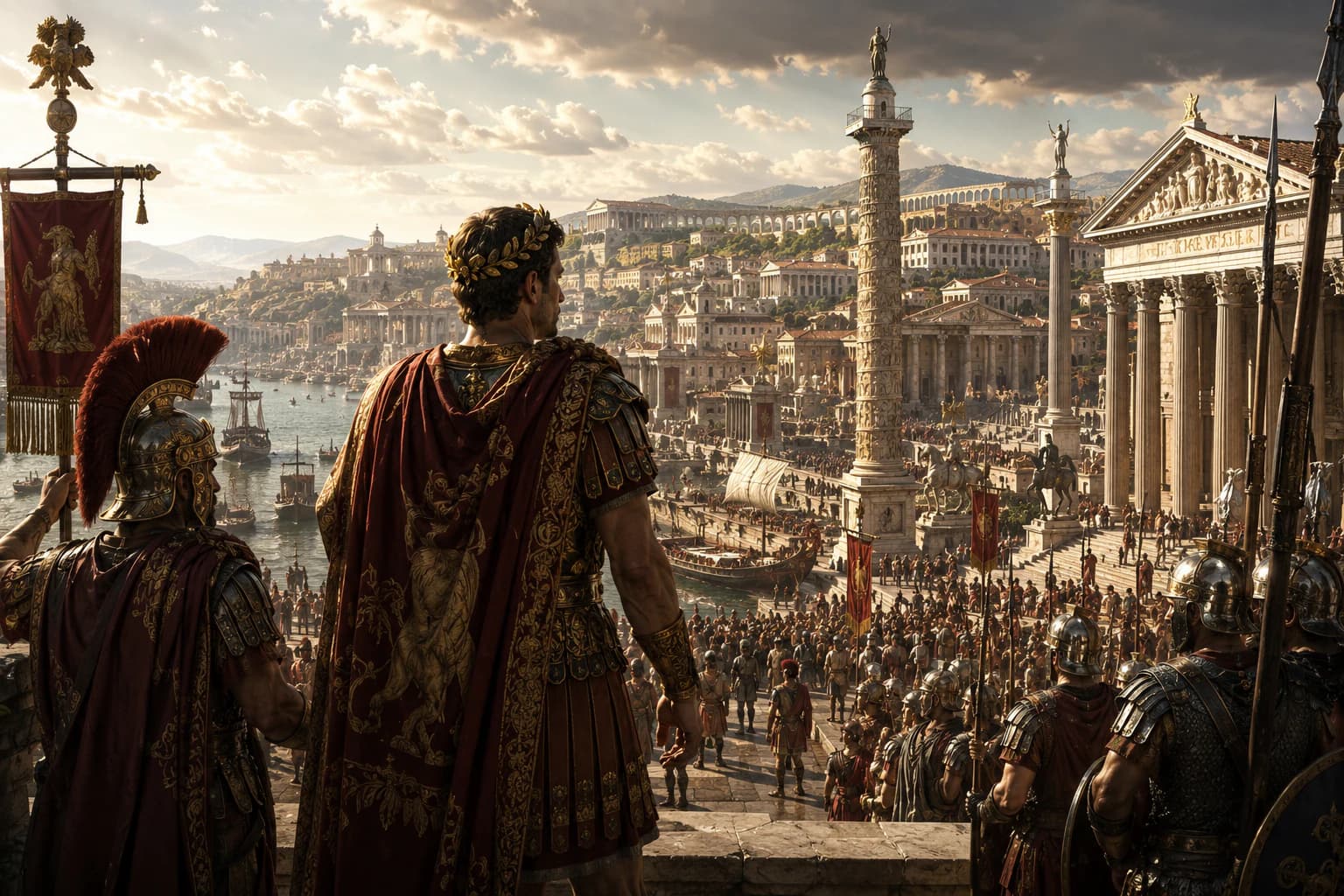
Hadrian's reign was unusually mobile. He spent long periods away from Rome, visiting provinces, inspecting troops, settling disputes, founding or refounding cities, and making imperial presence visible across the Mediterranean world. This travel was government by performance as well as administration: local communities saw the emperor, petitioned him, honoured him, and received benefits in return. His building programme was equally ambitious. In Rome, the Pantheon was rebuilt under his reign in the form that still dominates the city. Near Tivoli, his villa gathered architectural ideas from across the empire into one extraordinary landscape of power and memory. In Athens, he supported major works and cultivated the image of a Roman ruler at home in Greek civilisation. Hadrian's cultural policy did not erase provincial difference. It tried to make diversity feel contained within a shared imperial order.

132–136

Jewish revolt

Hadrian's legacy cannot be reduced to walls, domes, and elegant provincial tours. The Bar Kokhba revolt in Judea was one of the most devastating wars of his reign. Its causes remain debated, including tensions over Romanisation, Jerusalem's refoundation as Aelia Capitolina, and possibly restrictions connected to Jewish religious practice. What is clear is the scale of the conflict. Simon Bar Kokhba led a determined revolt that forced Rome into a costly campaign before it was crushed. The aftermath was brutal. Judea was reorganised, Jerusalem's Jewish population was restricted, and the province became associated with the name Syria Palaestina. Hadrian's policy of unity met a community for whom Roman control threatened identity, sacred space, and law. The result shows the hard edge of imperial consolidation: stability for Rome could mean catastrophe for those who resisted it.

138 and beyond

Lasting influence

Hadrian's final years were difficult. Ill health, suspicion, and succession planning darkened a reign that had often projected control. After the death of his first chosen heir, Lucius Aelius, he adopted Antoninus Pius on condition that Antoninus adopt Marcus Aurelius and Lucius Verus, creating a chain of succession that helped stabilise the next generation. Hadrian died in 138 and was buried in the great mausoleum he had begun in Rome, later Castel Sant'Angelo. His importance lies in the direction he gave the high empire. He did not make Rome gentle, and his repression in Judea remains central to any honest biography. But he did show that imperial achievement could mean consolidation, law, infrastructure, cultural patronage, and intelligent limits. Hadrian's Rome was still a military empire, yet under him it learned to present endurance itself as greatness.

Continue in context

Connected stories

Move from the profile into the wider events and settings this figure belongs to.

Tertiary paths

Content note

This profile is written for educational use and connects to related Stories of History pages. The main portrait is an AI-assisted historical reconstruction, included as an illustrative aid rather than documentary evidence. Image policy

References

Sources & Further Reading

Reliable reference works, archives and reading paths connected to this profile.

Further reading

  1. Encyclopaedia Britannica, Search results for Hadrian,” accessed June 2026.Open source
  2. WorldCat, Books and library holdings for Hadrian,” accessed June 2026.Open source

Primary sources

  1. Library of Congress, Search results for Hadrian,” accessed June 2026.Open source

Reviewed claim sources

Loading reviewed claim sources...

A weekly route through history

Find out first about the latest published stories, feature notes and occasional Premium offers in one weekly email.