People

Theodoric the Great

Theodoric the Great was king of the Ostrogoths and ruler of Italy from 493 to 526. Educated in Constantinople, he built a stable post-Roman kingdom before his final years were darkened by the deaths of Boethius and Symmachus.

Born
454 CE
Died
526 CE
Role
King of Italy

King of Italy (454–526)

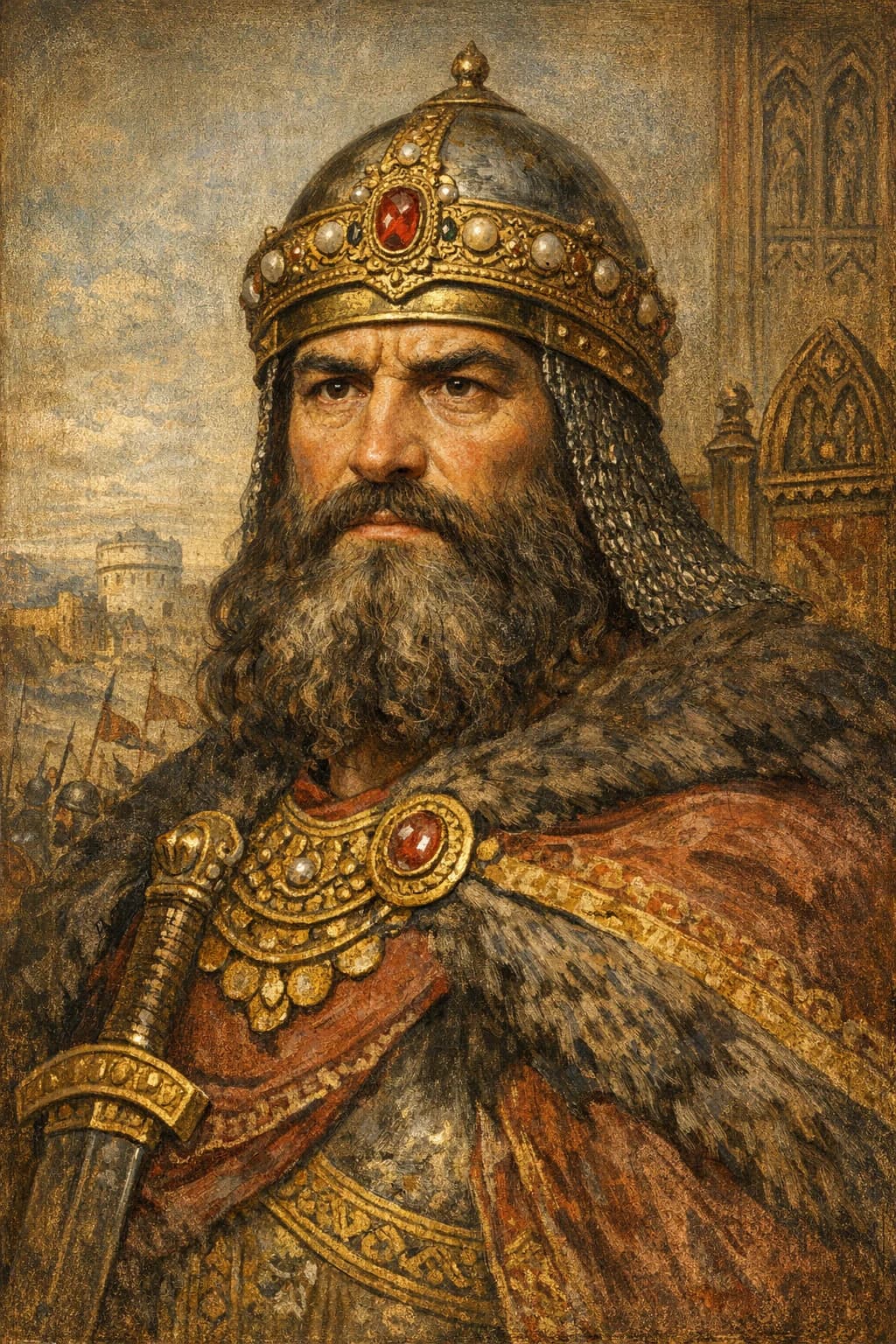
AI-generated portrait of Theodoric the Great, King of Italy
AI-assisted historical reconstruction

An illustrative reconstruction based on historical context. It is not a photograph or documentary likeness. Image policy

Quick answer

Theodoric the Great was king of the Ostrogoths and ruler of Italy from 493 to 526. Educated in Constantinople, he built a stable post-Roman kingdom before his final years were darkened by the deaths of Boethius and Symmachus.

Born
454 CE
Died
526 CE
Role
King of Italy
Years
454-526 CE
Quick facts

Profile details

Additional identity and tagging details that are not already covered in the introduction.

Also known as
Theodoric, Theoderic, Theoderic the Great
Facts

Theodoric the Great timeline facts

Selected specifics from this profile's life story.

461–474
Hostage in Constantinople

As a child, Theodoric was sent to Constantinople as a diplomatic hostage, where he learned the culture and machinery of Roman power.

493–520
Governing two peoples

Theodoric governed Italy by balancing Gothic military power with Roman law, senatorial prestige and civil administration.

524–526
Final years

Theodoric's final years were marked by increasing tension with the Roman aristocracy and the eastern empire, and by the execution of his father-in-law the philosopher Symmachus.

After 526
Legacy of Theodoric

Theodoric the Great left a complex legacy: celebrated as the model of a post-Roman ruler who maintained civilisation, and condemned for the executions that shadowed his final years.

Life Journey

Hostage, conqueror, Roman ruler, and post-imperial king

Follow the story in a more continuous narrative, with a reading mode that matches how much depth you want.

Complete chronology

461–474

Hostage in Constantinople

Theodoric's childhood was shaped by imperial strategy. Sending elite children as hostages was a standard tool of eastern Roman diplomacy: it restrained federate leaders while educating future rulers in Roman assumptions. Theodoric spent roughly a decade at the court of Leo I, observing ceremonial, administration, military hierarchy and the confidence of the empire that still ruled from Constantinople. Ancient sources differ on the depth of his formal literacy, but his later career shows deep practical familiarity with Roman government. When he returned to the Ostrogoths, he was neither simply Roman nor simply Gothic in outlook. He was a frontier ruler trained inside the most sophisticated state of his age.
474–488

Leading the Ostrogoths

The Ostrogoths were a powerful but unsettled people, occupying territory in the Balkans under a complex relationship with the eastern empire — part allies, part threats, part clients. Theodoric spent his early reign establishing his authority within the tribe and conducting the kind of warfare and raiding that maintained a Germanic king's prestige and provided his warriors with rewards. His relationship with the eastern emperor was consistently ambivalent: he was at times a valued ally and at times a disruptive force in the Balkans. Constantinople's solution to this complicated presence — dispatching Theodoric to Italy to deal with Odoacer — was as much a way of removing him from the Balkans as it was a genuine military commission.

489–493

Conquest of Italy

The conquest of Italy was a hard military campaign, not a ceremonial transfer of authority. Theodoric defeated Odoacer at the Isonzo and Verona, then struggled through years of siege and counter-siege before Ravenna finally submitted in 493. The settlement was supposed to share rule, but it lasted only days. At a banquet, Theodoric killed Odoacer, removing the one man who could rival his command of Italy. The act was brutal and politically clarifying. It also shows the double nature of Theodoric's kingship. He could govern through Roman law and senatorial dignity, but his authority began with the older logic of warrior kingship: a rival left alive was a future civil war.

493–520

Governing two peoples

Theodoric's governing model was one of the most successful experiments of the post-western imperial world. Goths formed the military backbone of the kingdom; Romans continued to staff civil administration, courts and senatorial life. Roman law remained central for Roman subjects, while Gothic identity and military privilege were preserved. This was not equality in a modern sense, but it was a workable peace between communities that might otherwise have competed destructively. Cassiodorus, writing royal letters in Theodoric's name, projected an image of lawful restoration rather than conquest. The king repaired buildings, maintained aqueducts and presented himself as guardian of Roman civilisation. For a generation, Italy experienced an order many contemporaries valued highly.

493–526

Diplomatic network

Theodoric's diplomacy reached far beyond Italy. He used marriage alliances to connect his family with Visigoths, Burgundians, Vandals, Franks and Thuringians, creating a network intended to restrain conflict among the western successor kingdoms. After the Visigothic defeat by the Franks at Vouille in 507, he intervened to protect Gothic interests and acted as regent for his young grandson in Spain. His vision was not the restoration of the western empire in a formal sense, but something close to post-imperial coordination under his prestige. It depended heavily on his personal authority, which made it impressive and fragile at the same time.

524

Execution of Boethius

The case of Boethius stands as the most damaging episode of Theodoric's reign. Anicius Manlius Severinus Boethius was one of the most distinguished Romans of his era — a philosopher, translator of Greek texts, and senior official in Theodoric's government. He was arrested in 524 on charges of corresponding treasonably with the eastern emperor, tried by the Senate (which convicted him under what appears to have been political pressure), and executed in 525. While in prison awaiting execution, Boethius wrote the Consolation of Philosophy, one of the most influential texts of the medieval world. Whether Boethius was genuinely guilty of conspiracy, or whether Theodoric's suspicions of Roman aristocratic loyalty to Constantinople had run out of control, is still debated. The execution marked a decisive break from his earlier model of governance.

524–526

Final years

The arrest and execution of Boethius was followed by that of his father-in-law Symmachus, another leading Roman aristocrat, who was killed in 526. The pattern suggested a ruler whose confidence in the loyalty of his Roman subjects had collapsed in his old age, whether from evidence of genuine conspiracy, the anxiety of a man who knew his kingdom was fragile, or simply the political panic that sometimes grips powerful rulers as they age. Pope John I, whom Theodoric had sent to Constantinople on a diplomatic mission, died in Theodoric's custody in 526, adding a religious dimension to his deteriorating reputation. Theodoric himself died in August 526, leaving behind a kingdom that had not resolved the question of how his succession would work.

526

Death and succession

Theodoric's mausoleum at Ravenna remains one of the most distinctive surviving structures of the post-Roman west: a two-storey tomb of Istrian limestone, its roof a single monolithic slab of stone weighing hundreds of tonnes. He was buried there with the ceremony appropriate to a king who had governed Italy for over thirty years. His heir was his grandson Athalaric, a child whose mother Amalasuntha served as regent. The Gothic nobles were uncomfortable with a regency oriented toward Roman culture and Roman alliances, and tension over the direction of the kingdom developed quickly. Within ten years, the eastern emperor Justinian would use the chaos of Ostrogothic succession as the justification for his attempted reconquest of Italy.

After 526

Legacy of Theodoric

Theodoric's historical legacy has always been ambivalent. The Roman authors who served him — Cassiodorus, Ennodius — praised him effusively. Later medieval tradition remembered him as 'Dietrich von Bern,' a heroic figure in Germanic epic poetry, though the historical Theodoric bears little resemblance to the legend. Modern historians have largely agreed that his kingdom represented the most successful adaptation of Germanic rule to the Roman institutional inheritance that the western transition produced. The execution of Boethius and Symmachus are the permanent shadow on this assessment. That Boethius wrote the Consolation of Philosophy in his death cell — and that it became one of the most widely read texts of the medieval world — means that Theodoric's most durable contribution to European culture may be the circumstances in which his victim was forced to think most clearly.

Continue in context

Connected stories

Move from the profile into the wider events and settings this figure belongs to.

Tertiary paths

Content note

This profile is written for educational use and connects to related Stories of History pages. The main portrait is an AI-assisted historical reconstruction, included as an illustrative aid rather than documentary evidence. Image policy

References

Sources & Further Reading

Reliable reference works, archives and reading paths connected to this profile.

Further reading

  1. Encyclopaedia Britannica, Search results for Theodoric the Great,” accessed June 2026.Open source
  2. WorldCat, Books and library holdings for Theodoric the Great,” accessed June 2026.Open source

Primary sources

  1. Library of Congress, Search results for Theodoric the Great,” accessed June 2026.Open source

Reviewed claim sources

Loading reviewed claim sources...

A weekly route through history

Find out first about the latest published stories, feature notes and occasional Premium offers in one weekly email.
