People

Romulus Augustulus

Romulus Augustulus was the last conventional Western Roman emperor, ruling in 475-476. Odoacer deposed him, sent the imperial regalia to Constantinople, and helped make 476 the symbolic fall of the Western Roman Empire.

Born
461 CE
Died
511 CE
Role
Last Emperor of the Western Roman Empire

Last Emperor of the Western Roman Empire (461–c. 511)

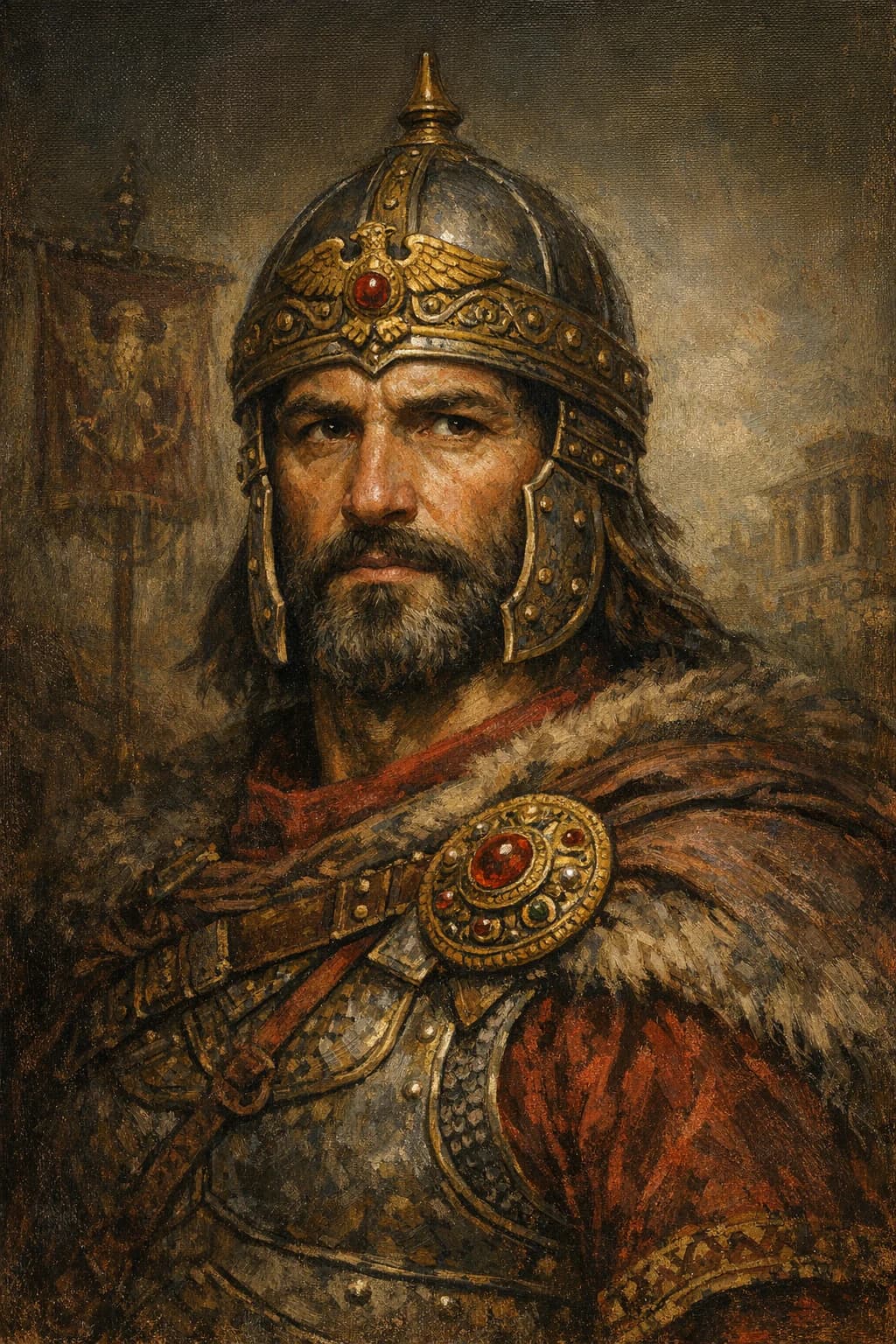
AI-generated portrait of Romulus Augustulus, last Western Roman Emperor
AI-assisted historical reconstruction

An illustrative reconstruction based on historical context. It is not a photograph or documentary likeness. Image policy

Quick answer

Romulus Augustulus was the last conventional Western Roman emperor, ruling in 475-476. Odoacer deposed him, sent the imperial regalia to Constantinople, and helped make 476 the symbolic fall of the Western Roman Empire.

Born
461 CE
Died
511 CE
Role
Last Emperor of the Western Roman Empire
Years
461-511 CE
Quick facts

Profile details

Additional identity and tagging details that are not already covered in the introduction.

Also known as
Romulus Augustus
Facts

Romulus Augustulus timeline facts

Selected specifics from this profile's life story.

461–475
Son of a general

Romulus was the son of Orestes, a capable Roman general of barbarian origin who had served Attila the Hun before switching allegiance to the western imperial court.

476
Odoacer's revolt

Odoacer led the federate troops in revolt, defeated and executed Orestes, and then deposed Romulus Augustulus — the last act that historians conventionally mark as the fall of the Western Roman Empire.

476 AD
Was 476 really the end?

The date 476 AD as the 'fall of Rome' was not a contemporary designation — it was assigned centuries later by historians looking for a convenient turning point in a process that had taken decades.

After 476
A symbolic end

Romulus Augustulus did little personally, but his name marks the conventional end of the Western Roman Empire and remains one of the most cited dates in European history.

Life Journey

The last name on a list no one was keeping

Follow the story in a more continuous narrative, with a reading mode that matches how much depth you want.

Complete chronology

461–475

Son of a general

The biography of Romulus Augustulus is inseparable from that of his father Orestes, who was the more historically significant figure. Orestes had served as a secretary to Attila the Hun before the Hunnic empire collapsed, then transferred his abilities and ambitions into western Roman service. He rose to become magister militum — effectively the senior military commander — under the emperor Julius Nepos. The young Romulus was the instrument of his father's ambitions: a boy of Roman and presumably presentable descent who could be placed on the throne while Orestes controlled the military. The name chosen for the boy combined the legendary founder of Rome with a diminutive of Augustus — a grandiose construction that almost everyone noticed was ironic.
475

Orestes seizes power

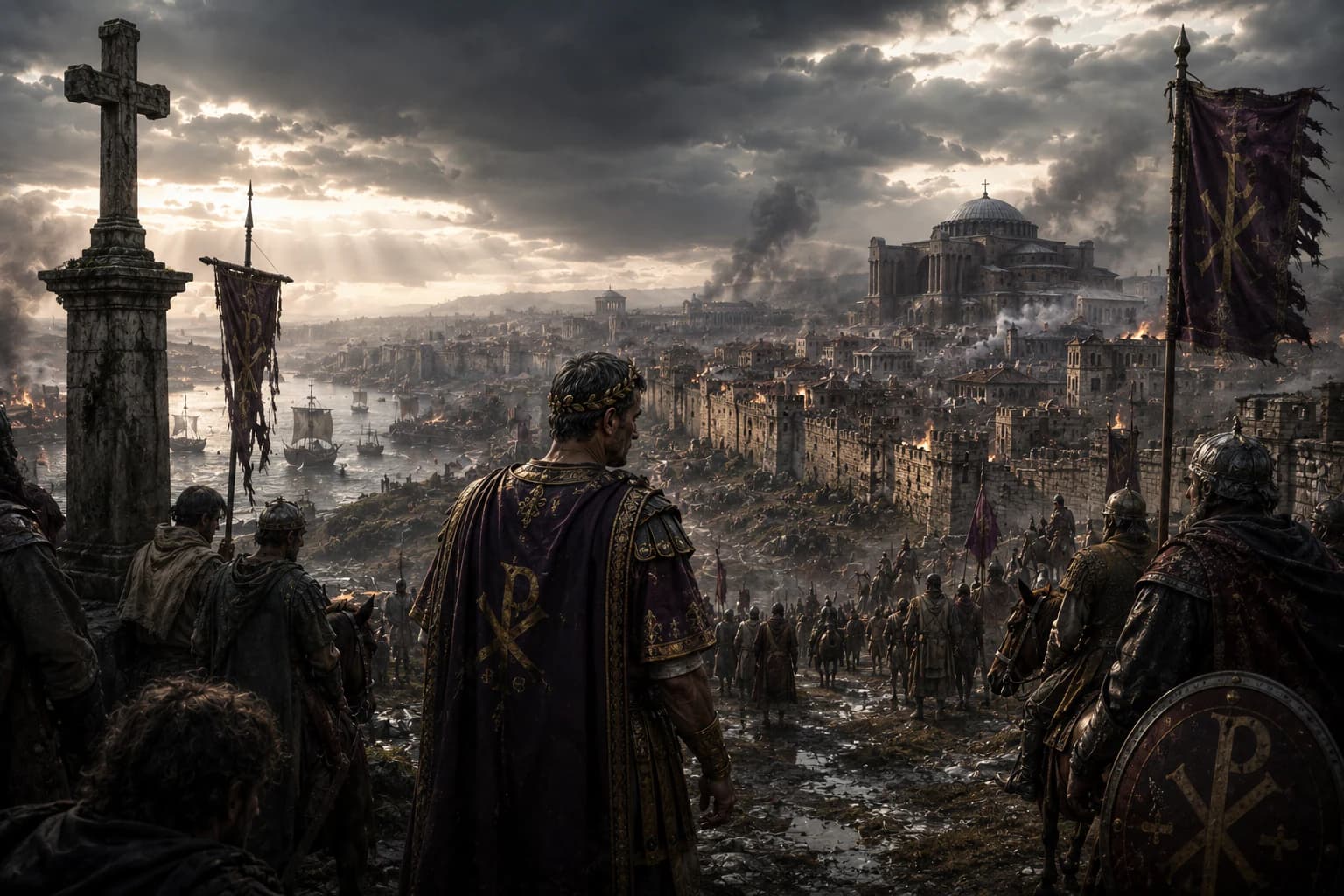
In August 475, Orestes moved against Julius Nepos with the support of the federate barbarian troops — Germanic soldiers serving within the Roman military system — who made up the bulk of the western army. Nepos fled to Dalmatia, where he would continue to be recognised as emperor by the eastern court in Constantinople and by some western officials for years afterward. Orestes had achieved his coup but not resolved the underlying tension: the same federate troops who had brought him to power immediately began demanding land grants in Italy — an expectation that had fuelled previous military revolts and that Orestes refused to satisfy. He had used soldiers he could not pay what they actually wanted.

475–476

Ten months on the throne

The reign of Romulus Augustulus is notable almost entirely for its brevity and for the name attached to its end. The boy emperor cannot have exercised any real authority — he was perhaps fourteen years old and was clearly a proxy for his father's power. Orestes governed, managed what remained of the western administrative apparatus, and tried to hold off the demands of the federates for land. The federates were led by Odoacer, a chieftain of mixed Germanic background who had served in the Roman military and understood its machinery well. Their demands were clear; Orestes's refusal was equally clear. The confrontation that followed was not a clash of civilisations but a fairly straightforward military mutiny.

476

Odoacer's revolt

Odoacer's revolt was swift and militarily decisive. Orestes was captured and executed at Piacenza in late August 476. The teenage emperor surrendered without resistance — there was none to offer. Odoacer deposed him, and at this point made a decision of historical importance: rather than putting Romulus to death, he sent him into comfortable exile at the Castellum Lucullanum, a fortified villa at Pizzofalcone near Naples. The reasons are not fully clear — contemporary sources suggest that Odoacer considered the boy too young and too evidently a pawn to merit execution, or that there was something in his bearing that inspired pity. He was given an annual pension and appears to have lived there quietly for decades.

476

The imperial regalia sent east

The most politically significant act associated with Romulus's deposition was not his deposition itself but what happened to the symbols of western imperial power. Odoacer sent the imperial diadem and other regalia to Constantinople with a message to Zeno: one emperor was sufficient for the entire Roman world, and Odoacer would govern Italy under eastern nominal authority while exercising effective independence. Zeno's response was characteristically oblique — he replied that Julius Nepos, still alive in Dalmatia, was technically the legitimate western emperor and should be recognised. Odoacer ignored this. But the sending of the regalia marked the moment when the western imperial office was formally acknowledged, even by the man who had just abolished it, as no longer necessary.

476–c. 511

Comfortable exile

The last historically attested reference to Romulus Augustulus is in a letter written by Cassiodorus on behalf of the Ostrogothic king Theodoric the Great, probably around 507–511. The letter appears to increase his pension, suggesting he was still alive at that point and that the new Italian administration was maintaining the arrangement Odoacer had put in place. The castellum he was held in was a substantial fortified complex on a promontory above the Bay of Naples — not a prison in the conventional sense but a place from which he had no reason and perhaps no ability to depart. He grew old there, historically invisible. Archaeology has found evidence of continued occupation of the site into the early medieval period.

476 AD

Was 476 really the end?

For contemporaries, 476 was not necessarily a cataclysmic date. Julius Nepos continued to be recognised in some quarters as the legitimate western emperor until his murder in 480. The eastern empire continued without interruption. Trade, law, and even local Roman administration continued in Italy and elsewhere for years. The designation of 476 as the key date comes primarily from Gibbon and the historiographical tradition that followed him, looking for a clean end to a process that was actually gradual and contested. Historians have argued that the real 'fall' of Rome was dispersed across centuries — the sack of 410, the division after Theodosius, the loss of North Africa in the 430s and 440s, the deposition of 476, and the final end of senatorial resistance in the 530s.

476 AD

The significance of the name

The coincidence of names was not lost on contemporaries. Several ancient writers noted the irony: that the empire should end with a figure who bore the names of its legendary founder (Romulus) and its first actual emperor (Augustus, of which Augustulus was a diminutive — literally 'little Augustus'). The names carried the full weight of Roman history and made the contrast with the reality of 476 all the more pointed. A boy puppet, placed on the throne by his ambitious father, deposed after ten months, exiled to a coastal villa — and bearing the grandest names the Roman world had produced. Whether this irony was deliberately constructed by Orestes, who chose the names, or was simply the way it turned out, it gave the ending of the western empire a narrative neatness that history rarely provides.

After 476

A symbolic end

The Romulus Augustulus legacy is almost purely symbolic, and the symbolism is borrowed from the event rather than from the man. He was a passive instrument of Orestes's ambitions, a teenage figurehead for a military coup, and a convenient person to remove when that coup failed. Yet his name appears on more timelines than those of many rulers who actually governed, because it attaches to a date that helps people organise the end of antiquity. The convention of 476 as the fall of the Western Roman Empire is taught widely, challenged constantly, and retained because the alternatives are harder: a process stretching through military defeats, fiscal exhaustion, lost provinces, barbarian settlement, eastern continuity, and changing identities. The boy who did almost nothing became the label for almost everything.

Continue in context

Connected stories

Move from the profile into the wider events and settings this figure belongs to.

Tertiary paths

Content note

This profile is written for educational use and connects to related Stories of History pages. The main portrait is an AI-assisted historical reconstruction, included as an illustrative aid rather than documentary evidence. Image policy

References

Sources & Further Reading

Reliable reference works, archives and reading paths connected to this profile.

Further reading

  1. Encyclopaedia Britannica, Search results for Romulus Augustulus,” accessed June 2026.Open source
  2. WorldCat, Books and library holdings for Romulus Augustulus,” accessed June 2026.Open source

Primary sources

  1. Library of Congress, Search results for Romulus Augustulus,” accessed June 2026.Open source

Reviewed claim sources

Loading reviewed claim sources...

A weekly route through history

Find out first about the latest published stories, feature notes and occasional Premium offers in one weekly email.