People

Reinhard Heydrich

Reinhard Heydrich was a Nazi SS and police leader, head of the RSHA, acting Reich Protector in Bohemia and Moravia, and a central architect of the Holocaust.

Born
1904 CE
Died
1942 CE
Role
Nazi security chief and Holocaust architect

Nazi security chief and Holocaust architect (1904-1942)

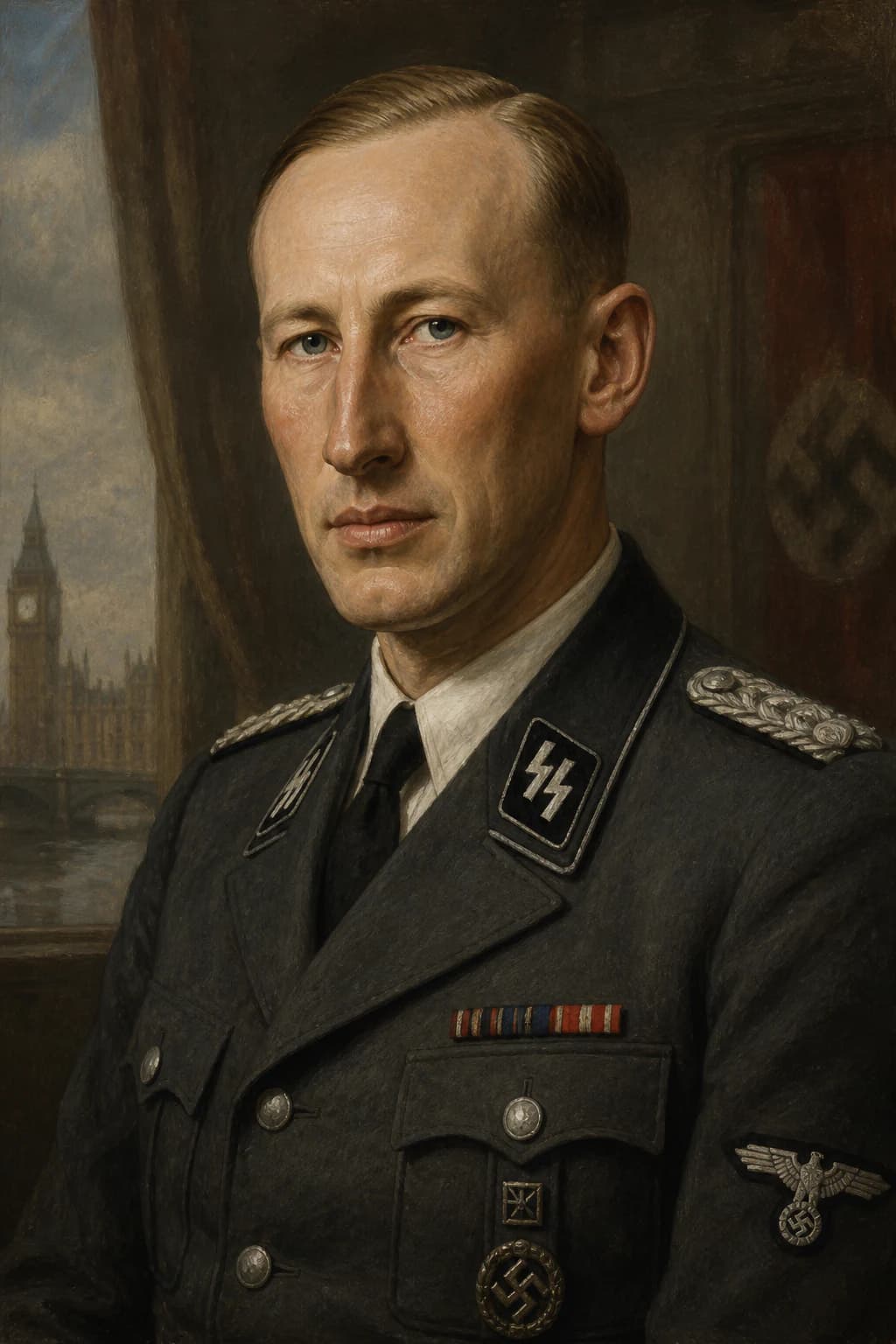
AI-generated portrait of Reinhard Heydrich
AI-assisted historical reconstruction

An illustrative reconstruction based on historical context. It is not a photograph or documentary likeness. Image policy

Quick answer

Reinhard Heydrich was a Nazi SS and police leader, head of the RSHA, acting Reich Protector in Bohemia and Moravia, and a central architect of the Holocaust.

Born
1904 CE
Died
1942 CE
Role
Nazi security chief and Holocaust architect
Years
1904-1942 CE
Quick facts

Profile details

Additional identity and tagging details that are not already covered in the introduction.

Also known as
Reinhard Tristan Eugen Heydrich
Facts

Reinhard Heydrich timeline facts

Selected specifics from this profile's life story.

1904-1931
Failed naval career

Reinhard Heydrich was born in Halle, entered the German navy, and turned to the SS after scandal ended his naval career.

1931-1939
Security architect

Heydrich built the SS intelligence service and became central to the Nazi police state after Hitler took power.

1942
Wannsee

Heydrich chaired the Wannsee Conference, coordinating ministries and agencies around the Nazi plan for the Final Solution.

1942
Assassination and reprisals

Czechoslovak agents attacked Heydrich in Prague in 1942; his death triggered brutal Nazi reprisals, including the destruction of Lidice.

Life Journey

Why Reinhard Heydrich matters

Follow the story in a more continuous narrative, with a reading mode that matches how much depth you want.

Complete chronology

1904-1931

Failed naval career

Reinhard Tristan Eugen Heydrich was born on 7 March 1904 in Halle an der Saale, the son of a composer and music conservatory director. He grew up in a cultured, nationalist middle-class household and became a skilled violinist as well as a competitive athlete. In 1922 he entered the Reichsmarine, hoping for a disciplined officer's career. That path ended in 1931 when he was dismissed after a breach-of-promise scandal involving a woman he had been expected to marry. The dismissal humiliated him and left him searching for a new future during Germany's political crisis. Through his wife Lina, a committed Nazi, Heydrich entered the orbit of Heinrich Himmler. The SS gave him a second career and a field in which ambition, cold intelligence, and ruthlessness could flourish.
1931-1939

Security architect

Himmler quickly recognised Heydrich's usefulness and placed him in charge of the SS intelligence service, the Sicherheitsdienst, or SD. Heydrich built files, networks, and methods for identifying enemies inside and outside the Nazi movement. After 1933, as Hitler's dictatorship destroyed democracy, Heydrich rose through the expanding police and security apparatus. He helped consolidate political policing, surveillance, and repression, working closely with Himmler as the SS absorbed more state power. In 1939 he became head of the Reich Security Main Office, the RSHA, which combined the Security Police, including the Gestapo and Criminal Police, with the SD. That structure made him one of the most powerful men in Nazi Germany. Heydrich's genius, if the word can be used for such purposes, lay in turning ideological paranoia into institutions.

1939-1941

Occupied Europe

War expanded Heydrich's authority from domestic repression to continental terror. His agencies targeted political opponents, Jews, Roma, Polish elites, Soviet officials, resistance networks, and many others marked as enemies. After the invasion of Poland in 1939, SS and police units carried out mass violence behind the front. After the invasion of the Soviet Union in 1941, Einsatzgruppen murdered Jews and others in mass shootings on an enormous scale. Heydrich was not a distant observer. His RSHA helped organise the security logic of occupation, in which conquest, racial ideology, and administrative coordination fused. In September 1941 he was also appointed acting Reich Protector of Bohemia and Moravia, where he combined repression with selective economic incentives to increase production while crushing resistance.

1942

Wannsee

On 20 January 1942 Heydrich chaired the Wannsee Conference in a villa outside Berlin. The meeting did not invent the Holocaust; mass murder was already underway. Its significance lay in coordination. Heydrich gathered senior officials from ministries, party offices, and occupation administrations to align the machinery of the state behind the Final Solution of the Jewish question. Adolf Eichmann prepared the minutes. Heydrich used the meeting to assert RSHA leadership over deportation and extermination policy, translating genocidal intent into interdepartmental procedure. This is why Heydrich is central to Holocaust history. He stood at the point where ideology, police power, transport, law, and ministerial bureaucracy met. Wannsee was not a frenzy of violence. It was something colder: a planning meeting for continental genocide.

1942

Assassination and reprisals

On 27 May 1942, Czechoslovak agents trained in Britain, Jan Kubis and Jozef Gabcik, attacked Heydrich in Prague during Operation Anthropoid. Heydrich died from his wounds on 4 June 1942. Nazi reprisals were savage. The village of Lidice was destroyed, men were shot, women deported, and children murdered or dispersed; Lezaky suffered a similar fate. The terror was intended to punish and intimidate, but Heydrich's assassination also became a major act of resistance memory. His historical legacy remains that of a principal architect of Nazi security terror and the Holocaust. He was feared even by many within the regime because he combined ambition, intelligence, ideological commitment, and institutional power. His short life left an immense shadow because the systems he helped build continued killing long after his death.

Continue in context

Connected stories

Move from the profile into the wider events and settings this figure belongs to.

Tertiary paths

Content note

This profile is written for educational use and connects to related Stories of History pages. The main portrait is an AI-assisted historical reconstruction, included as an illustrative aid rather than documentary evidence. Image policy

References

Sources & Further Reading

Reliable reference works, archives and reading paths connected to this profile.

Further reading

  1. Encyclopaedia Britannica, Search results for Reinhard Heydrich,” accessed June 2026.Open source
  2. WorldCat, Books and library holdings for Reinhard Heydrich,” accessed June 2026.Open source

Primary sources

  1. Library of Congress, Search results for Reinhard Heydrich,” accessed June 2026.Open source

Reviewed claim sources

Loading reviewed claim sources...

A weekly route through history

Find out first about the latest published stories, feature notes and occasional Premium offers in one weekly email.