People

Maximilien Robespierre

Maximilien Robespierre was a French revolutionary Jacobin leader and central figure of the Committee of Public Safety during the Reign of Terror.

Born
1758 CE
Died
1794 CE
Role
Jacobin revolutionary leader

French revolutionary leader (1758-1794)

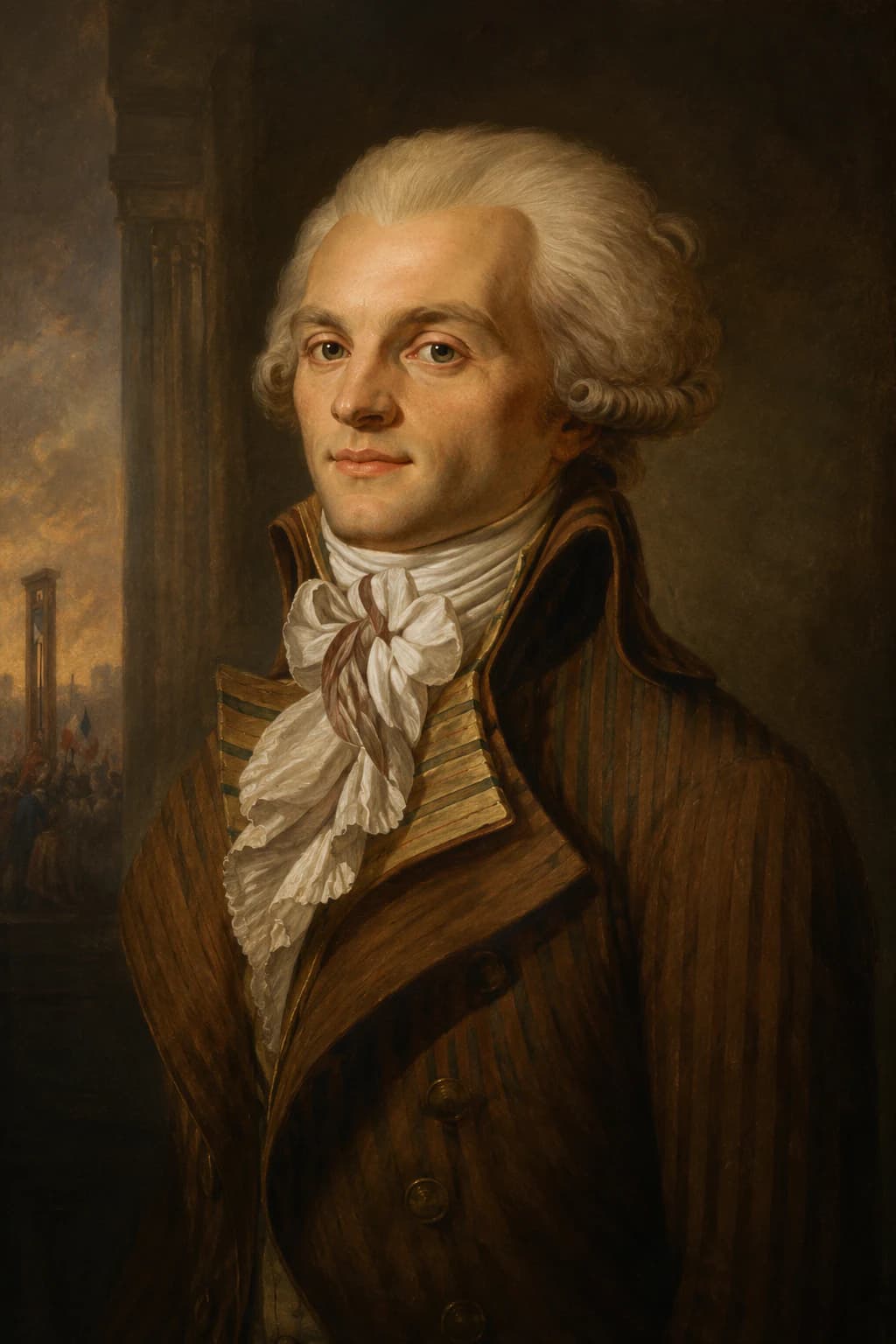
AI-generated portrait of Maximilien Robespierre in eighteenth-century dress
AI-assisted historical reconstruction

An illustrative reconstruction based on historical context. It is not a photograph or documentary likeness. Image policy

Quick answer

Maximilien Robespierre was a French revolutionary Jacobin leader and central figure of the Committee of Public Safety during the Reign of Terror.

Born
1758 CE
Died
1794 CE
Role
Jacobin revolutionary leader
Years
1758-1794 CE
Quick facts

Profile details

Additional identity and tagging details that are not already covered in the introduction.

Full name
Maximilien François Marie Isidore de Robespierre
Also known as
Maximilien de Robespierre, Robespierre
Facts

Maximilien Robespierre timeline facts

Selected specifics from this profile's life story.

1758
Arras lawyer

Robespierre was born in Arras and became a lawyer known for seriousness, discipline and commitment to Enlightenment ideas.

1792-1793
Against the king

After the monarchy fell, Robespierre argued that Louis XVI had to die for the Republic to live securely.

1794
Supreme Being

Robespierre promoted the Cult of the Supreme Being, hoping to give the Republic a moral and civic religion.

Long-term
Contested legacy

Robespierre remains one of the most debated figures of the French Revolution, seen as both defender of democracy and architect of terror.

Life Journey

Virtue, power and the logic of terror

Follow the story in a more continuous narrative, with a reading mode that matches how much depth you want.

Complete chronology

1758

Arras lawyer

Maximilien François Marie Isidore de Robespierre was born in Arras in 1758. Orphaned young in practical terms after family disruption, he advanced through education and trained as a lawyer. Before the Revolution, he built a provincial reputation as a principled advocate interested in justice, morality and public virtue. He admired Rousseau and believed politics should serve the general will rather than privilege. This early Robespierre was not yet the face of terror. He was a serious, ambitious and morally intense lawyer whose language of rights would soon find a national stage.
1789

Estates-General

In 1789, Robespierre was elected as a deputy of the Third Estate from Artois. He entered the Estates-General without great fame, but the Revolution rewarded persistence, clarity and ideological conviction. He defended civil equality, opposed aristocratic privilege and argued for broader political rights. At the Jacobin Club, his speeches made him increasingly visible. He was not a dazzling improviser like some rivals, but he was relentless. As the Revolution radicalised, his refusal to compromise on principle became one of his greatest strengths and, eventually, one of his greatest dangers.

1792-1793

Against the king

Robespierre opposed the rush to war in 1792, warning that foreign conflict could endanger liberty at home. Yet once the monarchy collapsed, he became one of the strongest voices against Louis XVI. During the king's trial, he argued that Louis was not an ordinary defendant but a defeated enemy of the nation. To spare him, Robespierre believed, would leave the Republic hostage to royalist hope and foreign intervention. The execution of Louis in January 1793 marked a decisive hardening of the Revolution and helped place Robespierre among the men prepared to defend republican power by extreme means.

1793

Committee of Public Safety

Robespierre joined the Committee of Public Safety in July 1793, at a moment when revolutionary France faced foreign armies, civil war in the Vendee, economic crisis and factional struggle in Paris. The committee became the centre of emergency government. Robespierre was not a dictator in the simple sense; power was shared among committee members and the National Convention. But his moral authority, Jacobin influence and public prominence made him the figure most associated with the regime. He defended centralisation, surveillance and repression as necessary to save the Republic from enemies within and without.

1793-1794

Reign of Terror

The Reign of Terror was not Robespierre's creation alone, but his name became inseparable from it. Revolutionary violence drew on war, fear, class anger, political rivalry and the belief that liberty could be protected only by destroying conspiracy. Robespierre argued that virtue without terror was powerless, while terror without virtue was destructive. That formula captured the terrible ambition of the moment: to purify politics through force. Girondins, royalists, alleged traitors, Hebertists and Dantonists all fell. The Revolution that had promised rights now justified death as a tool of public salvation.

1794

Supreme Being

Robespierre opposed both Catholic counter-revolution and aggressive atheistic de-Christianisation. In 1794, he supported the Cult of the Supreme Being, a civic religion meant to affirm virtue, immortality and republican morality. The Festival of the Supreme Being in June 1794 displayed his power but also deepened unease. To critics, he appeared to be placing himself at the centre of a new political faith. Combined with the Law of 22 Prairial, which made revolutionary justice faster and harsher, his moral vision began to frighten even former allies. The Revolution was consuming its own guardians.

1794

Thermidor

By July 1794, Robespierre's enemies in the Convention feared that they might be next. On 9 Thermidor Year II, he was denounced, arrested and outlawed after a confused struggle in Paris. His jaw was shattered before execution, probably by a pistol shot during the crisis, though the exact circumstances remain debated. On 28 July 1794, he was guillotined with allies including Saint-Just and Couthon. His fall ended the most intense phase of the Terror and opened the Thermidorian Reaction, in which former supporters of emergency rule recast him as the embodiment of revolutionary excess.

Long-term

Contested legacy

Robespierre's legacy resists easy judgement. He defended universal male suffrage, attacked slavery, criticised privilege and spoke the language of equality with unusual force. He also helped justify a political culture in which fear, denunciation and execution became instruments of government. Historians continue to debate whether he was a principled democrat trapped by war, a fanatic of virtue, a scapegoat for collective violence or all of these at once. His importance lies in that tension. Robespierre forces every history of revolution to confront a hard question: when does the defence of liberty become the destruction of liberty?

Continue in context

Connected stories

Move from the profile into the wider events and settings this figure belongs to.

Tertiary paths

Content note

This profile is written for educational use and connects to related Stories of History pages. The main portrait is an AI-assisted historical reconstruction, included as an illustrative aid rather than documentary evidence. Image policy

References

Sources & Further Reading

Reliable reference works, archives and reading paths connected to this profile.

Further reading

  1. Encyclopaedia Britannica, Search results for Maximilien Robespierre,” accessed June 2026.Open source
  2. WorldCat, Books and library holdings for Maximilien Robespierre,” accessed June 2026.Open source

Primary sources

  1. Library of Congress, Search results for Maximilien Robespierre,” accessed June 2026.Open source

Reviewed claim sources

Loading reviewed claim sources...

A weekly route through history

Find out first about the latest published stories, feature notes and occasional Premium offers in one weekly email.