Complete chronology
Full overview and deeper context for every journey step.
-124
Noble beginnings
Marcus Livius Drusus was born around 124 BC into one of the Republic's most connected political households. His father, also Marcus Livius Drusus, had been tribune in 122 BC and later consul, a conservative rival to Gaius Gracchus who understood how reform could be used to defend aristocratic power as well as challenge it. The younger Drusus therefore inherited more than status. He inherited a political problem. Rome's ruling class was trying to manage land hunger, corruption, juries, debt, Italian allied grievances and the memory of murdered reformers. Drusus grew up inside that unsettled world, with enough rank to act and enough danger around reform to know that action could be fatal.
An inherited name can open doors, but it also locks a person into existing conflicts.
-110s
Early political exposure
Drusus's early adulthood unfolded after the violent deaths of Tiberius and Gaius Gracchus had altered Roman politics. Reform was no longer a normal legislative argument; it carried the memory of street violence, emergency senatorial action and class suspicion. The equestrian order had gained influence in the courts, senators resented losing authority, and Rome's Italian allies supplied manpower without equal political rights. A law of 95 BC had also intensified tensions by policing claims to citizenship. Drusus saw that the Republic's problems were connected. Judicial corruption, senatorial prestige, popular benefits and allied citizenship could not be solved neatly one at a time.
Watching power in action often teaches more than holding it too soon.
-91
Tribune of the people
The tribunate gave Drusus the platform reformers had used before him: the right to propose laws, summon assemblies and challenge magistrates. In 91 BC he did not offer a narrow measure. He tried a grand bargain. Senators would regain dignity and influence, equestrians would be drawn into a rebalanced order, ordinary citizens would receive benefits, and the Italian allies would finally move toward citizenship. This made his programme unusually sophisticated and unusually fragile. Each part was meant to make another part acceptable. If one constituency felt cheated, the whole structure could collapse.
Power becomes meaningful when it is used to pursue a clear and risky agenda.
-91
Legal reforms proposed
The jury question sat at the centre of late Republican mistrust. Since Gaius Gracchus, equestrians had held great influence over extortion courts, where provincial governors could be prosecuted. Senators complained that equestrian juries used the courts for faction and profit; equestrians feared that returning control to senators would revive impunity among governors. Drusus proposed to enlarge the Senate by adding equestrians and then restore judicial authority to the expanded body. It was a clever attempt to absorb a rival elite into the state, but it satisfied few. To supporters it promised cleaner government. To opponents it looked like a disguised senatorial takeover.
Reforming institutions often threatens those who quietly benefit from their flaws.
-91
Allies and citizenship
The citizenship issue made Drusus historically decisive. Rome's Italian allies, the socii, had fought beside Roman legions, paid heavily in war, and shared the risks of empire without sharing full sovereignty. Many wanted Roman citizenship not as a sentimental honour but as legal protection, status, and a voice in the state they helped sustain. Drusus appears to have promised or prepared citizenship legislation for them. Roman citizens, however, feared a dilution of voting power, competition for land, and the rearrangement of privilege. The proposal exposed the Republic's central contradiction: Italy had become militarily Roman before it became politically Roman.
Expanding rights can strengthen a state, but it often unsettles those who already hold them.
-91
Rising opposition
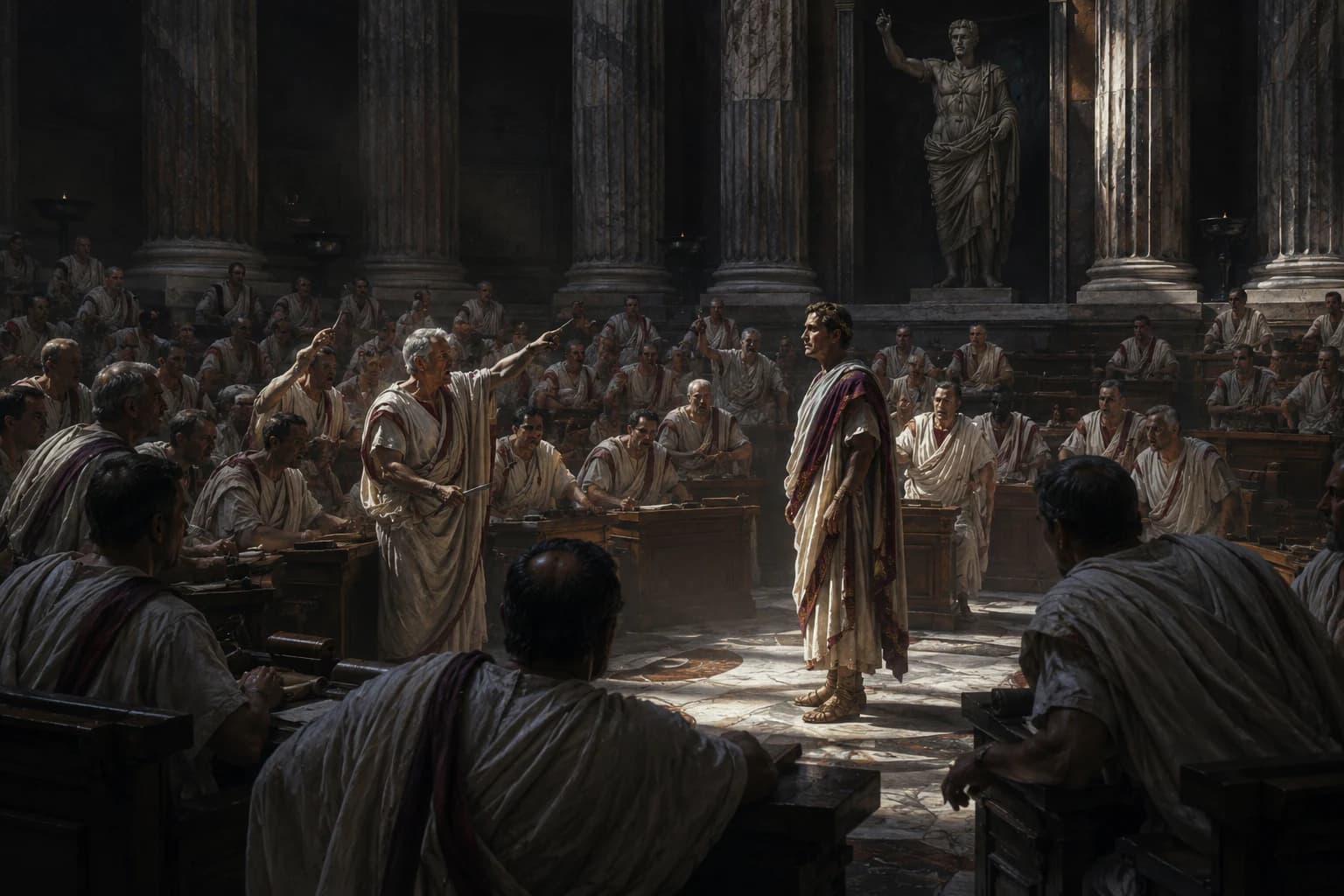
Drusus's programme generated support, but it also created a coalition of alarm. The consul Lucius Marcius Philippus became a leading opponent, and others attacked the legality and political danger of the measures. Ancient accounts are not always consistent on the technical sequence, but the political pattern is clear. A plan built from compromise was reinterpreted as overreach. Senators, equestrians and citizens could all find something in it to resent. When parts of the legislation were invalidated or blocked, Drusus's authority weakened sharply. His Italian supporters, who had attached hopes to him, were left wondering whether Rome could ever grant rights peacefully.
Ambitious change can unite opponents more quickly than it unites supporters.
-91
Violent turning point
Late in 91 BC, Drusus was murdered, traditionally stabbed in the atrium of his home as political tension reached its height. No culprit was conclusively identified. Ancient suspicion fell in different directions, which is itself revealing: enemies were numerous, motives were easy to imagine, and trust had collapsed. His death removed the one Roman politician who had publicly tied Italian citizenship to a wider settlement of the Republic's internal crisis. It also sent a devastating message to the allies. If a noble Roman tribune could be killed before delivering citizenship, peaceful negotiation looked less like a path and more like a trap.
When politics turns violent, even strong ideas can vanish with their advocates.
-91 to -88
Aftermath and unrest
The Social War began almost immediately after Drusus's death. Italian communities across central and southern Italy formed their own confederation, minted coinage, raised armies and fought Rome for citizenship, equality or independence, depending on local aims and later interpretation. Rome eventually won militarily, but the allies won the central political argument. Through laws passed during the conflict, citizenship was extended to many Italians who accepted Roman terms. That outcome makes Drusus's career painfully ironic. The Republic rejected reform when it was offered in politics, then conceded much of it under the pressure of war.
Ignored reforms can return later as conflicts that are far harder to control.
After -91
Enduring legacy
Marcus Livius Drusus did not leave a settled constitution or a victorious party. He left a warning. His reform package showed that many Roman problems were soluble in theory: juries could be reorganised, elites broadened, land distributed, grain subsidised, and Italians admitted to citizenship. What the Republic lacked was trust. Every concession looked like a weapon; every compromise threatened someone else's privilege. Drusus's legacy therefore lies in the gap between foresight and success. He saw that Italy had to be integrated into Roman citizenship. Rome accepted that truth only after his murder and a devastating war.
Some leaders plant ideas that only take root after they are gone.