People

Leonid Brezhnev

Leonid Brezhnev led the Soviet Union from 1964 to 1982. His rule brought stability, detente and superpower reach, but also economic stagnation, gerontocracy and the rigid system inherited by Gorbachev.

Born
1906 CE
Died
1982 CE
Role
Soviet leader

Soviet leader (1906–1982)

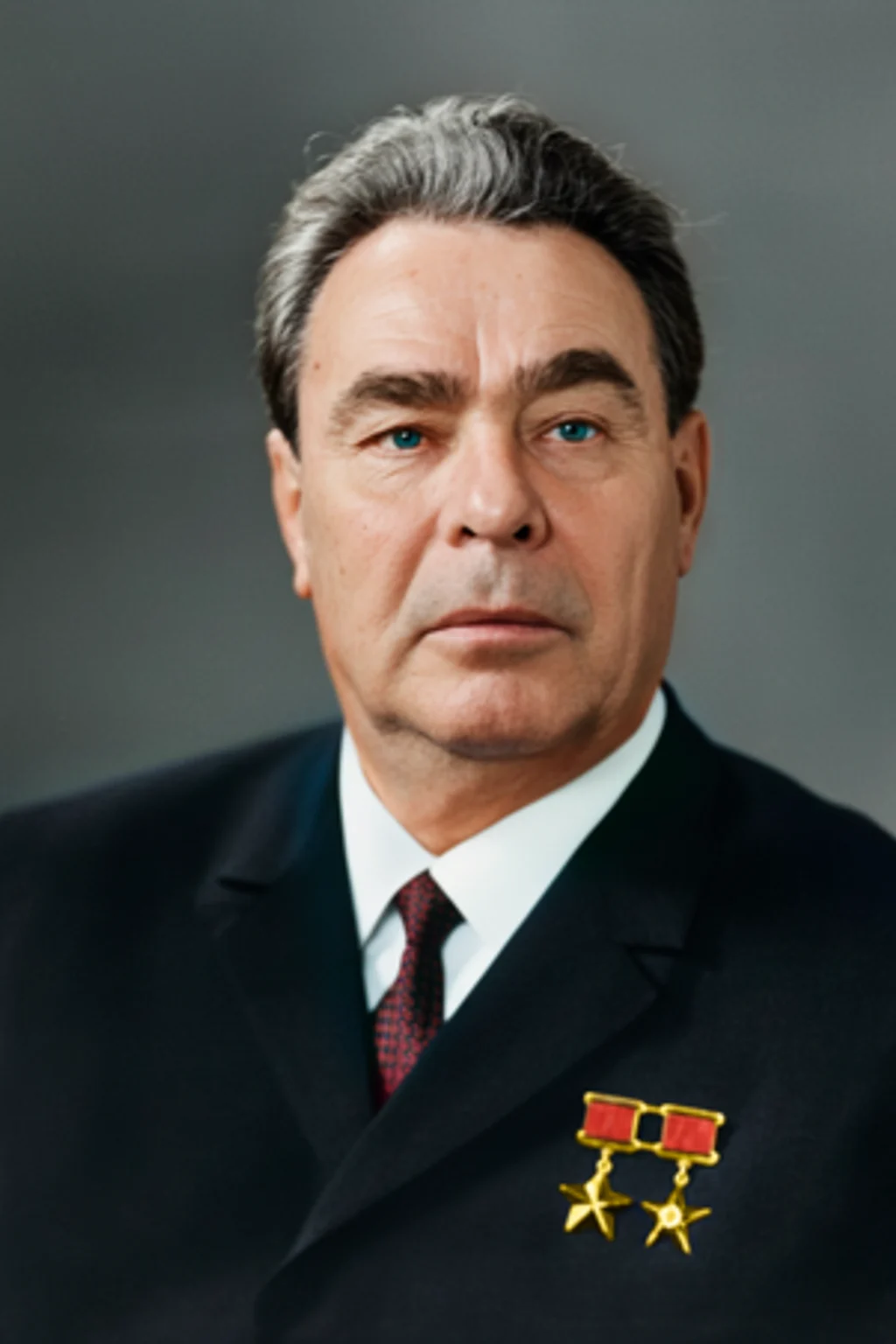
Portrait photograph of Leonid Brezhnev
Licensed archival image

A real historical or editorial image is used here. Source, licence and transformation details are publicly recorded. Image policy Attribution

Quick answer

Leonid Brezhnev led the Soviet Union from 1964 to 1982. His rule brought stability, detente and superpower reach, but also economic stagnation, gerontocracy and the rigid system inherited by Gorbachev.

Born
1906 CE
Died
1982 CE
Role
Soviet leader
Years
1906-1982 CE
Quick facts

Profile details

Additional identity and tagging details that are not already covered in the introduction.

Also known as
Leonid Ilyich Brezhnev, Brezhnev, Leonid Brezhnev Soviet leader
Facts

Leonid Brezhnev timeline facts

Selected specifics from this profile's life story.

1906–1920s
Industrial Beginnings

Born in the industrial town of Kamenskoye in Ukraine, Brezhnev grew up in a worker's world that suited the Soviet promise of advancement through loyalty and technical training.

1950s
Postwar Promotion

After 1945, Brezhnev rose through regional leadership in Ukraine, Moldavia and Kazakhstan, becoming a trusted Khrushchev ally before entering the top Soviet elite.

1970s
Global Presence

Abroad, Brezhnev combined detente with military strength, signing arms agreements while enforcing Soviet dominance in Eastern Europe through the Brezhnev Doctrine.

Post-1982
Aftermath and Legacy

When Brezhnev died in 1982, he left a powerful but tired Soviet Union whose demand for reform would define the final decade of the Cold War.

Life Journey

From provincial roots to long-serving power broker

Follow the story in a more continuous narrative, with a reading mode that matches how much depth you want.

Complete chronology

1906–1920s

Industrial Beginnings

Leonid Ilyich Brezhnev was born in 1906 in Kamenskoye, an industrial town in what is now Ukraine, into a Russian-speaking working family. His early life fitted the Soviet story the regime liked to tell about itself: the son of labour could rise through education, technical skill and party service. He trained as a land surveyor and metallurgical engineer, entering a world of factories, plans and disciplined administration rather than ideological originality. That background shaped his political style. Brezhnev was not a theorist like Lenin, a terror ruler like Stalin, or a restless improviser like Khrushchev. He was a product of institutions that rewarded dependability. From the beginning, his career pointed toward management, hierarchy and the belief that social order was itself a political achievement.
1930s

Party Advancement

Brezhnev joined the Communist Party in 1931 and rose through regional administration during the most dangerous decade of Soviet political life. The purges destroyed countless officials and opened vacancies for younger cadres, but advancement carried its own risks. A successful official had to be energetic without seeming independent, ambitious without attracting suspicion, and loyal in language as well as action. Brezhnev learned this grammar of survival. He worked in industrial and party posts in Ukraine, building a reputation as a competent organiser rather than a man of disruptive ideas. The experience taught him that systems could devour those who moved too quickly or spoke too freely. Later, as Soviet leader, he would prize predictability partly because his own formation had taken place in a state where unpredictability could be fatal.

1941–1945

War and Experience

The German invasion of the Soviet Union in 1941 turned Brezhnev's administrative career into a wartime one. He served as a political commissar and senior political officer, helping maintain morale, discipline and party control within the armed forces. His role was not that of a great battlefield strategist, despite later Soviet propaganda inflating his wartime image, especially around the fighting near Novorossiysk. Still, the war mattered deeply to his identity. It gave him credentials in the Soviet Union's central sacred narrative: survival against Nazi Germany. It also connected him to officers and officials who would matter in the postwar state. For Brezhnev, war reinforced the value of unity, command and patriotic legitimacy. It gave him a language of sacrifice and victory that he would use throughout his rule.

1950s

Postwar Promotion

Brezhnev's postwar ascent came through the regional party ladder. He held important posts in Ukraine, led the Moldavian Communist Party, and later worked in Kazakhstan during the Virgin Lands campaign, one of Nikita Khrushchev's signature efforts to boost grain production. These assignments gave him experience across the Soviet periphery and tied his fortunes to Khrushchev's patronage. He entered the Presidium, later the Politburo, and became one of the men through whom the Soviet centre managed its vast territories. Brezhnev's skill was not dazzling innovation. It was personal management: remembering colleagues, balancing interests, avoiding ideological extremes and making himself acceptable. In a system tired of Stalinist terror yet unsettled by Khrushchev's experiments, acceptability became a form of power.

1964

Power Shift

Khrushchev's fall in October 1964 was presented as orderly collective correction, but it was a palace coup within the party elite. Senior officials had grown weary of his impulsive reforms, administrative reorganisations and foreign-policy risks. Brezhnev helped bring him down and became First Secretary, later General Secretary, of the Communist Party. At first he looked like a compromise figure, balanced by Alexei Kosygin as premier and other senior leaders. That appearance helped him. Brezhnev did not seize power in Stalin's style; he accumulated it through patience, appointments, patronage and the promise that officials could keep their positions if they kept the peace. His rise marked a decisive shift from revolutionary drama to bureaucratic consolidation. The Soviet elite wanted fewer shocks. Brezhnev gave them exactly that.

Late 1960s–1970s

Era of Stability

The Brezhnev era is often called the era of stagnation, but for many Soviet citizens it initially felt like security. Wages rose, urban housing expanded, education and healthcare remained accessible, and the terror of Stalin's time did not return. Officials valued the stability of cadres: once in post, they often stayed there. Yet the same bargain that reduced fear also reduced renewal. The command economy could still produce steel, missiles and apartment blocks, but it struggled with quality, innovation, consumer goods and agricultural efficiency. Corruption spread through informal networks; targets were fulfilled on paper; shortages became routine. Brezhnev did not create every weakness of the Soviet system, but his leadership postponed hard choices. Stability became less a platform for confidence than a method of avoiding political pain.

1970s

Global Presence

Brezhnev's Soviet Union was a global superpower at the height of its reach. It achieved nuclear parity with the United States, supported allied regimes and movements abroad, and negotiated major arms-control agreements, including SALT I in 1972. Détente did not mean trust; it meant managing rivalry because uncontrolled confrontation was too dangerous. The same leader who shook hands with American presidents also sent Warsaw Pact forces into Czechoslovakia in 1968 to crush the Prague Spring. The Brezhnev Doctrine asserted that socialist states had limited sovereignty when Communist rule was at risk. This doctrine reassured hardliners and frightened reformers across Eastern Europe. Brezhnev's foreign policy therefore had two faces: cautious superpower negotiation and uncompromising control of the Soviet bloc.

Late 1970s–1982

Declining Health

Brezhnev's final years turned stability into inertia. His health deteriorated badly after strokes and other illnesses, yet the ritual of leadership continued around him. Public appearances became stiff performances of continuity while real decision-making slowed. The wider leadership aged with him, producing a gerontocracy whose instincts were defensive. The 1979 invasion of Afghanistan deepened the problem. Intended to preserve a friendly regime on the Soviet border, it became a costly war that damaged detente, drained morale and revealed the dangers of strategic rigidity. At home, economic growth weakened further and cynicism widened the gap between official language and daily experience. The Soviet Union still looked formidable, but its ability to adapt had been quietly compromised.

Post-1982

Aftermath and Legacy

Brezhnev died on 10 November 1982 after eighteen years at the summit of Soviet power. His legacy is not simply failure. He avoided a return to mass terror, maintained superpower status, expanded Soviet military strength and presided over a period many citizens later remembered as predictable compared with the upheavals that followed. But the costs were immense. The economy lost momentum, political life ossified, dissent was contained rather than answered, and the leadership became expert at confusing calm with health. Yuri Andropov, Konstantin Chernenko and then Mikhail Gorbachev inherited not a collapsing state, but a rigid one: too large and armed to ignore, too brittle to reform easily. Brezhnev's importance lies in that contradiction. He preserved the Soviet system longer than many expected, and in preserving it so cautiously, helped make its later crisis harder to escape.

Continue in context

Connected stories

Move from the profile into the wider events and settings this figure belongs to.

Russian & Soviet Leaders lineage
Lineage11 leaders
Russian & Soviet Leaders
1917 CE–present

A curated succession from Soviet party-state leaders to Russian Federation presidents, spanning Lenin to Putin.

View lineage
Tertiary paths

Content note

This profile is written for educational use and connects to related Stories of History pages. The main portrait uses a real historical or editorial image, with source and licence details recorded for attribution review. Image policy Image attribution

References

Sources & Further Reading

Reliable reference works, archives and reading paths connected to this profile.

Further reading

  1. Encyclopaedia Britannica, Search results for Leonid Brezhnev,” accessed June 2026.Open source
  2. WorldCat, Books and library holdings for Leonid Brezhnev,” accessed June 2026.Open source

Primary sources

  1. Library of Congress, Search results for Leonid Brezhnev,” accessed June 2026.Open source

Reviewed claim sources

Loading reviewed claim sources...

A weekly route through history

Find out first about the latest published stories, feature notes and occasional Premium offers in one weekly email.