People

James Buchanan

James Buchanan was the 15th U.S. President. His presidency from 1857 to 1861 deepened the sectional crisis over slavery and ended with Southern secession.

Born
1791 CE
Died
1868 CE
Role
15th President of the United States

15th President of the United States (1791–1868)

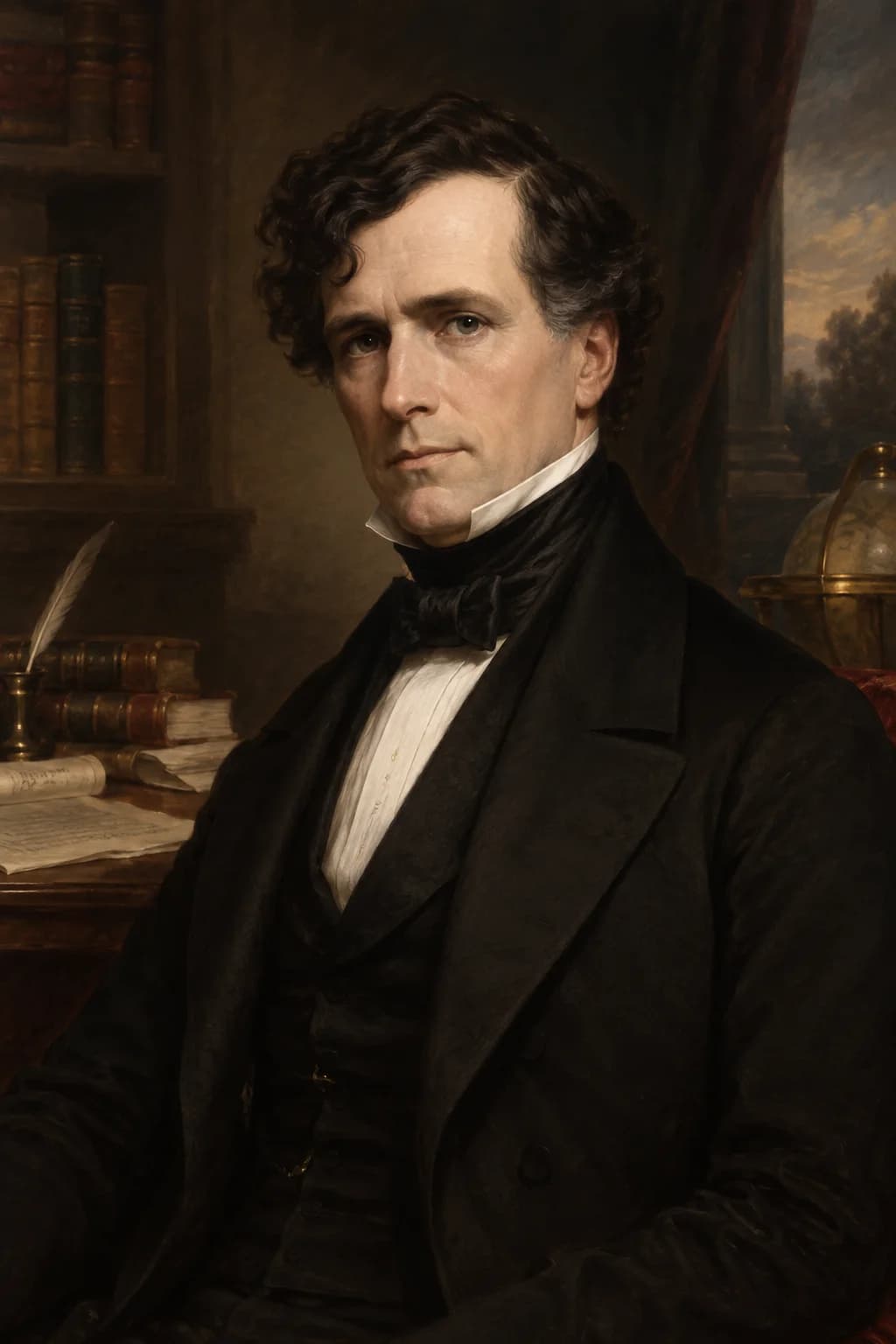
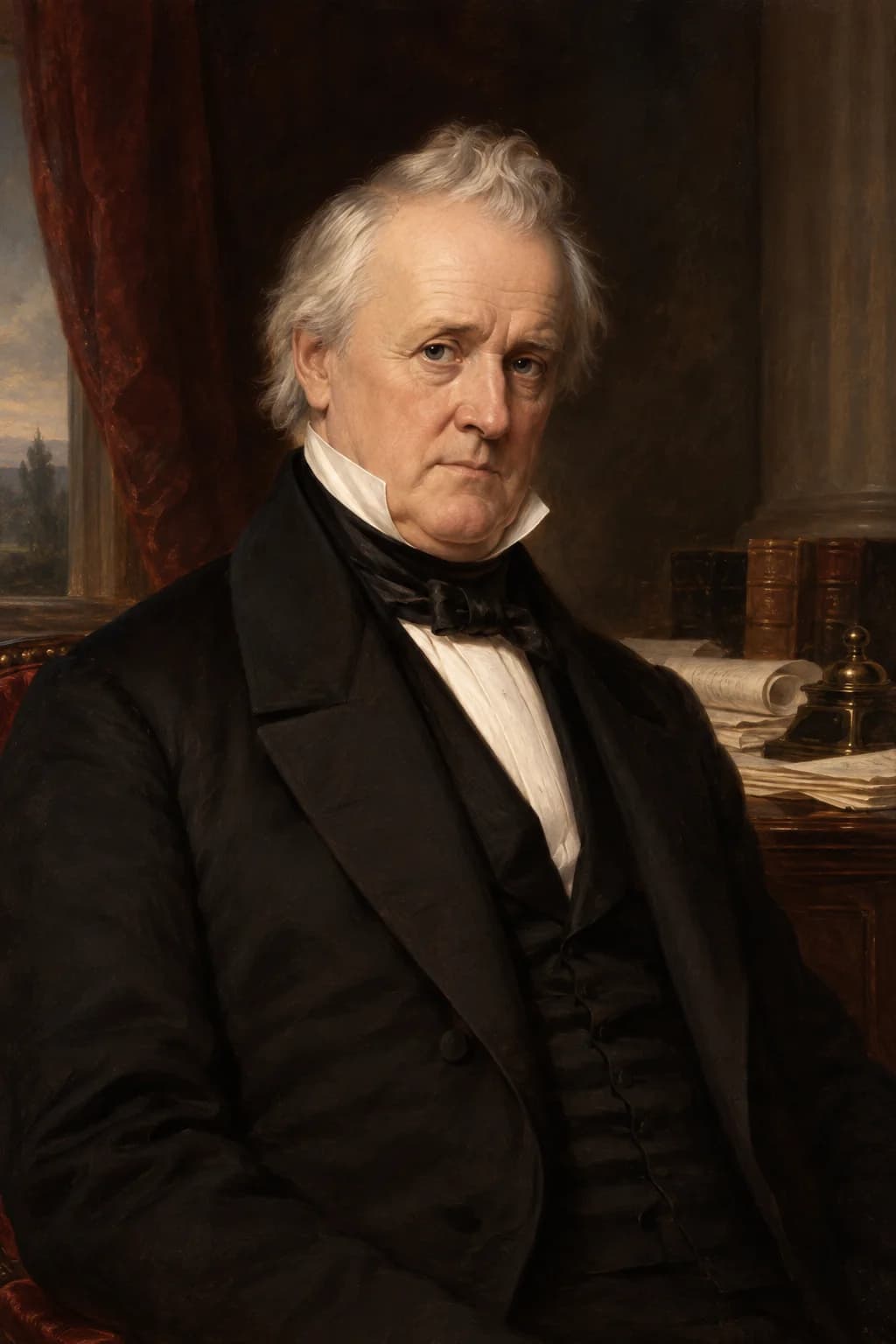
AI-generated portrait of James Buchanan in formal presidential attire
AI-assisted historical reconstruction

An illustrative reconstruction based on historical context. It is not a photograph or documentary likeness. Image policy Attribution

Quick answer

James Buchanan was the 15th U.S. President. His presidency from 1857 to 1861 deepened the sectional crisis over slavery and ended with Southern secession.

Born
1791 CE
Died
1868 CE
Role
15th President of the United States
Years
1791-1868 CE
Facts

James Buchanan timeline facts

Selected specifics from this profile's life story.

1791–1809
Frontier roots

James Buchanan was born in Pennsylvania in 1791 to an Ulster Scots immigrant family that valued discipline, education and commercial respectability.

1832–1845
Diplomatic service

As minister to Russia and later Britain, Buchanan gained diplomatic stature and avoided some domestic battles that damaged other Democrats.

1857–1860
Deepening divisions

Buchanan endorsed the Dred Scott decision and backed the proslavery Lecompton Constitution, choices that made sectional distrust worse.

1861–1868
Historical judgment

Buchanan spent retirement defending his choices, but his legacy remains tied to presidential failure on the eve of the Civil War.

Life Journey

A career of experience tested by national fracture

Follow the story in a more continuous narrative, with a reading mode that matches how much depth you want.

Complete chronology

1791–1809

Frontier roots

James Buchanan was born on 23 April 1791 at Cove Gap, Pennsylvania, and grew up in Mercersburg, where his father built success as a merchant after immigrating from Ulster. Buchanan's background was not aristocratic, but it was ambitious, disciplined and socially aspiring. He absorbed a respect for order, reputation and advancement through established institutions. Those habits helped him in a long public career, but they also encouraged a dangerous faith in procedure. Buchanan would spend his life inside the constitutional system of the United States. When that system began to fail over slavery, he struggled to imagine action outside inherited legal categories.
1809–1812

Legal training

Buchanan studied at Dickinson College, where youthful discipline did not always come easily, then trained for the law in Lancaster. He became a capable and prosperous attorney, skilled at argument and careful with public image. Law offered him more than income. It gave him a worldview in which legitimacy flowed through forms, offices, documents and precedent. That legal temperament made him attractive to voters who wanted competence and stability. It also helps explain his later failure: in a revolutionary crisis, Buchanan kept reaching for narrow constitutional formulas when the deeper question was whether the republic could survive half slave and half free.

1814–1831

Entry into politics

Buchanan entered public life in the Pennsylvania legislature and then the U.S. House of Representatives. He began as a Federalist but adjusted with the age, becoming a Democrat aligned with Andrew Jackson's coalition. That shift was characteristic. Buchanan was rarely a political visionary; he was a survivor inside changing party structures. In Congress he defended states' rights, party discipline and the idea that sectional conflict could be managed through compromise and deference to constitutional limits. He built a national profile without becoming a national inspiration. His talent was persistence, not moral imagination.

1832–1845

Diplomatic service

Buchanan served as U.S. minister to Russia under Andrew Jackson and later as minister to Britain under Franklin Pierce. These posts strengthened his reputation as an experienced statesman. In Russia he helped negotiate a commercial treaty; in London he dealt with imperial Britain at a time when American expansion, trade and Central American questions mattered deeply. His absence from the United States during the Kansas-Nebraska uproar of 1854 was politically useful. While other Democrats were stained by the violence and sectional rage that followed, Buchanan could present himself in 1856 as experienced but untainted. It was one of the great accidents of his career.

1845–1857

Cabinet leadership

Buchanan's service as Secretary of State from 1845 to 1849 placed him inside the politics of Manifest Destiny. He helped manage the Oregon boundary dispute with Britain and served during the Mexican-American War, when the United States seized enormous western territories. Expansion brought glory to some Americans and catastrophe to others, especially Mexico and Indigenous nations. It also reopened the question Buchanan never solved: would slavery spread into new lands? Like many Democrats, he hoped party management and constitutional compromise could contain the issue. Each acquisition made that hope less realistic.

1856

Elected president

The election of 1856 took place in a country already in crisis. The Whig Party had collapsed, the Republican Party had risen on opposition to slavery's expansion, and Kansas had become a battleground between proslavery and antislavery settlers. Buchanan offered the Democratic Party an experienced nominee who had been abroad during the worst domestic fighting. He defeated Republican John C. Fremont and former president Millard Fillmore, then entered office insisting that the slavery question could be settled by law. The timing was brutal. Within days of his inauguration, the Supreme Court's Dred Scott decision made compromise even harder.

1857–1860

Deepening divisions

Buchanan hoped the Supreme Court would settle the slavery question, but Dred Scott did the opposite. The decision declared that Black people could not claim U.S. citizenship and that Congress lacked power to prohibit slavery in the territories. Buchanan accepted it as authoritative, helping convince many northerners that a Slave Power was bending every branch of government. He then supported the Lecompton Constitution, a fraudulent proslavery constitution for Kansas, despite fierce opposition from many settlers and from Stephen A. Douglas. The episode split the Democratic Party and destroyed Buchanan's credibility as a neutral guardian of the Union. His instinct for legal finality had become political gasoline.

1860–1861

Approaching secession

The final test came after Abraham Lincoln won the 1860 election. South Carolina seceded in December, followed by other Deep South states before Buchanan left office. His message to Congress captured the paralysis of his presidency: secession was unconstitutional, but he believed the federal government had no clear authority to force a state back into the Union. That position satisfied almost nobody. Buchanan did eventually refuse to surrender Fort Sumter and supported efforts to reinforce federal positions, but his cabinet had already contained southern sympathizers, federal property was being seized, and momentum had passed to the secessionists. He remained president while the Union came apart in real time.

1861–1868

Historical judgment

Buchanan left office on 4 March 1861, handing Abraham Lincoln a country already fractured and a crisis already armed. In retirement at Wheatland, he wrote a defense of his administration, arguing that sectional forces and Republican agitation had made disaster unavoidable. Historians have been far less forgiving. No president alone caused the Civil War; slavery, expansion, party breakdown, racism and decades of compromise all mattered. But Buchanan's importance lies in the difference between experience and judgment. He had held nearly every kind of public office, yet at the decisive moment he strengthened proslavery positions, alienated northern opinion, split his party and responded to secession with constitutional hesitation. To ask why James Buchanan was important is to confront one of the sharpest negative lessons in American presidential history: long preparation does not guarantee courage when the old rules stop working.

Continue in context

Connected stories

Move from the profile into the wider events and settings this figure belongs to.

American Presidents lineage
Lineage47 presidents
American Presidents
1789 CE–present

The succession of American presidents from George Washington to today.

View lineage
Tertiary paths

Content note

This profile is written for educational use and connects to related Stories of History pages. The main portrait is an AI-assisted historical reconstruction, included as an illustrative aid rather than documentary evidence. Image policy Image attribution

References

Sources & Further Reading

Reliable reference works, archives and reading paths connected to this profile.

Further reading

  1. Encyclopaedia Britannica, Search results for James Buchanan,” accessed June 2026.Open source
  2. WorldCat, Books and library holdings for James Buchanan,” accessed June 2026.Open source

Primary sources

  1. Library of Congress, Search results for James Buchanan,” accessed June 2026.Open source

Reviewed claim sources

Loading reviewed claim sources...

A weekly route through history

Find out first about the latest published stories, feature notes and occasional Premium offers in one weekly email.