Complete chronology
Full overview and deeper context for every journey step.
c. 1507 BC
Daughter of a pharaoh
Hatshepsut entered a royal world shaped by conquest, temple wealth, and Theban religious power. Her father Thutmose I campaigned in Nubia and the Levant, extending the prestige of the 18th Dynasty. As a king's daughter, Hatshepsut was trained not only for marriage but for ritual visibility: royal women appeared in ceremonies, supported cults, and helped secure dynastic continuity. She later married her half-brother Thutmose II, a conventional but politically important union in the royal house. Her early life placed her close to the language and theatre of kingship. That proximity mattered. When crisis came, she did not have to invent authority from nothing; she already knew how Egyptian power spoke, dressed, built, and justified itself.
Proximity to power from birth shapes expectations — and ambitions — that outlast early circumstances.
c. 1492 BC–1479 BC
Queen and regent
The death of Thutmose II left a child, Thutmose III, as heir. His mother was a secondary wife, while Hatshepsut stood as the senior royal woman with unmatched ceremonial status. Acting as regent for a young king was not in itself revolutionary; Egyptian history had room for royal women to protect a succession. The remarkable development was the direction Hatshepsut then took. Instead of fading as Thutmose III matured, she accumulated the full titles, images, and rituals of kingship. The transition seems to have been gradual, and scholars continue to debate exactly when regency became co-kingship. What is clear is that Hatshepsut turned a temporary guardianship into a durable political reality.
Regencies that require real governance can evolve into something their architects never formally announced.
c. 1479 BC
Full pharaoh
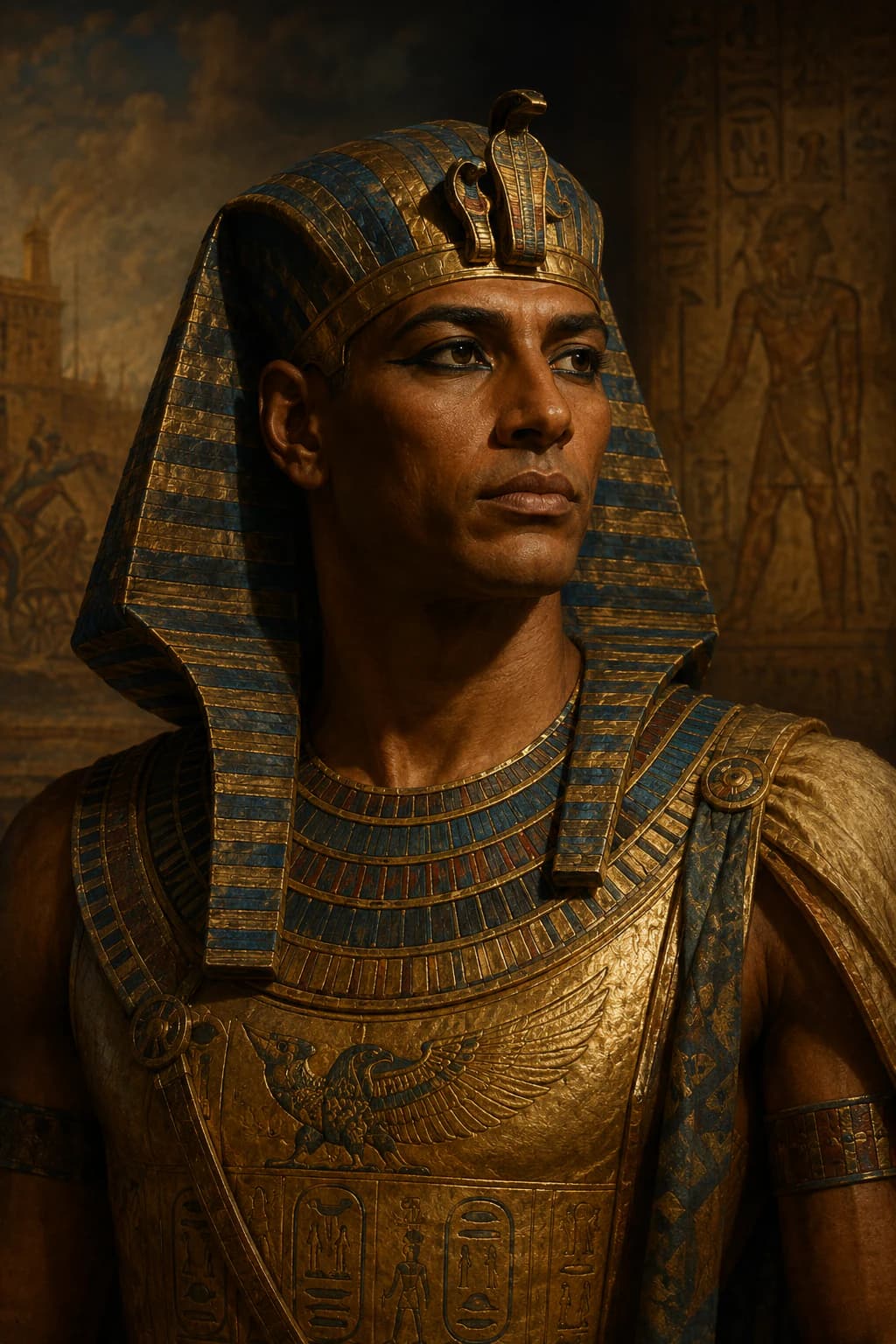
Hatshepsut's kingship was radical because it worked through convention rather than simply rejecting it. Pharaoh was imagined as a male role, bound to divine sonship, ritual performance, and the physical symbols of rule. Hatshepsut therefore adopted kingly titulary, the double crown, and at times the false beard, while inscriptions could move between feminine identity and masculine royal grammar. This was not crude disguise. It was a precise use of Egyptian political theology: she presented herself as the person properly performing kingship. Thutmose III remained co-ruler and was not erased from the system; he later proved a formidable military pharaoh. But during Hatshepsut's mature reign the initiative, display, and ideological argument belonged overwhelmingly to her.
Working within a system's own rules, rather than against them, can be more effective than open defiance.
c. 1479 BC–1458 BC
Building programme
Hatshepsut's construction record stands among the most ambitious of the New Kingdom. Her mortuary temple at Deir el-Bahri, designed against the cliffs of western Thebes, fused landscape, ceremony, and political message with extraordinary confidence. Its terraces, colonnades, processional routes, and reliefs made the king's legitimacy something visitors could physically move through. At Karnak she raised obelisks whose upper portions were covered with electrum so they flashed in the sun, linking her reign to Amun's favour. These were not vanity projects in the modern sense. In Egypt, building was theology, propaganda, employment, memory, and statecraft at once. Hatshepsut made stone argue for her.
Monumental building is never purely aesthetic — it is the materialisation of a claim to legitimate authority.
c. 1470 BC
Expedition to Punt
Among the achievements Hatshepsut advertised most vividly was the expedition to Punt, a trading partner whose exact location remains debated but is usually associated with the Horn of Africa or the southern Red Sea world. The expedition brought back incense, ebony, gold, animal skins, exotic creatures, and living myrrh trees to be planted in Egypt. These goods had economic value, but their ritual meaning was just as important: incense fed the temples, and foreign abundance proved that the gods had opened distant lands to the pharaoh. By carving the voyage on the walls of Deir el-Bahri, Hatshepsut turned trade into royal narrative. She did not simply send ships; she made the successful return part of her claim to cosmic order.
A carefully recorded achievement outlasts the action itself, which is why powerful rulers invest so heavily in their own commemoration.
c. 1479 BC–1458 BC
Justifying the reign
Egyptian kingship required divine sanction, and Hatshepsut invested heavily in showing that her rule had been intended by the gods. At Deir el-Bahri she presented a divine birth cycle in which Amun fathered her, a motif known in royal ideology but especially useful for a woman occupying the king's role. She also emphasised her father's approval, priestly support, and successful service to Amun. It is tempting to call this propaganda and stop there, but that would flatten the world she inhabited. Legitimacy in ancient Egypt was ritual, political, and religious at once. Hatshepsut's inscriptions show a ruler carefully weaving every available thread into one claim: she ruled because heaven, dynasty, and performance all confirmed it.
When authority is contested or unusual, those who hold it often work harder to justify it than those for whom it is simply assumed.
c. 1458 BC
Death of a pharaoh
The circumstances of Hatshepsut's death are not recorded in narrative form. She appears to have died after roughly two decades of rule, probably in middle age by royal standards. A mummy identified with high probability as hers in 2007 showed evidence consistent with serious disease, including cancer, though medical conclusions about ancient remains must always be handled carefully. She was associated with burial in the Valley of the Kings, and her funerary arrangements reflected the unusual path from queen to pharaoh. Thutmose III then ruled alone and became one of Egypt's greatest military kings. The surviving evidence does not support a simple melodrama of immediate revenge. The attack on Hatshepsut's memory came later, and its timing matters.
The full consequences of a reign are often only visible in what happens after it ends.
c. 1430 BC–1420 BC
Erasure from history
The destruction of Hatshepsut's public image appears to have begun decades after her death, not immediately. Statues were smashed and buried, cartouches were chiselled away, and inscriptions were altered so that Thutmose I, Thutmose II, or Thutmose III replaced her in the visible royal sequence. Older explanations imagined Thutmose III as a resentful stepson taking revenge, but the delayed timing makes that too simple. Many scholars now see a dynastic motive: late in his reign, Thutmose III may have wanted to clarify the male line of succession for his son Amenhotep II by reducing the memory of a woman who had ruled as king. The erasure was targeted rather than total, and it accidentally preserved much by burying it. Even destruction became a kind of archive.
To erase someone from the record is a confirmation of how much they mattered — you do not bother to destroy what never threatened you.
After 1458 BC
Rediscovery and legacy
Hatshepsut returned to history through damaged names, altered reliefs, statue fragments, and the patient work of Egyptology. Deir el-Bahri and Karnak revealed a ruler too substantial to remain hidden once scholars learned how to read the scars. The probable identification of her mummy in 2007 added a powerful human dimension, though her true monument remains the political record she left in stone. Today Hatshepsut matters not only because she was a woman who ruled as pharaoh, but because she shows how flexible and disciplined ancient authority could be. Her reign was stable, wealthy, and ideologically sophisticated. The attempt to erase her confirms the very thing it tried to deny: Hatshepsut had occupied kingship so successfully that later rulers considered her memory worth managing.
What survives the attempt to destroy it often carries more meaning than what was never threatened.