Complete chronology
Full overview and deeper context for every journey step.
Early 1400s
A Genoese nobleman at war
Giovanni Giustiniani Longo belonged to the Genoese aristocratic and colonial world that stretched across the Mediterranean and Black Sea. The exact details of his birth are less secure than those of emperors and kings, but his career places him among the military entrepreneurs of late medieval Italy: nobles and captains whose fortunes were made through command, ships, fortresses, trade, and service far from their home city. Genoa was not simply an Italian city-state. It was a maritime network with interests in Chios, Galata, the Aegean, the Black Sea, and the commercial life of Constantinople.
That background explains why Giustiniani mattered in 1453. He was not a romantic outsider who happened to arrive at a doomed city. He came from a world with practical reasons to care about Constantinople's survival and the balance of power in the eastern Mediterranean. Genoese soldiers, sailors, and merchants understood siege warfare, walls, artillery, contracts, and the value of disciplined troops. Giustiniani's importance lay in bringing exactly the kind of battlefield professionalism that Constantine XI lacked in sufficient numbers.
He came from a maritime frontier where commerce and warfare were often inseparable.
1453
Answering Constantinople's call
When the Ottoman threat to Constantinople became unmistakable, Giovanni Giustiniani came to the city with a force of well-armed volunteers. His arrival mattered out of proportion to the number of men he brought. Constantinople's defenders were short of manpower, but they were also short of experienced commanders who could organise resistance at the most dangerous points of the walls. Giustiniani supplied both confidence and competence.
Constantine XI received him as a vital ally. The emperor needed Western assistance, yet Western aid was politically complicated by the conflict over union between the Orthodox and Catholic churches. Giustiniani's role cut through some of that tension because his value was immediate and practical. He could command soldiers, direct repairs, hold breaches, and stiffen morale. In the final months of Byzantium, his presence showed how the city's defense depended not only on Greek loyalty but on a wider Mediterranean coalition of people who feared, opposed, or simply could not ignore Ottoman expansion.
His arrival gave the defense a professional core at the exact point where morale and organisation mattered.
April-May 1453
Commander at the land walls
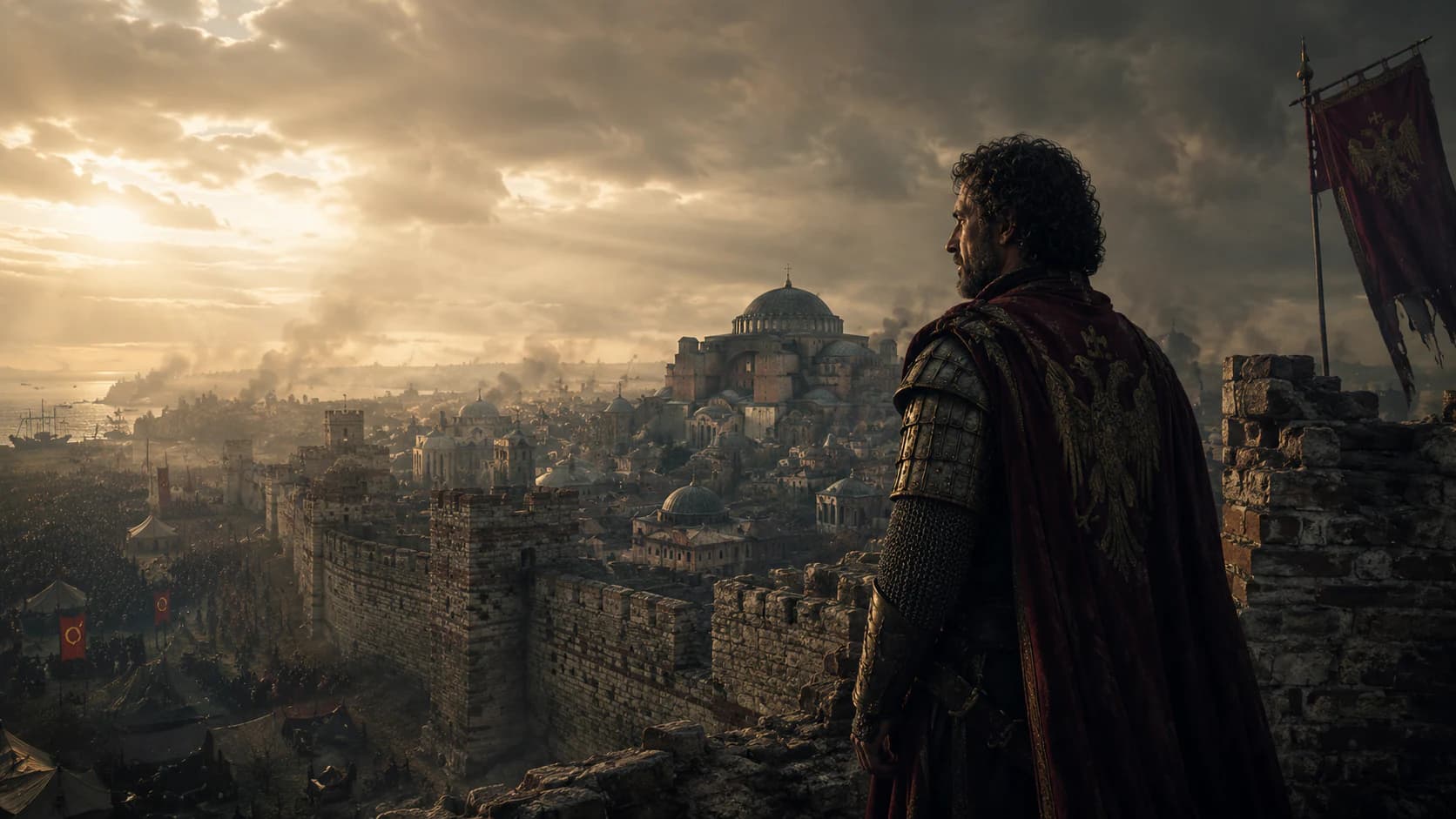
During the siege, Giustiniani was placed at the land walls near the most threatened sector, often associated with the area around the Gate of St. Romanus. This was the heart of the crisis. Constantinople's seaward defenses and the Golden Horn mattered, but the Theodosian walls on the landward side absorbed the main force of Mehmed II's artillery and infantry attacks. Heavy cannon damaged stonework that had protected the city for centuries, and every breach had to be repaired under pressure.
Giustiniani's command was valuable because siege defense required more than bravery. It demanded rotation of exhausted men, rapid repair, control of panic, and the ability to judge when to counterattack or hold position. His troops became a kind of hinge between Byzantine defenders and foreign volunteers. The sources naturally magnify the drama of the final days, but they agree on the central point: Giustiniani was among the most important military leaders inside the city. Without him, Constantinople's defense may have collapsed sooner.
He turned limited manpower into organised resistance at the siege's most dangerous point.
1453
A fragile coalition
The defense of Constantinople in 1453 was not a simple national story. Greeks formed its heart, but Genoese, Venetians, Catalans, and other foreigners also played roles. Some were motivated by faith, some by politics, some by trade, and some by personal honour. These groups did not always trust one another. Genoa and Venice had long been commercial rivals. The Latin presence in Constantinople carried painful memories for many Byzantines because of the Fourth Crusade and the Latin occupation of the city in the thirteenth century.
Giustiniani's achievement was partly military and partly social. He had to function inside that crowded world of suspicion, emergency, and competing loyalties. Constantine XI needed him, but dependence on a Genoese commander also revealed the empire's weakness. Mehmed II, by contrast, could organise the siege through a central Ottoman command. The defenders had courage, but their coalition was improvised. Giustiniani helped make that improvisation work for weeks under bombardment.
His command shows how the last Byzantine defense was both heroic and structurally fragile.
29 May 1453
The wound that changed the morning
On 29 May 1453, as Mehmed's troops launched the final assault, Giustiniani was severely wounded. Accounts differ over the precise nature of the injury and the exact sequence that followed, which is important: the event is famous, but not every detail can be treated as certain. What is clear is that he left the fighting line to receive treatment and that his withdrawal shocked the defenders around him.
This moment has sometimes been treated as if one man's wound caused Constantinople's fall. That is too simple. The city was already exhausted, the walls were badly damaged, Ottoman pressure was relentless, and the defenders were outnumbered. Yet morale in siege warfare can be as decisive as masonry. Giustiniani had become a symbol of competent resistance. When he was carried or escorted away, some soldiers seem to have read the movement as a sign that the defense was failing. The Ottoman breakthrough followed amid confusion, pressure, and collapse. Giustiniani did not lose the city alone; his injury exposed how much the defense had come to depend on his presence.
His wound mattered because a commander can become part of the structure that holds fear in place.
1453
Death after the fall
After the Ottoman breakthrough, Giustiniani was taken from Constantinople and died soon afterward, traditionally on Chios, from the wound he had received. His death made him one of the many figures whose lives were consumed by the fall of the city, though his story differs from Constantine XI's. The emperor vanished into the fighting and became a symbol of imperial extinction. Giustiniani survived the wall long enough to carry the siege's trauma away from the city, then died before he could become a long-term witness or political actor in the new Ottoman order.
His reputation has been debated. Some later tellings blame him for leaving the line; others honour him as the commander whose skill prolonged the defense. A fair reading holds both the human and military realities together. He was badly wounded. He had fought hard. His withdrawal had consequences. The fall of Constantinople cannot be reduced to cowardice, betrayal, or a single broken moment. Giustiniani's end belongs to the larger tragedy of a defense that was brave, multinational, and ultimately overwhelmed.
His death closed a career remembered almost entirely through one desperate siege.
After 1453
Legacy of a defender
Giovanni Giustiniani's legacy rests on the fact that he was not an emperor, sultan, or founder of a dynasty, yet his actions shaped one of the most famous days in world history. His biography answers a different question from Constantine XI's or Mehmed II's. It asks how a city actually holds out under siege: who stands at the breach, who organises repair, who steadies frightened soldiers, and how quickly confidence can collapse when trusted leadership disappears.
For readers asking why Giustiniani was important, the answer is that he gave Constantinople's final defense a sharper military edge. His presence helped the city resist Mehmed II's army for weeks, and his injury during the final assault became one of the turning points remembered by eyewitnesses and later historians. He also represents the entangled world of the fifteenth-century eastern Mediterranean, where Genoese, Venetian, Byzantine, and Ottoman interests met at the walls of a city all of them understood to be more than ordinary territory. Giustiniani's achievements were not conquest or reform. They were discipline, endurance, and command under impossible pressure.
He matters because the fall of Constantinople was shaped not only by rulers, but by the commanders who held the walls.