People

Ferdinand Magellan

Ferdinand Magellan was a Portuguese navigator in Spanish service. His 1519 expedition crossed the Pacific and enabled the first circumnavigation of the globe, though he died in the Philippines in 1521.

Born
1480 CE
Died
1521 CE
Role
Portuguese explorer

Portuguese explorer (1480–1521)

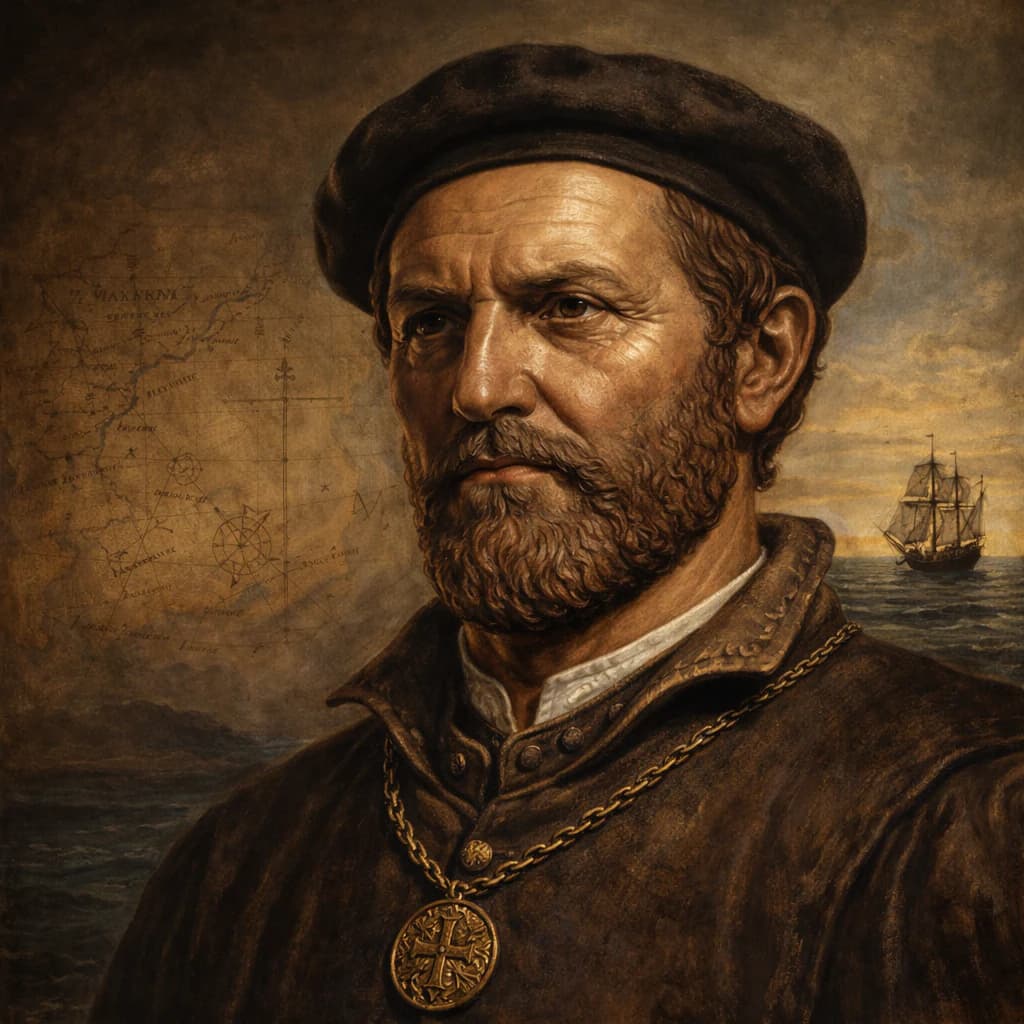
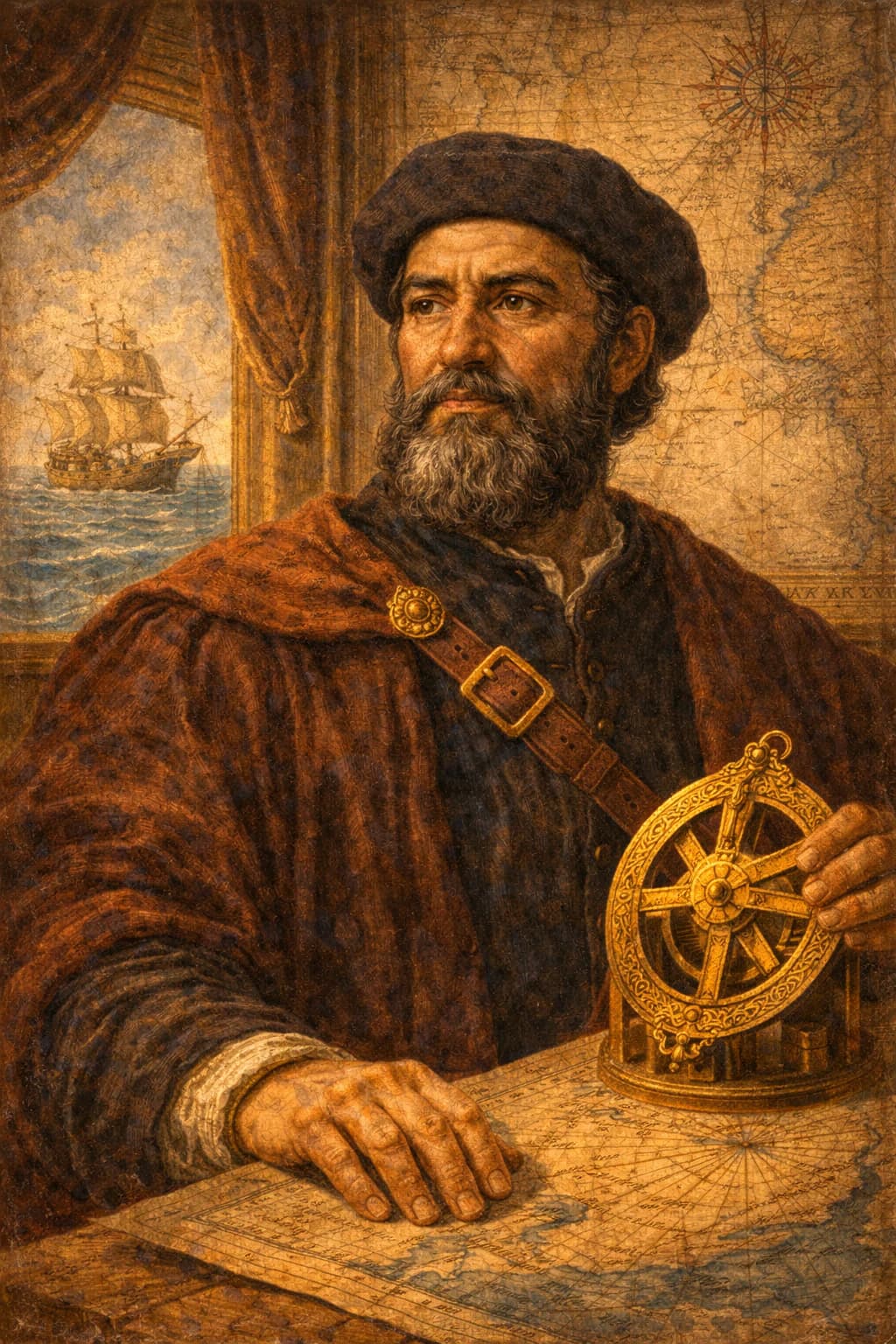
AI-generated portrait of Ferdinand Magellan in 16th-century explorer attire
AI-assisted historical reconstruction

An illustrative reconstruction based on historical context. It is not a photograph or documentary likeness. Image policy

Quick answer

Ferdinand Magellan was a Portuguese navigator in Spanish service. His 1519 expedition crossed the Pacific and enabled the first circumnavigation of the globe, though he died in the Philippines in 1521.

Born
1480 CE
Died
1521 CE
Role
Portuguese explorer
Years
1480-1521 CE
Facts

Ferdinand Magellan timeline facts

Selected specifics from this profile's life story.

1480
Noble Beginnings

Ferdinand Magellan was born in Portugal around 1480, entering a maritime kingdom where royal service, navigation, and oceanic ambition were closely linked.

1518
Spanish Support

In 1518, Magellan persuaded Charles I of Spain to back an expedition seeking a western passage to the Spice Islands.

1520–1521
Across the Pacific

The Pacific crossing revealed the true scale of the planet, as Magellan's crews endured hunger, disease, and weeks of ocean far wider than expected.

1522
Circumnavigation Legacy

Magellan did not complete the circumnavigation, but the Victoria returned to Spain in 1522 under Juan Sebastian Elcano, proving a continuous sea route around the globe.

Life Journey

A voyage that redrew the world’s horizons

Follow the story in a more continuous narrative, with a reading mode that matches how much depth you want.

Complete chronology

1480

Noble Beginnings

Ferdinand Magellan was born into the lesser Portuguese nobility at a time when Portugal was turning Atlantic experience into an Asian empire. His youth placed him near courtly service rather than at the center of power, and that position shaped him: close enough to learn the language of patrons, ships, and royal ambition, but not secure enough to rely on inherited status alone. Portugal's explorers had rounded Africa, entered the Indian Ocean, and pushed toward the spice trade that linked Europe to Southeast Asia. In that atmosphere, geography was not an abstract school subject. It was wealth, rivalry, and statecraft. Magellan grew up in a world where a route could change a kingdom's fortunes. His later voyage was born from that culture of risk, calculation, and oceanic imagination.

1505–1513

Eastern Expeditions

Magellan's early career unfolded in the hard school of Portuguese expansion. He sailed east with fleets that were not simply exploring but fighting, bargaining, building forts, and forcing entry into commercial networks that already had long histories of their own. Service in India and around Malacca exposed him to the realities behind European dreams of spices: monsoon winds, local rulers, shipboard disease, armed competition, and the need to make decisions with partial information. He gained experience of Asian waters and heard enough about the Spice Islands, the Moluccas, to imagine them as a reachable prize. This mattered later because his westward proposal was not a fantasy drawn only on a map. It was the gamble of a man who had seen part of the eastern world and believed there might be another way to reach it.

1514–1517

Royal Dispute

Magellan's break with Portugal came from disappointment as much as vision. He believed his service had not been properly rewarded, and his proposals failed to win the support he wanted from King Manuel I. The decision to offer his expertise to Spain was therefore both personal and geopolitical. Under the Treaty of Tordesillas, Spain and Portugal claimed different spheres of expansion, but the exact position of the Spice Islands remained a matter of argument and measurement. If Magellan could show that the Moluccas were reachable by sailing west, and perhaps within Spain's allotted zone, he could give the Spanish crown a way into the spice trade without simply following Portugal around Africa. To Portugal, that looked like betrayal. To Magellan, it was the opening left by rejection.

1518

Spanish Support

Spain had reason to listen. Columbus had crossed the Atlantic, Balboa had seen the Pacific from Panama, and Spanish leaders knew that a vast ocean lay beyond the Americas. What they did not have was a navigable route through or around the landmass blocking the way to Asia. Magellan and the cosmographer Rui Faleiro offered a solution: sail west, find a passage in the south, cross the unknown ocean, and claim access to the spice trade for Spain. The crown granted Magellan command, ships, and privileges, but trust was thin. Many Spanish officers disliked serving under a Portuguese captain, and Portuguese agents had every reason to obstruct the voyage. The expedition began with royal backing, but also with suspicion built into its command structure.

1519

Setting Sail

The fleet that departed Sanlucar de Barrameda carried around 270 men on five ships: Trinidad, San Antonio, Concepcion, Victoria, and Santiago. It also carried distrust. The officers and sailors came from several kingdoms, supplies were finite, and nobody knew how far the Pacific might stretch even if a passage could be found. The Atlantic crossing was only the beginning. As the expedition worked down the coast of South America, frustration grew over cold, delay, and Magellan's guarded leadership style. During the winter at Port Saint Julian, mutiny broke out. Magellan suppressed it with calculated severity, executing or abandoning some opponents and reasserting control. The episode reveals both his strength and his danger as a leader: he could hold a desperate mission together, but he did so through secrecy, force, and an iron sense of command.

1520

Finding the Strait

The passage through southern South America was not a clean doorway but a labyrinth of channels, winds, currents, and uncertainty. One ship had already been lost scouting the coast, and the San Antonio deserted during the strait passage, returning to Spain with men hostile to Magellan's command. The remaining ships pressed on through weeks of tension before emerging into a vast ocean that seemed, at first, calm enough for Magellan to call it Pacific. The discovery was one of the great navigational achievements of the age. It proved that the Americas could be passed by sea in the far south and turned a speculative route into a physical reality. Yet it also deepened the danger. The expedition had found the way through, but it had no accurate grasp of the ocean still ahead.

1520–1521

Across the Pacific

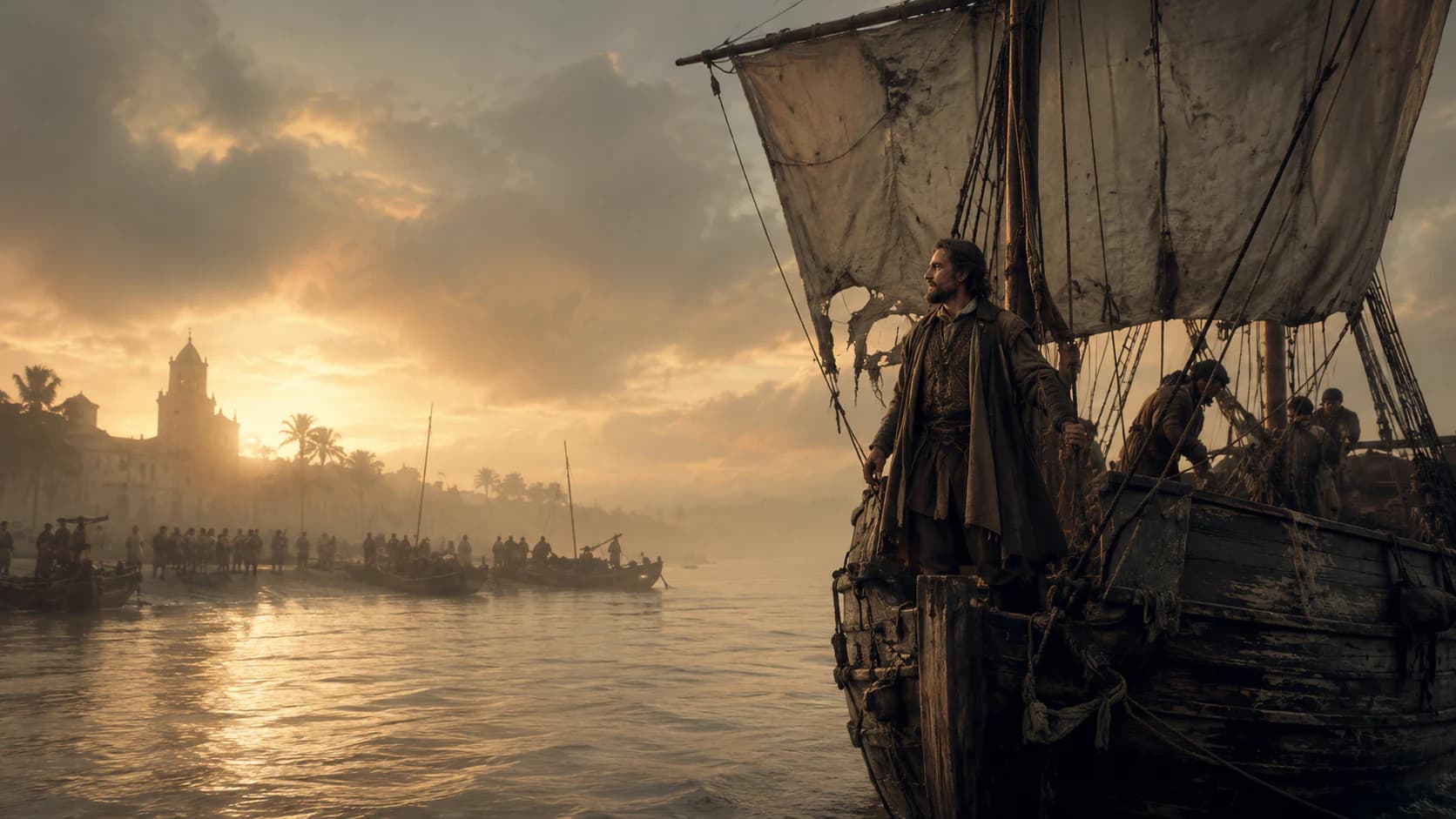
The Pacific crossing was the voyage's great revelation and its great ordeal. European mapmakers had badly underestimated the distance between the Americas and Asia. For more than three months, the remaining ships crossed open water with dwindling food, foul supplies, and men weakened by scurvy and hunger. Antonio Pigafetta's surviving account preserves the misery of the passage, but the larger meaning was geographical. The expedition exposed the enormous width of the Pacific and forced Europeans to rethink the size of the Earth in practical maritime terms. When the ships finally reached Guam and then the Philippines in 1521, they had crossed an ocean no European expedition had previously traversed. Magellan had not yet reached the Spice Islands, but he had already changed the map of human possibility.

1521

Battle of Mactan

In the Philippines, Magellan's role shifted from navigator to would-be power broker. He formed an alliance with the ruler of Cebu and tried to use military force and Christian conversion to extend Spanish influence among neighboring communities. On Mactan, he faced Lapulapu, a local leader who refused submission. Magellan's force was too small, the terrain and tide worked against him, and European weapons did not produce the easy dominance he expected. He was killed on 27 April 1521. The death complicates his biography. Magellan's achievement as a navigator was extraordinary, but his final decision shows the lethal arrogance that often accompanied European expansion. He survived oceanic uncertainty only to fall in a political conflict he did not understand well enough.

1522

Circumnavigation Legacy

After Magellan's death, the expedition nearly collapsed. Command passed through other hands, ships were abandoned or lost, and the survivors had to choose between capture, starvation, and the long road home. Juan Sebastian Elcano ultimately brought the Victoria back to Spain in September 1522 with only a small remnant of the original crew. That return completed the first circumnavigation of Earth. Magellan deserves credit for conceiving, commanding, and driving the expedition through its decisive breakthroughs: the South American strait and the Pacific crossing. Elcano deserves credit for finishing what Magellan could not. The legacy belongs to both achievement and cost. The voyage transformed European geography, strengthened imperial competition, and revealed the connectedness of the world's oceans. It also foreshadowed the violence, coercion, and cultural disruption that would follow expanding European maritime power.

Continue in context

Connected stories

Move from the profile into the wider events and settings this figure belongs to.

Tertiary paths

Content note

This profile is written for educational use and connects to related Stories of History pages. The main portrait is an AI-assisted historical reconstruction, included as an illustrative aid rather than documentary evidence. Image policy

References

Sources & Further Reading

Reliable reference works, archives and reading paths connected to this profile.

Further reading

  1. Encyclopaedia Britannica, Search results for Ferdinand Magellan,” accessed June 2026.Open source
  2. WorldCat, Books and library holdings for Ferdinand Magellan,” accessed June 2026.Open source

Primary sources

  1. Library of Congress, Search results for Ferdinand Magellan,” accessed June 2026.Open source

Reviewed claim sources

Loading reviewed claim sources...

A weekly route through history

Find out first about the latest published stories, feature notes and occasional Premium offers in one weekly email.