People

Eleanor of Aquitaine

Eleanor of Aquitaine was Duchess of Aquitaine, Queen of France, Queen of England and mother of Richard I and King John. Her marriages, lands, patronage, rebellion and regency made her one of the most powerful women of medieval Europe.

Born
1122 CE
Died
1204 CE
Role
Queen consort of both France and England

Queen consort of both France and England (1122–1204)

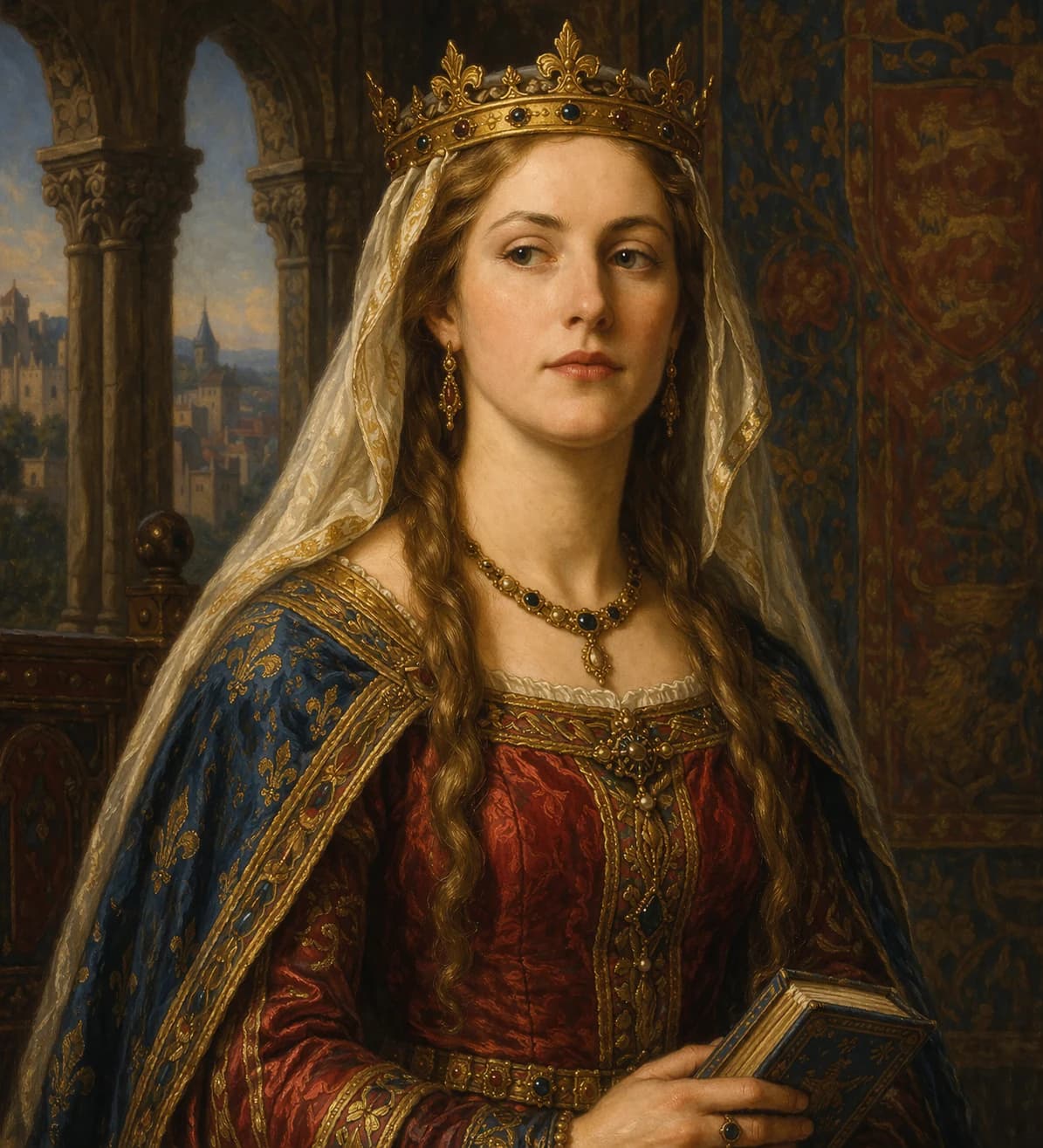
AI-generated portrait of Eleanor of Aquitaine in medieval royal attire
AI-assisted historical reconstruction

An illustrative reconstruction based on historical context. It is not a photograph or documentary likeness. Image policy

Quick answer

Eleanor of Aquitaine was Duchess of Aquitaine, Queen of France, Queen of England and mother of Richard I and King John. Her marriages, lands, patronage, rebellion and regency made her one of the most powerful women of medieval Europe.

Born
1122 CE
Died
1204 CE
Role
Queen consort of both France and England
Years
1122-1204 CE
Facts

Eleanor of Aquitaine timeline facts

Selected specifics from this profile's life story.

1122
Duchess at birth

Eleanor inherited Aquitaine as a teenager, making her duchess of one of western Europe's largest, wealthiest and most culturally influential territories.

1152
Marriage annulled

In 1152 her marriage to Louis was annulled on grounds of consanguinity, returning Aquitaine to Eleanor and reopening the politics of western Europe.

1173–1174
Family rebellion

In 1173 Eleanor supported her sons' rebellion against Henry II, a dynastic crisis that ended with her capture and years of confinement.

1204
Enduring legacy

Eleanor's final years included diplomacy for King John and the marriage politics of her grandchildren before her death at Fontevraud in 1204.

Life Journey

A life of power, resilience and dynastic influence

Follow the story in a more continuous narrative, with a reading mode that matches how much depth you want.

Complete chronology

1122

Duchess at birth

Eleanor was born around 1122 into the ruling house of Aquitaine, a duchy that stretched across much of southwestern France and possessed a courtly culture distinct from the more austere world of northern Capetian power. When her father, William X, died in 1137, Eleanor became his heir. That inheritance made her politically explosive. Aquitaine was not a small dowry attached to a marriage; it was a vast territorial bloc with its own nobles, customs, wealth and prestige. Whoever married Eleanor gained access to power that could alter the balance of France. Her life cannot be understood as a story of influence borrowed from husbands. From the beginning, she was the prize, the partner and the problem.
1137

Queen of France

Within months of inheriting Aquitaine, Eleanor married Louis, heir to the French throne, and soon became queen when Louis VI died. Politically the match looked brilliant: the Capetian monarchy gained connection to a huge southern duchy, while Eleanor received the highest royal title in France. In practice, the marriage was strained by culture, temperament and dynastic pressure. Louis VII was pious and often hesitant; Eleanor came from a world associated with aristocratic display, poetry and regional confidence. Most importantly, the marriage produced daughters but no surviving son. In a dynasty anxious about succession, that absence mattered. The union that had promised to strengthen France instead revealed how difficult it was to absorb Aquitaine into royal power.

1147–1149

Crusade experience

Eleanor's participation in the Second Crusade has attracted legend, some of it far more colorful than the evidence allows. She did travel east with Louis VII and a substantial Aquitainian retinue, and her presence made the expedition unusually visible as a royal and aristocratic enterprise. The crusade itself was a failure, marked by difficult logistics, military disaster and strained relations among western leaders and Byzantine and eastern Christian allies. At Antioch, where Eleanor's uncle Raymond ruled, tensions between Eleanor and Louis became politically dangerous. Rumors later embroidered the episode, including accusations about Eleanor's conduct that should be treated with caution. What is clear is that the crusade widened the fracture in the marriage and showed Eleanor operating on an international stage.

1152

Marriage annulled

The annulment of Eleanor's marriage to Louis VII was formally based on consanguinity, the fact that the couple were related within prohibited degrees. That reason was legally convenient; the deeper causes included incompatibility, political frustration and the lack of a male heir. The result was extraordinary. Eleanor recovered Aquitaine rather than disappearing into a convent or remaining trapped in a failed royal marriage. She was once again an heiress of immense value, and therefore in immediate danger of abduction or forced marriage. Her next move had to be swift. The annulment did not end her political importance. It restored it in concentrated form.

1152

Alliance with Henry

Eleanor married Henry Plantagenet in May 1152, only weeks after her annulment from Louis. The speed was astonishing and the consequences immense. Henry already held Normandy and Anjou and had a strong claim to the English throne. When he became Henry II of England in 1154, the combined Angevin world stretched from the Scottish border to the Pyrenees, though it was not an empire in the modern centralized sense. It was a bundle of lordships, duchies and kingdoms held together by inheritance, marriage, force and negotiation. Eleanor's Aquitaine was central to that structure. The marriage was politically dynamic and personally productive, producing eight children, but it also created a family system loaded with future conflict.

1154–1170s

Empire builder

Eleanor's power under Henry II was real but uneven. She issued charters, appeared in government contexts, supported religious houses and remained the essential link to Aquitaine. Her court has long been associated with troubadour culture, courtly love and literary patronage, though historians rightly distinguish between later romantic myth and documentable influence. What can be said is that Eleanor belonged to a world where aristocratic culture mattered politically. Patronage, marriage alliances, ceremonial presence and household networks all helped hold territory together. In Aquitaine especially, her authority was not ornamental. The duchy had to be managed through local loyalties, and Eleanor's identity as hereditary duchess gave Angevin rule a legitimacy Henry alone could not supply.

1173–1174

Family rebellion

The rebellion of 1173-1174 exposed the Angevin family's central weakness: Henry II gathered territories and sons, but he struggled to share meaningful authority. The Young King Henry, Richard, Geoffrey and their allies rebelled against him, supported by foreign powers and discontented nobles. Eleanor's backing of her sons was a decisive personal and political breach. Her motives remain debated: defense of Aquitainian autonomy, anger at Henry's dominance, maternal strategy, or some combination of all three. The revolt failed. Eleanor was captured while trying to reach her sons and spent much of the next fifteen years under varying degrees of confinement. Imprisonment did not erase her significance. It proved Henry feared what her name and networks could still do.

1189

Return to power

Henry II's death transformed Eleanor's position. Richard I released his mother immediately and relied on her authority as he prepared for the Third Crusade. Eleanor helped secure loyalty across England and the continental lands, acted with regnal authority in his absence and later worked to raise the enormous ransom required after Richard was captured on his return from crusade. She was already in her late sixties, but her political energy was remarkable. Her authority rested on age, lineage, experience and motherhood to the king. In a dynasty famous for male violence and rivalry, Eleanor became one of its most effective stabilizers.

1204

Enduring legacy

Eleanor outlived Henry II and all but two of her children. After Richard's death in 1199, she supported John, whose shaky rule needed every source of legitimacy it could find. Even in old age she crossed the Pyrenees to help arrange the marriage of her granddaughter Blanche of Castile to the future Louis VIII of France, a match that would shape Capetian history. Eleanor died in 1204 at Fontevraud Abbey, the burial place of the Angevin dynasty. Her legacy is unusually wide: queen of two kingdoms, duchess in her own right, mother of kings, patron, rebel, prisoner, regent and diplomat. Some legends around her are exaggerated, but the documented life is extraordinary enough. She mattered because she repeatedly returned to power after systems designed to contain her had failed.

Continue in context

Connected stories

Move from the profile into the wider events and settings this figure belongs to.

Tertiary paths

Content note

This profile is written for educational use and connects to related Stories of History pages. The main portrait is an AI-assisted historical reconstruction, included as an illustrative aid rather than documentary evidence. Image policy

References

Sources & Further Reading

Reliable reference works, archives and reading paths connected to this profile.

Further reading

  1. Encyclopaedia Britannica, Search results for Eleanor of Aquitaine,” accessed June 2026.Open source
  2. WorldCat, Books and library holdings for Eleanor of Aquitaine,” accessed June 2026.Open source

Primary sources

  1. Library of Congress, Search results for Eleanor of Aquitaine,” accessed June 2026.Open source

Reviewed claim sources

Loading reviewed claim sources...

A weekly route through history

Find out first about the latest published stories, feature notes and occasional Premium offers in one weekly email.