Complete chronology
Full overview and deeper context for every journey step.
1405
Born into a shrinking empire
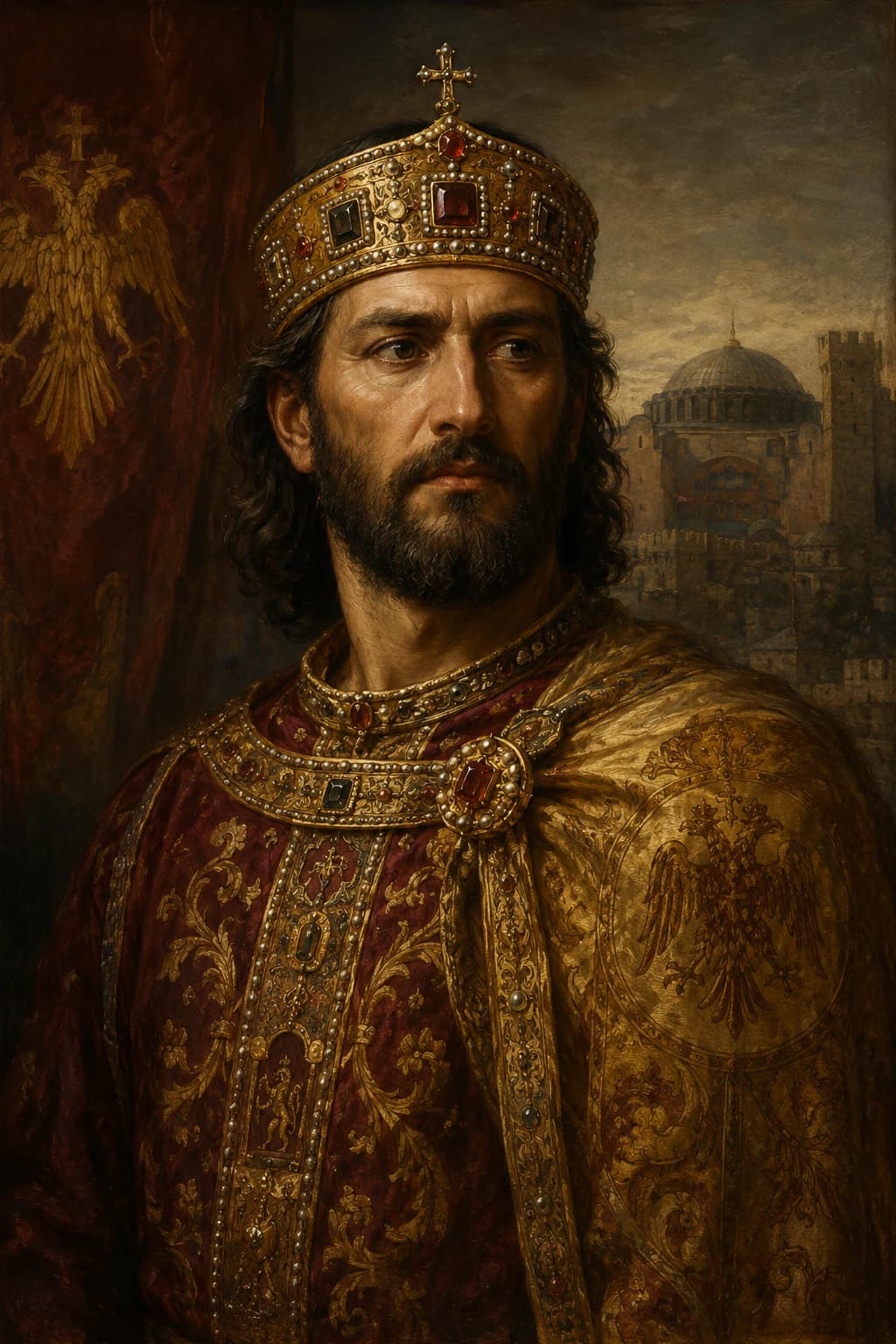
Constantine XI Palaiologos was born in Constantinople in the early fifteenth century, usually dated in this project to 1405, into the ruling Palaiologos dynasty. He was a son of Emperor Manuel II Palaiologos and Helena Dragas, whose Serbian family name helped give Constantine the additional name Dragases. By then the Byzantine Empire was not the Mediterranean superpower it had once been. Its authority was reduced to Constantinople, parts of the Peloponnese, and scattered possessions held together by diplomacy, family politics, and the memory of Roman imperial legitimacy.
That inheritance shaped Constantine's biography. He grew up in a court that still spoke the language of empire while living with the realities of dependence. The Ottomans surrounded Byzantine territory on land. Italian maritime powers shaped trade and naval politics. Western aid was possible but uncertain, and often entangled with the bitter question of church union between Orthodox and Catholic Christians. To understand who Constantine XI was is to understand this tension: he was not the ruler of a strong empire entering a temporary crisis, but a prince trained to preserve dignity, territory, and faith in an imperial system already close to exhaustion.
His life began inside a dynasty whose title remained grander than its resources.
1420s-1440s
Prince in the Morea
Constantine's political education came largely in the Morea, the Byzantine Despotate in the Peloponnese. This region mattered because it was one of the few places where Byzantine power could still do more than survive. As despot, Constantine worked within a family system in which brothers and relatives shared authority, competed for influence, and relied on marriage alliances, local elites, fortified towns, and outside patrons. The Morea was not a peaceful refuge. It sat between Latin, Greek, Albanian, Venetian, and Ottoman interests, and its rulers had to be soldiers as much as administrators.
Constantine gained a reputation for energy there. He strengthened Byzantine positions, pushed into parts of central Greece, and associated his rule with the Hexamilion wall across the Isthmus of Corinth, an old defensive line intended to shield the Peloponnese from northern invasion. These efforts showed ambition, but they also revealed the limits of late Byzantine strategy. When Ottoman power pressed hard after the Christian defeat at Varna in 1444, Byzantine advances could not be secured for long. Constantine learned that courage and local success could delay Ottoman pressure, not remove it.
The Morea gave him experience in command, but also taught him how narrow Byzantine room for manoeuvre had become.
1449
An emperor without abundance
Constantine became emperor in 1449 after the death of John VIII Palaiologos. His accession was unusual in tone because there was little room left for imperial magnificence. He was proclaimed in the Morea and then travelled to Constantinople, where the imperial capital remained symbolically immense but materially vulnerable. Its walls were still famous, its churches still carried centuries of memory, and its name still mattered across Europe and the eastern Mediterranean. Yet the city was underpopulated, financially strained, and increasingly isolated inside Ottoman power.
His reign therefore began as an exercise in emergency management. Constantine had to maintain authority within the city, negotiate with Italian communities, seek military aid from the West, and manage religious division among his own subjects. The Council of Florence had promised union between the Greek and Latin churches, but many Orthodox believers rejected it as surrender to Rome. Constantine accepted union in the hope that it might unlock help from Catholic powers, but the policy carried domestic cost. His office demanded impossible balancing: save the city with Western assistance without appearing to trade away the soul of Byzantine Christianity.
His crown gave him legitimacy, but not the army, money, or unity that legitimacy required.
1451-1452
Facing Mehmed II
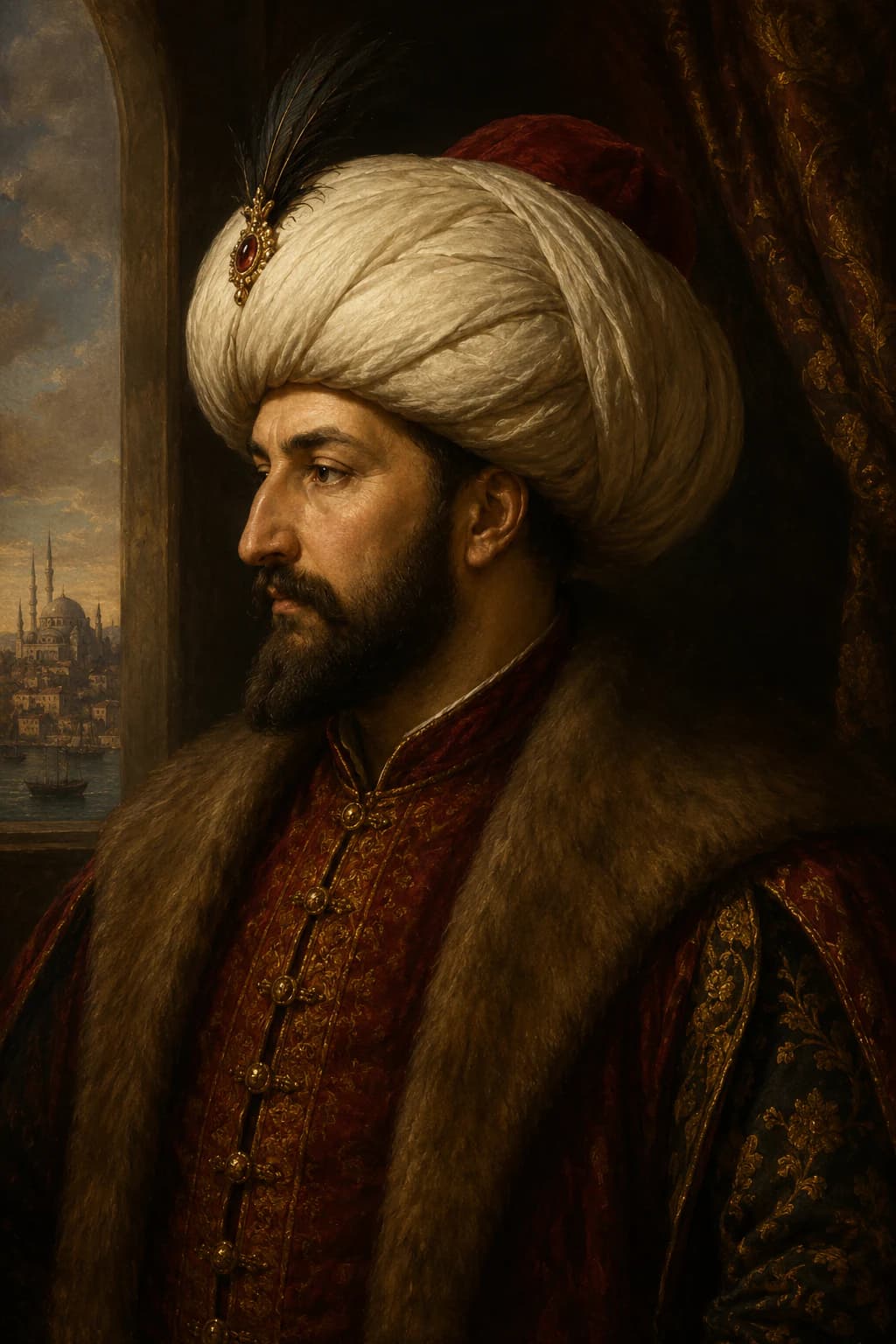
When Mehmed II returned to the Ottoman throne in 1451, Constantinople's danger became immediate. Earlier Ottoman rulers had threatened the city, but Mehmed treated its conquest as a defining imperial project. Constantinople blocked full Ottoman control of the Bosporus, carried unmatched prestige, and offered a capital from which the sultan could claim a wider Roman and Islamic destiny. Constantine XI understood the scale of the threat, but he could not match Mehmed's resources.
Mehmed's construction of Rumeli Hisari on the European side of the Bosporus in 1452 tightened control over the straits and signalled that the siege was not a rumour. Constantine protested and negotiated, but protest could not reverse facts on the ground. His hope rested on fortifications, resolve, and outside help. Some aid came, including Genoese soldiers under Giovanni Giustiniani and smaller bodies of foreign volunteers, but the great crusading rescue Byzantium needed did not arrive. Constantine's strategic position was brutally clear: he had to defend one of history's strongest cities with too few men against a ruler who had prepared to make its fall the foundation of his fame.
The coming siege was a contest between Constantinople's ancient walls and a new Ottoman imperial will.
April 1453
The siege begins
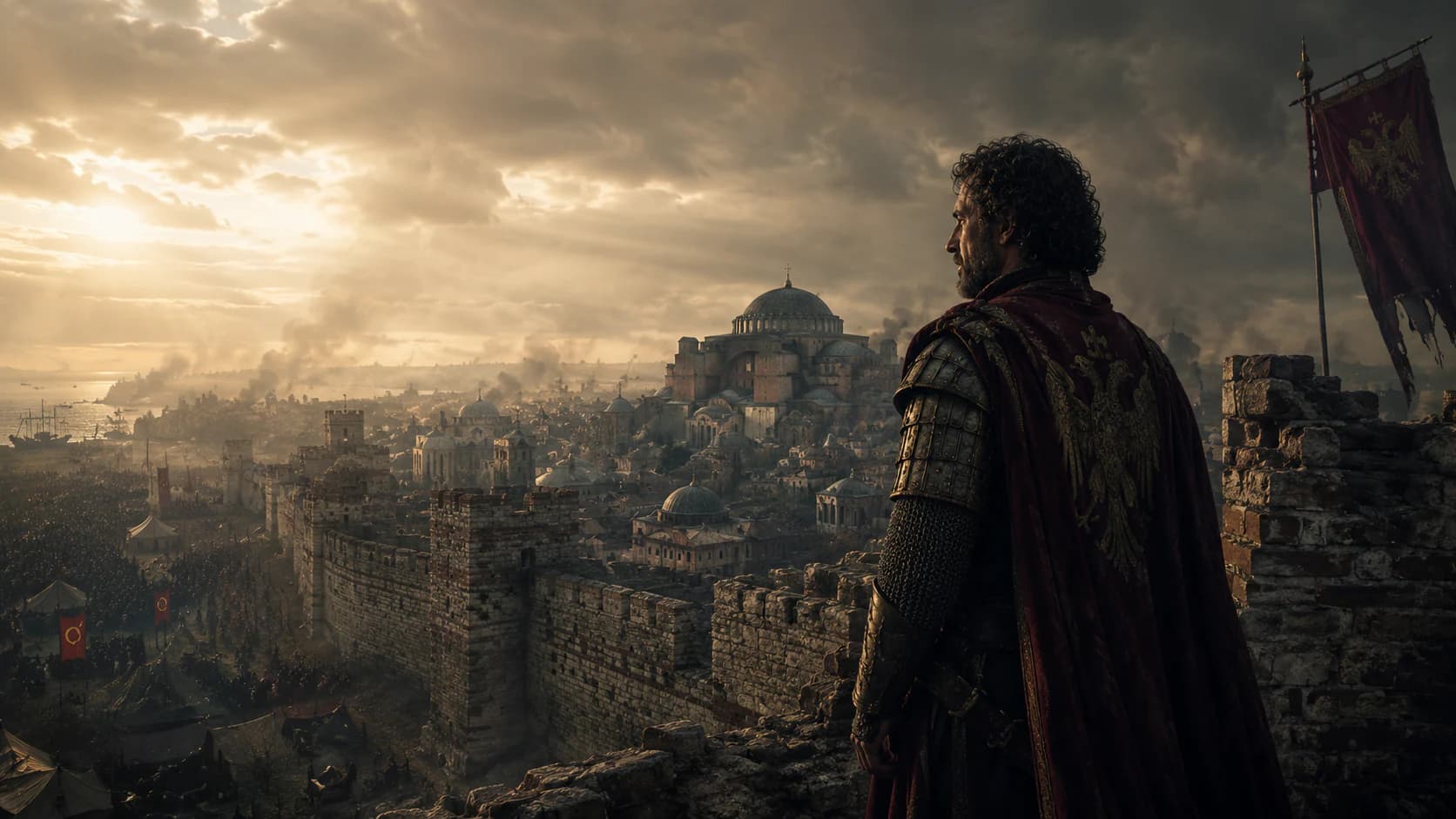
The final siege began in April 1453. Mehmed II brought a large army, naval forces, engineers, and heavy artillery, including massive cannon that battered the Theodosian land walls. Constantine's defenders were far fewer, but they had advantages: the walls, the Golden Horn's chain, defensive experience, and the moral power of fighting for a city that had survived Arab, Bulgar, Rus, and earlier Ottoman pressure. The defense was an international coalition in miniature. Greeks, Genoese, Venetians, Catalans, and others fought within a city whose politics had often been divided by those same outside powers.
Constantine's importance during the siege was not technical command alone. He represented the continuity of the city. He encouraged defenders, worked with Giustiniani at the vulnerable land walls, and tried to hold together factions that could not afford mistrust. The siege became a slow test of endurance. Artillery damaged walls that had once seemed almost invincible. Ottoman assaults probed weaknesses. Supplies and morale tightened. Each repair made at night showed discipline; each new breach showed that time favoured Mehmed. Constantine could not win by destroying the Ottoman army. His only path was survival long enough for relief or Ottoman exhaustion, and neither came.
Constantine's defense depended on endurance, improvisation, and the hope that time might still become an ally.
29 May 1453
The final assault
The decisive assault came before dawn on 29 May 1453 after weeks of bombardment, attrition, and failed negotiations. Ottoman forces attacked in waves, exhausting defenders and pressing the damaged sections of the land walls. Giovanni Giustiniani, whose leadership had been vital at the most threatened point, was badly wounded and withdrawn from the line. His departure damaged morale at a critical moment, though it did not by itself explain the city's fall. The defense was already stretched to breaking point.
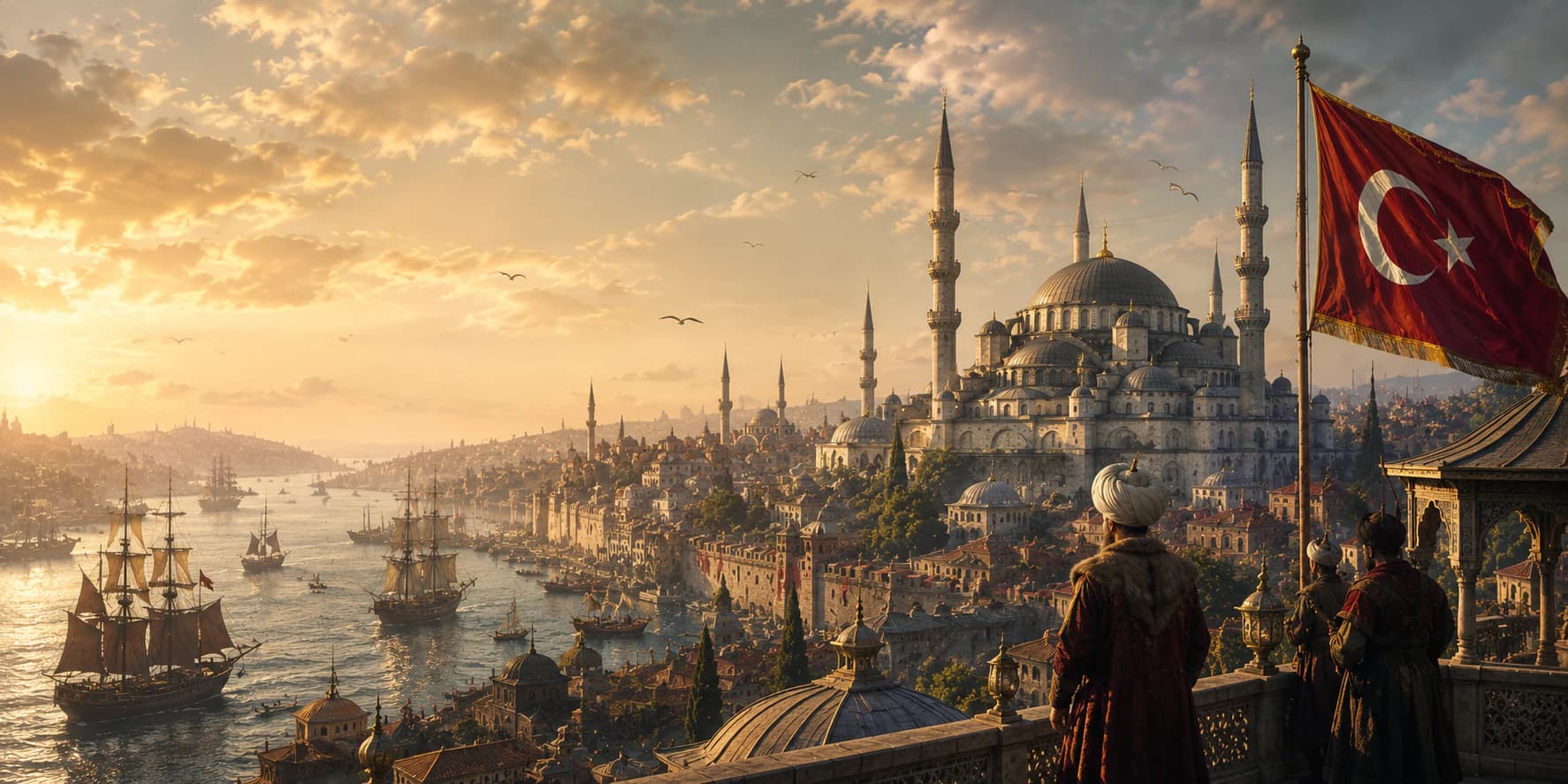
Constantine XI's last moments are famous precisely because they are uncertain. Later accounts say he cast off imperial insignia and fought among his men; no secure final speech or identified body survives. What can be said with confidence is that he died or vanished during the Ottoman breakthrough, and that his death coincided with the end of Byzantine sovereignty. The fall of Constantinople was not simply the capture of a city. It ended the last political remnant of the eastern Roman Empire and allowed Mehmed II to make the city his Ottoman capital. Constantine's body disappeared into battle, but his role became inseparable from the last defense of Byzantium.
His unclear death made him less a conventional fallen monarch than the human symbol of an empire's ending.
After 1453
Memory and legend
Constantine XI's legacy grew from history into memory. In political terms, he lost: his reign ended with conquest, and no Byzantine restoration followed. Yet historical significance is not measured only by victory. He became important because he embodied the final stand of a civilisation that had preserved Roman statecraft, Greek learning, Orthodox Christianity, and imperial ceremony for more than a thousand years after the western Roman Empire had fallen.
Later Greek tradition transformed him into the Marble Emperor, a legendary ruler hidden in stone who would one day return. That legend should not be treated as evidence for his death; it is evidence for what his death meant. Communities living under Ottoman rule, and later national movements seeking continuity with Byzantium, found in Constantine a language of endurance, loss, and hope. Modern historians are more cautious. They do not need to imagine him as flawless or militarily brilliant to recognise his importance. Constantine XI mattered because he faced a crisis he could not realistically master, yet chose to remain with his city. His biography answers the question of why he is remembered: he was the last Byzantine emperor, and his final defense turned political collapse into one of history's most enduring stories of imperial twilight.
His legacy belongs as much to memory and identity as to the military history of 1453.