People

Charles de Gaulle

Charles de Gaulle was the French general and statesman who refused to accept defeat in 1940, led Free France from exile, returned at liberation, and later founded the Fifth Republic. His career made him a symbol of French sovereignty, wartime resistance, presidential authority and an independent foreign policy.

Born
1890 CE
Died
1970 CE
Role
French general and statesman

French general and statesman (1890–1970)

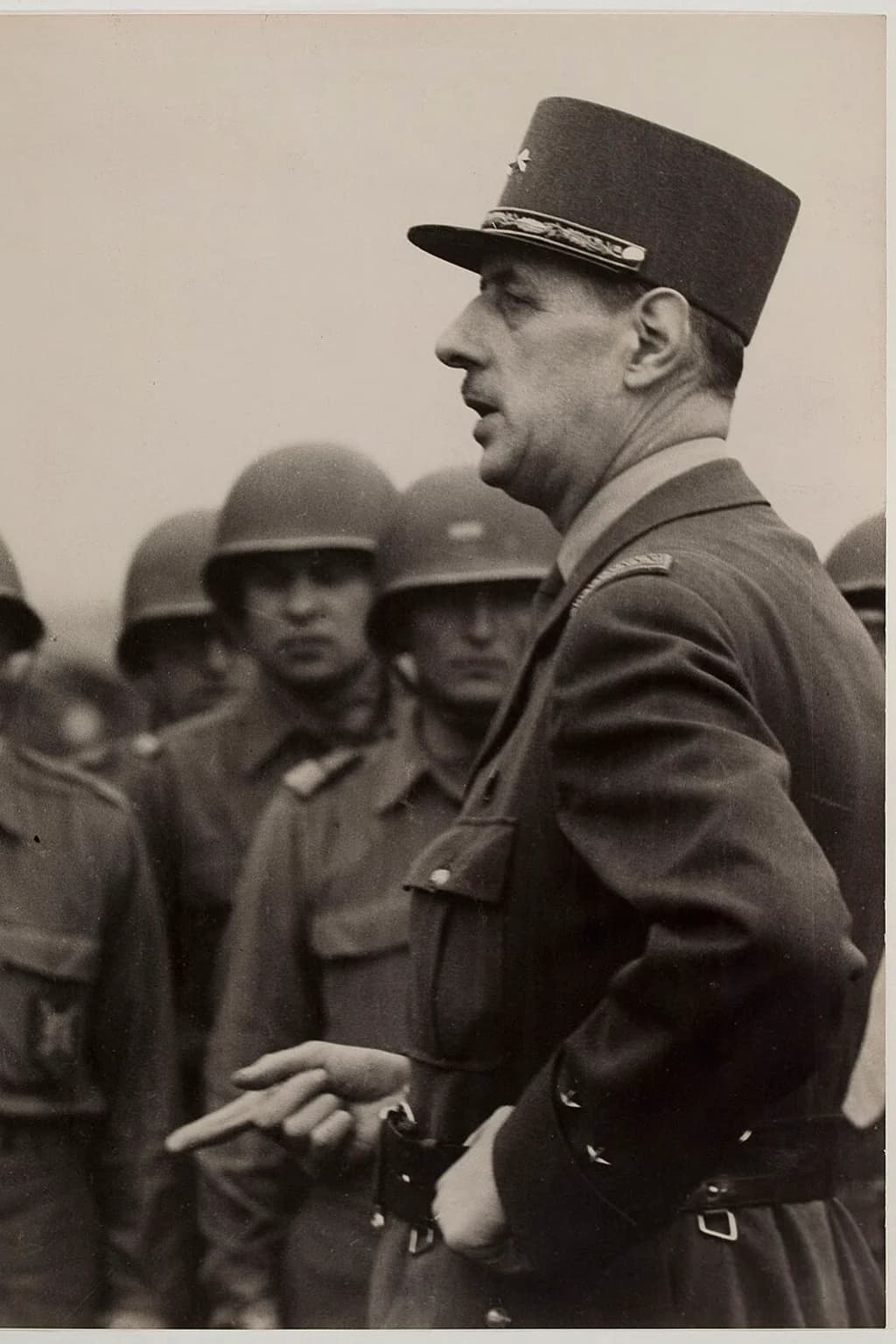
Portrait photograph of Charles de Gaulle
Historical photograph

A real historical or editorial image is used here. Source, licence and transformation details are publicly recorded. Image policy Attribution

Quick answer

Charles de Gaulle was the French general and statesman who refused to accept defeat in 1940, led Free France from exile, returned at liberation, and later founded the Fifth Republic. His career made him a symbol of French sovereignty, wartime resistance, presidential authority and an independent foreign policy.

Born
1890 CE
Died
1970 CE
Role
French general and statesman
Years
1890-1970 CE
Facts

Charles de Gaulle timeline facts

Selected specifics from this profile's life story.

1890
Intellectual upbringing

Charles de Gaulle was born in Lille in 1890 into a Catholic, patriotic family whose historical imagination shaped his belief in France as a nation with a special destiny.

1940
Refusal to surrender

After France's collapse in June 1940, de Gaulle flew to London and broadcast his appeal to continue the war rather than accept the Vichy armistice.

1958
Founding new system

The Algerian crisis brought de Gaulle back in 1958, and he used the emergency to create the Fifth Republic with a powerful presidency.

After 1970
Lasting influence

De Gaulle resigned in 1969 after losing a referendum and died the following year, leaving France with a political system and national myth still shaped by his presence.

Life Journey

Defiance, leadership and national renewal

Follow the story in a more continuous narrative, with a reading mode that matches how much depth you want.

Complete chronology

1890

Intellectual upbringing

Charles de Gaulle was born in Lille on 22 November 1890 and raised in a family where France was not an abstraction but a moral inheritance. His father, Henri, was a teacher with strong historical interests; the household combined Catholic faith, intellectual discipline and patriotic memory, including the wound left by defeat in the Franco-Prussian War. De Gaulle absorbed an unusually literary idea of nationhood. France, to him, was not merely a government or territory but a continuing historical personality that could suffer humiliation and still recover grandeur. This early formation matters because it explains both the force and the limits of his later politics. He could be lonely, severe and theatrical because he believed leadership required speaking for something larger than ordinary party interest. Long before he possessed power, he had built an inner France to serve.
1910s

Military formation

De Gaulle entered the military academy at Saint-Cyr and served under Philippe Petain before the First World War made modern conflict inescapable. He fought at Dinant and Verdun, was wounded several times, and in 1916 was captured by the Germans after being left for dead. Captivity frustrated him deeply. He attempted escape repeatedly, but spent the remainder of the war as a prisoner. The experience sharpened rather than softened him. He admired discipline and courage, but he also saw how industrial warfare punished rigid thinking. The French army's victory in 1918 confirmed the importance of endurance, yet de Gaulle drew a different lesson from many senior officers. He became convinced that future war would reward mobility, armour, communication and command initiative, not simply fortified patience. That conviction later put him at odds with the institution he served.

1920s–1930s

Challenging orthodoxy

In the 1920s and 1930s de Gaulle became a soldier-writer, publishing works that argued for command authority, mechanised warfare and a professional armoured force able to strike quickly. His ideas were not identical to German blitzkrieg doctrine, but they pushed against the French army's reliance on mass mobilisation and defensive planning symbolised by the Maginot Line. Senior commanders did not wholly ignore tanks, but they tended to disperse them in support of infantry rather than concentrate them for operational shock. De Gaulle's writings made him noticed, irritating and useful in unequal measure. He was too junior to dictate policy, too insistent to disappear, and too convinced of his own judgement to become a comfortable staff officer. By 1940 he had a reputation as an original mind, but not yet the authority to make France listen.

1940

Refusal to surrender

Germany's offensive in May 1940 destroyed the assumptions on which French strategy had rested. De Gaulle briefly commanded an armoured division and was then appointed under-secretary for war in Paul Reynaud's collapsing government. When Marshal Petain moved toward an armistice, de Gaulle chose exile over obedience. On 18 June 1940, speaking on the BBC from London, he called on French soldiers, engineers and workers to continue the fight. The broadcast was heard by fewer people at the time than legend later suggested, and the text most often remembered is not a perfect recording of mass national awakening. Its significance lies elsewhere. A relatively unknown brigadier general, with almost no army and no recognised state, asserted that France had not ceased to exist because a government had surrendered. That was a political act of extraordinary audacity.

1940–1944

Leading Free France

Leading Free France required more than courage on the radio. De Gaulle had to gather colonial territories, military units, intelligence networks and political legitimacy into something that could plausibly claim to represent the French nation. The task was made harder by Allied suspicion. Winston Churchill valued de Gaulle but often found him exasperating; Franklin Roosevelt distrusted him and preferred alternatives who seemed easier to manage. De Gaulle's difficult manner was partly personality and partly strategy. He feared that if Free France behaved like a dependency, France would be treated after liberation as a rescued territory rather than an Allied power. The internal French picture was equally complex: communists, Gaullists, socialists, conservatives, colonial officials and armed resistance groups all had to be brought into a common framework. Jean Moulin's work in unifying the Resistance under de Gaulle's authority was crucial. By 1944, Free France had become not simply a movement of defiance, but a provisional state waiting to return.

1944

Liberation and return

The liberation of Paris in August 1944 gave de Gaulle the stage on which his claim became visible. His march down the Champs-Elysees was not merely ceremonial. It asserted that France had liberated itself in partnership with the Allies and that republican authority, not Vichy collaboration or Allied occupation government, would fill the vacuum. This was selective memory, but politically powerful. De Gaulle led the Provisional Government, restored state institutions, extended voting rights to women, nationalised key sectors and sought to punish collaboration without letting revenge dissolve public order. He also faced parties and resistance movements that wanted a more parliamentary, social or revolutionary settlement than he preferred. In January 1946, frustrated by the emerging Fourth Republic's party-dominated system, he resigned. The wartime saviour stepped aside rather than preside over institutions he believed would weaken the state.

1958

Founding new system

The Fourth Republic suffered from short-lived governments, colonial wars and an inability to resolve Algeria, which France treated legally as part of the republic rather than a distant colony. In May 1958, unrest among settlers and soldiers in Algiers raised the possibility of military intervention in metropolitan politics. De Gaulle returned as the one figure many believed could command both the army and the state. He insisted on constitutional change. The Fifth Republic, approved in 1958, created a stronger executive and a presidency designed to stand above party fragmentation. His return was legal, but it occurred under pressure intense enough that critics saw it as a constitutional rescue with a shadow of coercion. Once in power, he made the central decision that many of his supporters in Algeria had not expected: he moved toward Algerian self-determination. The Evian Accords of 1962 ended the war and recognised Algerian independence, at enormous human and political cost.

1959–1969

Presidential leadership

De Gaulle's presidency combined institutional stability with a highly personal style of rule. France modernised rapidly during the postwar boom, developed its own nuclear deterrent, and pursued what he called a policy of national independence. He withdrew France from NATO's integrated military command in 1966, recognised the People's Republic of China in 1964, resisted British entry into the European Economic Community, and tried to position France as neither subordinate to Washington nor sympathetic to Moscow. At home, the presidency was plebiscitary and theatrical: de Gaulle spoke over parties to the people through referendums, press conferences and carefully staged appearances. The system brought authority, but also brittleness. In May 1968, student protest and mass strikes exposed a society younger, more impatient and less deferential than the France of 1940 or 1958. De Gaulle survived the immediate crisis and won a parliamentary victory, but the spell had weakened.

After 1970

Lasting influence

In 1969 de Gaulle tied a referendum on regional and Senate reform to his own authority. When voters rejected it, he resigned at once. He died in Colombey-les-Deux-Eglises on 9 November 1970, having refused the normal trappings of a state funeral. His legacy remains unusually large because it is institutional, diplomatic and symbolic at the same time. The Fifth Republic still bears his imprint: a strong presidency, direct appeal to the electorate and suspicion of parliamentary drift. Gaullism also became a language of sovereignty, national independence and state authority that later French leaders could adapt even when they disagreed with him. Yet de Gaulle was not simply a democratic saint or nationalist monument. He could be imperious, dismissive of parties, slow to grasp social change and willing to bend memory into political myth. His achievement was to make defeated, occupied and divided France act again as though it had agency. That act of will changed the twentieth-century French state.

Continue in context

Connected stories

Move from the profile into the wider events and settings this figure belongs to.

Tertiary paths

Content note

This profile is written for educational use and connects to related Stories of History pages. The main portrait uses a real historical or editorial image, with source and licence details recorded for attribution review. Image policy Image attribution

References

Sources & Further Reading

Reliable reference works, archives and reading paths connected to this profile.

Further reading

  1. Encyclopaedia Britannica, Search results for Charles de Gaulle,” accessed June 2026.Open source
  2. WorldCat, Books and library holdings for Charles de Gaulle,” accessed June 2026.Open source

Primary sources

  1. Library of Congress, Search results for Charles de Gaulle,” accessed June 2026.Open source

Reviewed claim sources

Loading reviewed claim sources...

A weekly route through history

Find out first about the latest published stories, feature notes and occasional Premium offers in one weekly email.
