Related Moment
When the World Came Home
The ship was small. Its accomplishment was enormous.
In September 1522, the battered Victoria returned to Spain and completed the first recorded circumnavigation of Earth.
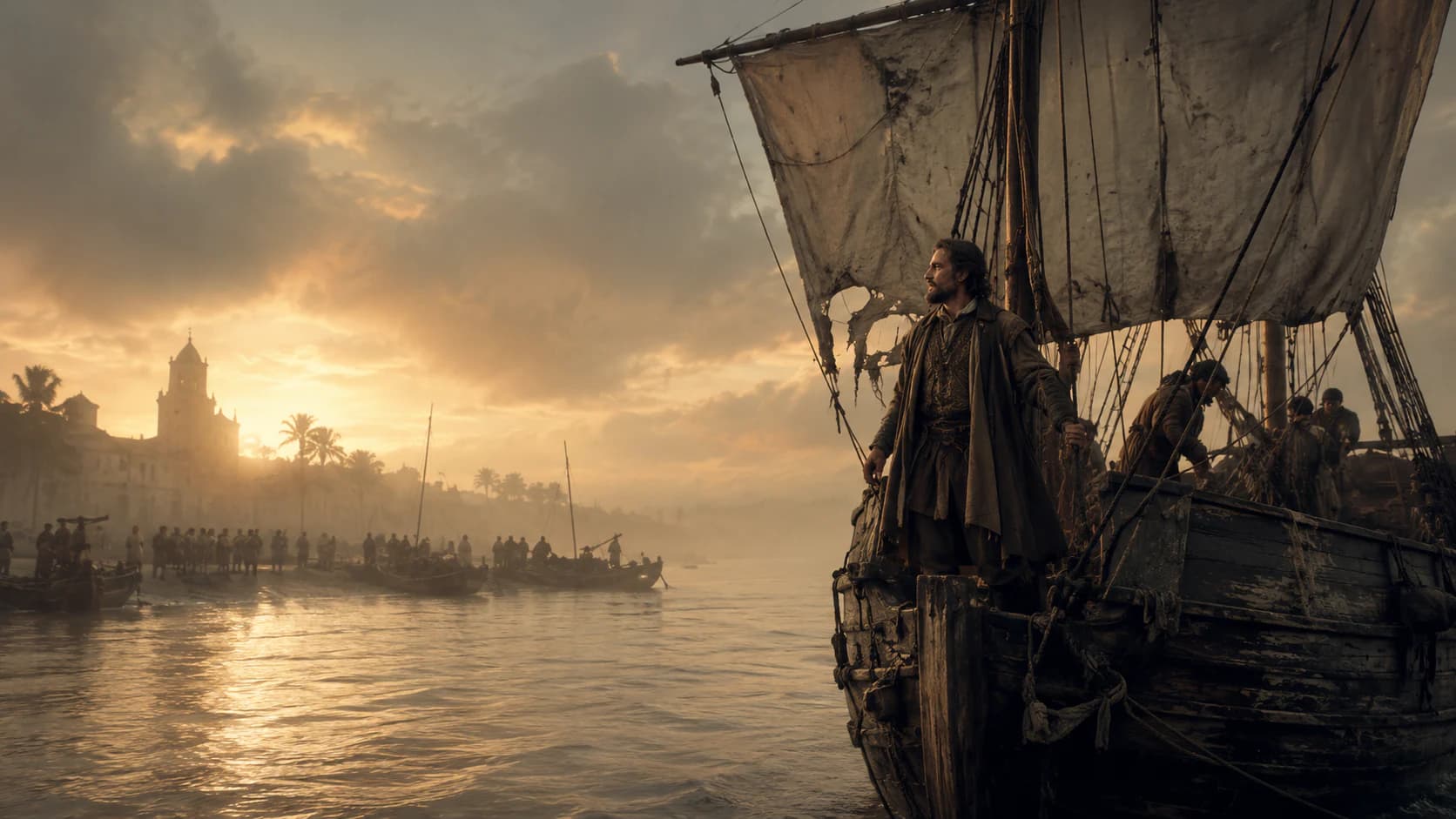
The ship looked less like a triumph than a survivor. Its sails hung in tatters. Its hull creaked from years of punishment. The men aboard were gaunt, sunburned, and barely recognizable as the sailors who had left Spain almost three years earlier.
As drifted into Spanish waters in September 1522, few could have guessed what it had accomplished. Behind that battered vessel lay an entire world.
Three years earlier, five ships had sailed from Spain under . Their mission was simple in theory and nearly impossible in practice: find a western route to the rich of Southeast Asia.
Europe's appetite for cloves, nutmeg, and other spices was enormous. Portugal had established eastern routes around Africa. Spain wanted another way, and the expedition left in 1519 with roughly 270 men aboard five ships.
The fleet endured mutiny in Patagonia. One ship was wrecked. Another deserted and returned home. After months of searching, the expedition discovered the narrow passage now known as the Strait of and entered an ocean so vast that no European had yet crossed it from east to west.
Then came starvation. Sailors ate whatever they could find. Disease spread. Men died. In the Philippines, was killed during a conflict on Mactan Island, leaving the surviving crews stranded on the far side of the world.
What began as an expedition for spices had become a desperate struggle simply to get home.
By late 1521, only a handful of ships remained. , commanded by , loaded its hold with valuable spices in the and prepared for the return journey. Trinidad was too damaged to accompany it. The ships separated. Victoria sailed alone.
Instead of retracing the outward route, pushed west across the Indian Ocean through waters patrolled by Portugal, Spain's rival in the spice trade. Capture could mean imprisonment or worse.
The ship crossed enormous distances with dwindling food supplies. Storms battered the vessel. Men weakened from hunger. By the time rounded the Cape of Good Hope, many aboard were close to collapse, and some died before Spain was even in sight.
Months later, after sailing around Africa and across the Atlantic, the exhausted crew finally sighted Spain. On 6 September 1522, reached . Two days later it arrived at , the city from which the expedition had originally departed.
The voyage had begun with five ships and hundreds of men. It ended with one vessel and eighteen European survivors.
The hold of was filled with spices valuable enough to offset much of the expedition's cost. More importantly, the voyage had produced knowledge no treasure could match.
The crew had crossed oceans previously unknown to Europeans, charted routes that would influence future navigation, and demonstrated in practical terms that a ship could sail continuously around the globe and return to its starting point.
Even a strange detail reinforced the magnitude of what they had done: the sailors discovered that their records were one day behind those kept in Spain, a consequence of circumnavigating the Earth that would later matter to global timekeeping.
did not live to see the victory. Many of the expedition's sailors never returned. But when the battered reached Spain, it carried proof that the oceans were no longer separate frontiers, but parts of a single world.