Related Moment
The Morning Humanity Left the Ground
Twelve seconds. One hundred and twenty feet. The age of wings had begun.
On a cold December morning in 1903, Orville and Wilbur Wright proved that a powered machine could fly under human control.
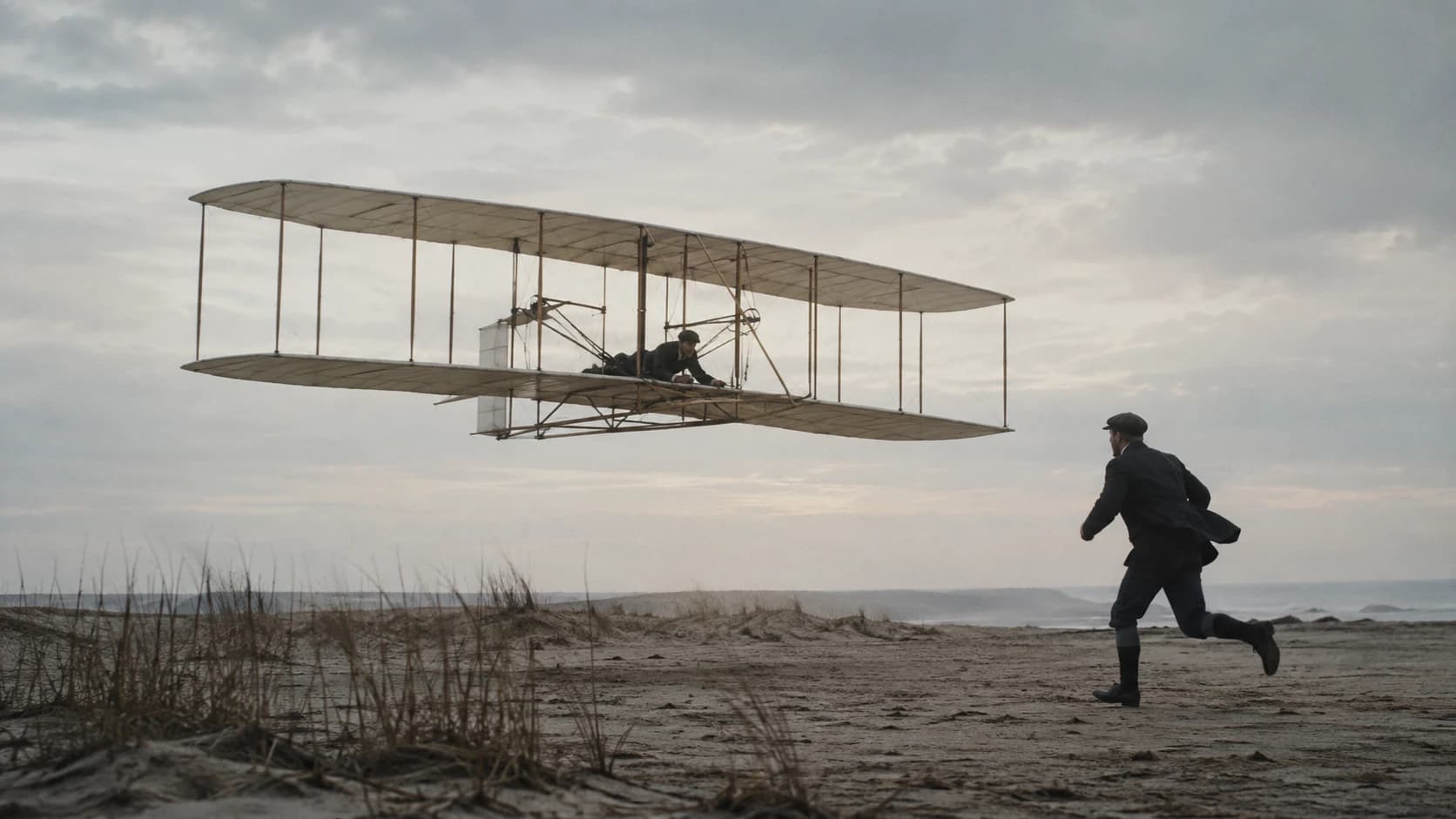
The wind was so cold it cut through coats. On the sand near , a strange wooden machine faced the gale: muslin wings, bicycle chains, a homemade engine, and two brothers who had spent years being doubted.
At 10:35 a.m., lay flat across the lower wing. steadied the tip. Then the machine began to move.
The place was not chosen for glory. , North Carolina, was remote, windy, sandy, and forgiving to crash into. and were not professors or military engineers. They were bicycle makers from Dayton, Ohio.
Bicycles had taught them something vital: balance mattered more than brute force. Other inventors chased bigger engines. The Wrights chased control. Through gliders, wind-tunnel tests, and relentless failure, they learned how a pilot might guide a machine through air rather than merely be carried by it.
The ran along its wooden rail. For a moment, it seemed less like triumph than accident. The machine pitched upward, dipped, corrected, lurched again. fought it with both hands and instinct.
Then it was airborne. Not high. Not graceful. Not long. Twelve seconds. One hundred and twenty feet. But for those twelve seconds, a powered, heavier-than-air machine flew under human control.
Three more flights followed that day. The last, with at the controls, lasted 59 seconds and covered 852 feet. Then a gust caught the on the ground and wrecked it. The first airplane had flown its final flight.
There was no roaring crowd. No instant celebration. The news was confused, distorted, and in some places ignored. That almost fits the moment. History did not arrive like thunder. It arrived as a fragile craft skipping over sand, watched by a handful of men in winter coats.
The brothers sent word home. They had done it. Not imagined flight. Not floated. Not fallen slowly. Flown.
The first flight was short enough to fit inside a city block. Its shadow reached around the world.