Complete chronology
Full overview and deeper context for every journey step.
1871
Dayton beginnings
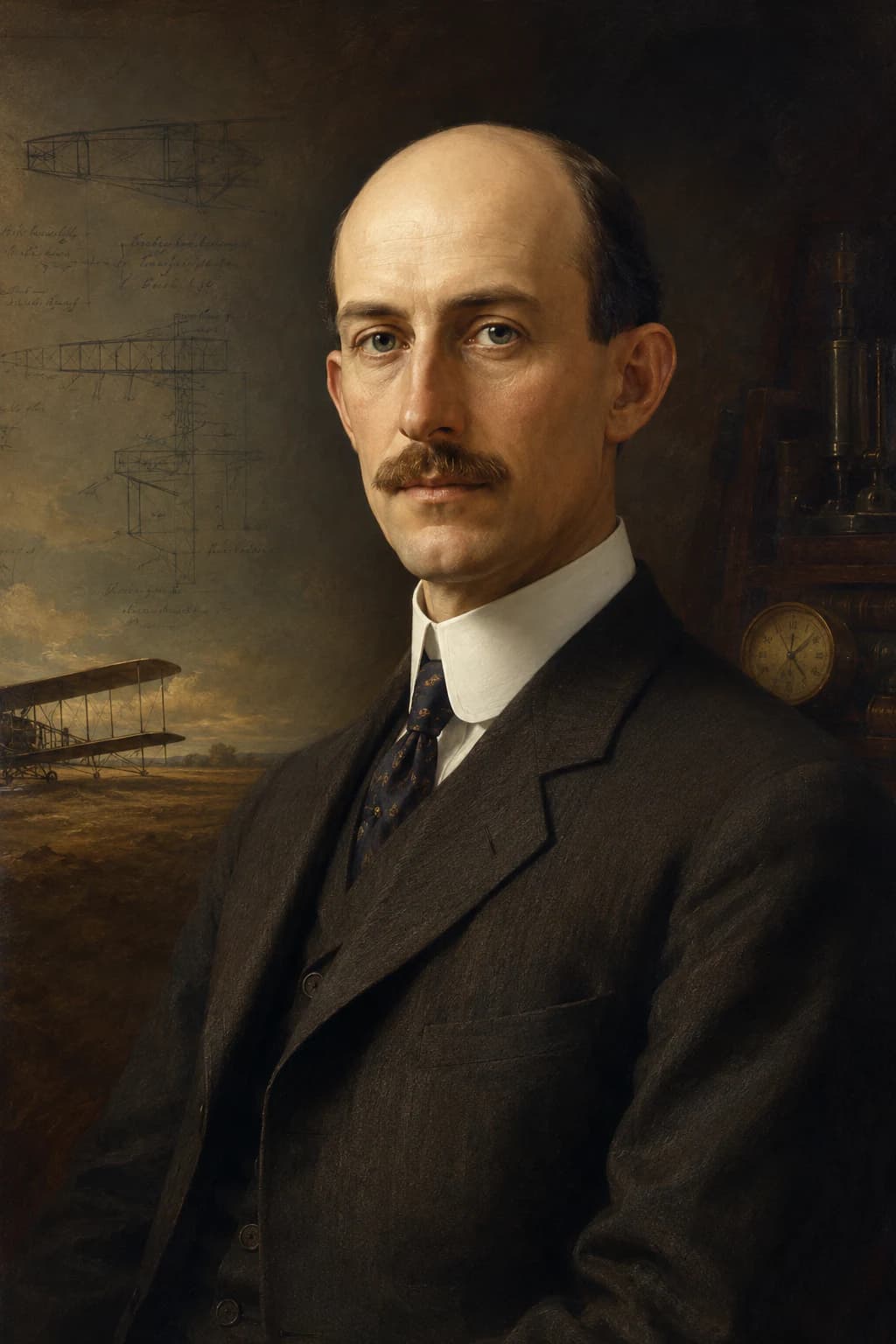
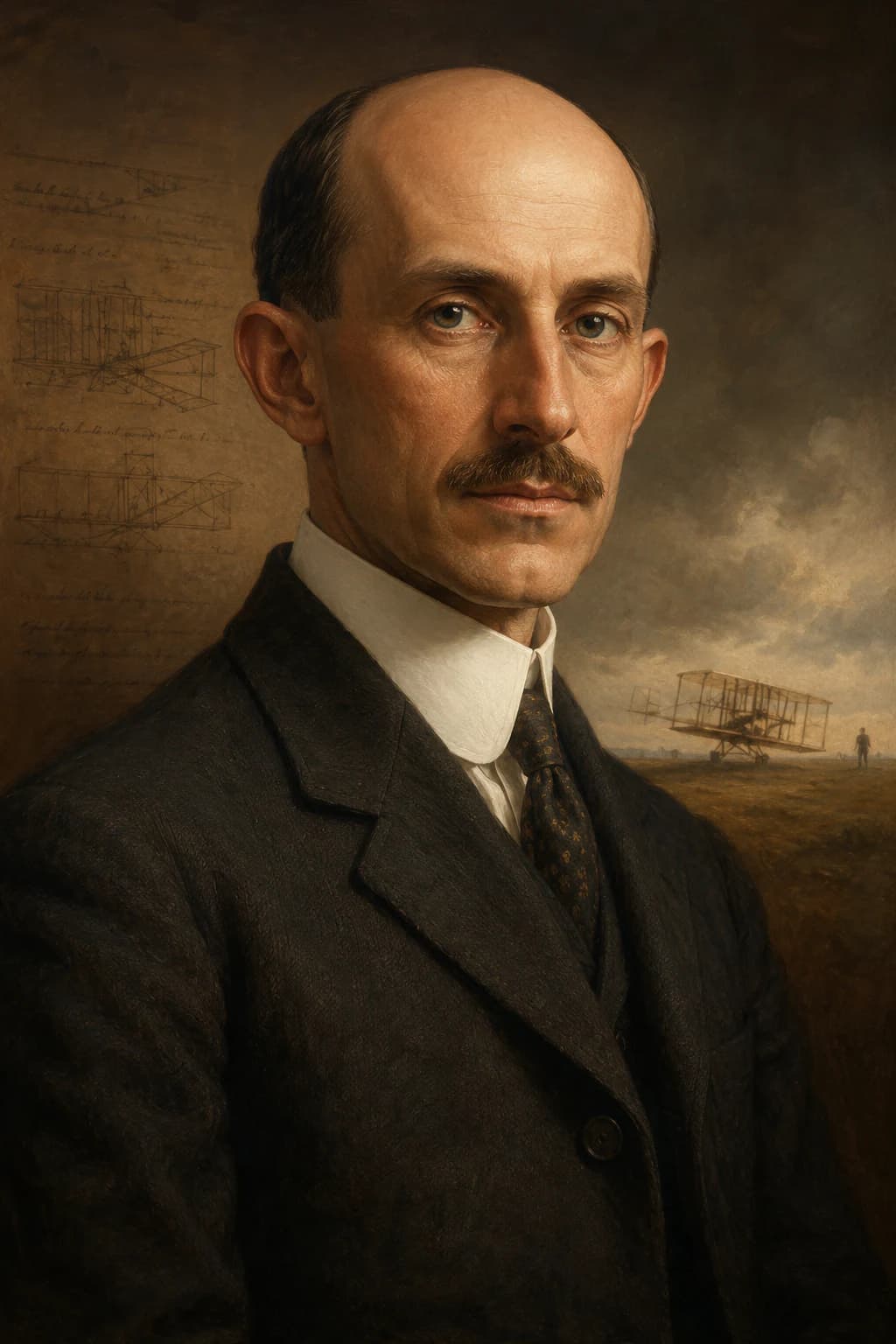
Orville Wright was born on 19 August 1871 in Dayton, Ohio, the son of Milton Wright, a bishop in the Church of the United Brethren in Christ, and Susan Koerner Wright, whose practical skill with tools left a deep mark on her children. Orville grew up in a household that valued reading, independence, and making things work. He did not follow the standard path of a credentialed engineer. That is part of his historical importance. His education came through printers' ink, bicycle chains, careful observation, and the habit of testing an idea against the physical world.
With his older brother Wilbur, Orville moved through small businesses before aviation: printing, journalism, and bicycle manufacture and repair. The bicycle shop mattered because it gave the brothers daily experience with balance, lightweight structures, bearings, chains, friction, and customers who expected practical reliability. When people ask who Orville Wright was, the answer is not simply the man who happened to be on the machine in 1903. He was a craftsman-inventor whose strengths lay in mechanical intuition, patient adjustment, and the courage to trust measured experiment over accepted authority.
Orville's route into aviation ran through workshop intelligence rather than formal engineering prestige.
1896-1899
The problem of control
By the late 1890s, flight was no longer a fantasy, but no one had yet produced a fully practical powered airplane. Otto Lilienthal's gliding experiments showed that human flight was possible, and his fatal crash in 1896 warned that lift without reliable control could be deadly. Samuel Langley, Octave Chanute, and others contributed data, designs, and encouragement, but the Wright brothers identified the problem differently. They believed the key was not simply a stronger engine or larger wings. A flying machine had to be controlled in roll, pitch, and yaw by a pilot who could respond in real time.
Orville's role in this phase was inseparable from Wilbur's, but he was not a junior assistant. The brothers argued, built, watched birds, wrote to the Smithsonian for reading material, and turned theory into apparatus. Their wing-warping idea, developed from observing how wings could be twisted to change lift, became one part of a broader control system. This focus on control explains why their achievement was different from a powered hop. They were trying to make an aircraft that could be flown, not merely launched.
Their breakthrough began with the decision to solve flying as a control problem.
1900-1902
Kitty Hawk experiments
The brothers chose the Outer Banks of North Carolina for practical reasons: steady winds, open sand, privacy, and softer landings than hard fields. Their first gliders in 1900 and 1901 were disappointing enough to push them toward deeper investigation. Rather than abandon the project, they questioned the data. Back in Dayton, they built a small wind tunnel and tested wing shapes themselves. This was one of the decisive moments in aviation history. They stopped treating inherited tables as reliable and created their own evidence.
Orville's mechanical exactness was central to this work. Wind tunnel testing required careful construction, repeatable measurements, and the discipline to let results overturn expectation. The improved 1902 glider proved that their control system could work. With wing-warping, a forward elevator, and a movable rudder coordinated with roll control, they moved toward what became three-axis control. That achievement is why the Wright brothers' biography cannot be reduced to one December morning. By the time Orville piloted the first flight, the essential intellectual victory had already been won through years of gliding, crashing, measuring, and redesigning.
The famous powered flight rested on less glamorous months of measurement and correction.
1903
Building the Flyer
The move from glider to powered airplane required a machine light enough to fly, strong enough to survive, and controllable enough to matter. No suitable engine was available off the shelf, so the brothers and their mechanic Charlie Taylor built one in Dayton. The propellers were not treated as simple screws pushing air backward; the Wrights understood them as rotating wings and designed them accordingly. Orville's practical mechanical ability helped turn this difficult package of engine, structure, controls, chains, and propellers into a working aircraft.
The 1903 Wright Flyer was fragile, awkward, and experimental, but it embodied the principles that made later aviation possible. Its pilot lay prone. Its engine drove twin propellers by chain. Its control system demanded skill and attention. It was not a finished commercial product. It was a proof machine. That distinction matters. Orville and Wilbur were not claiming to have solved every future problem of aviation; they were proving that a heavier-than-air machine could take off under its own power, remain under human control, and be flown repeatedly.
The Flyer was less a polished vehicle than a working argument: controlled powered flight could be done.
17 December 1903
First flight
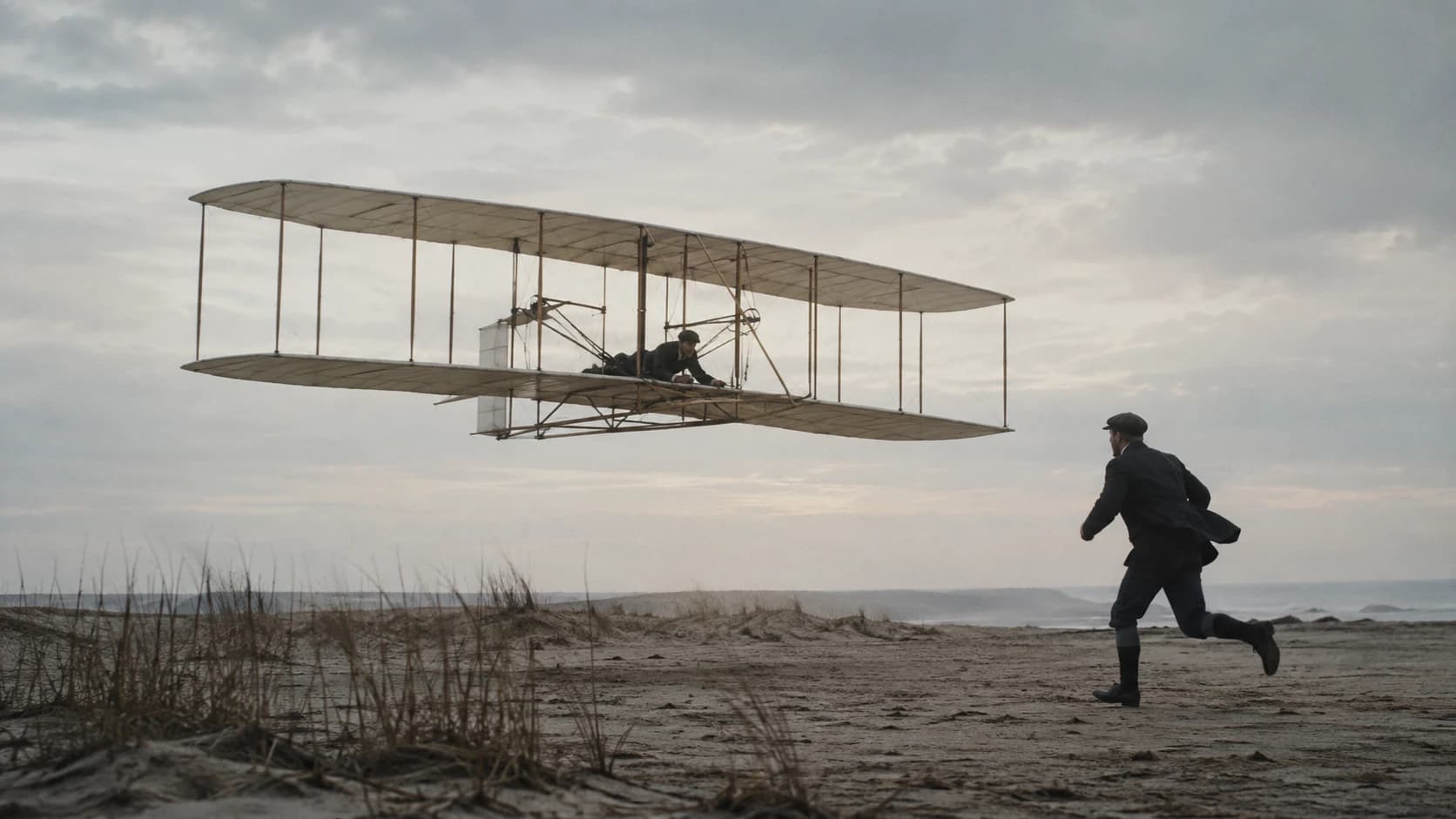
On the morning of 17 December 1903, at Kill Devil Hills near Kitty Hawk, Orville Wright lay on the lower wing of the Flyer while Wilbur steadied the machine at the rail. At 10:35 a.m., Orville made the first flight: 12 seconds over 120 feet. By later standards it was tiny. By historical standards it was immense. Three more flights followed that day, with Wilbur making the longest at 852 feet in 59 seconds. The machine was damaged after the fourth flight and never flew again.
Orville's achievement was not that he made the longest flight of the day. He did not. His significance lies in piloting the first one: the moment when years of theory, workshop labour, glider testing, and risk became visible proof. The claim has attracted later disputes and rival stories, especially around other experimenters, but the Wrights' evidence, photographs, witnesses, technical control, and repeatability remain central to why historians recognise their 1903 flights. Orville did not merely leave the ground. He controlled a powered aircraft in the air, and that is the key fact.
The first flight was short because it was a beginning, not because it was small in consequence.
1904-1909
From proof to public aviation
The years after Kitty Hawk were frustrating and transformative. In 1904 and 1905 the brothers flew improved machines at Huffman Prairie near Dayton, gradually learning how to turn, circle, stay aloft longer, and make flight practical. Yet public recognition lagged. The Wrights were cautious because they wanted patent protection and contracts before revealing too much. That caution made some observers skeptical, especially while European experimenters advanced rapidly.
Orville shared in the transition from private experiment to public proof. In 1908, while demonstrating for the U.S. Army at Fort Myer, Virginia, he crashed. Passenger Lieutenant Thomas Selfridge was killed, becoming the first person to die in a powered airplane crash, and Orville was badly injured. The accident revealed both the promise and danger of aviation. Orville recovered, returned to flying, and helped secure the Army contract in 1909. By then the Wright brothers had moved from being bicycle makers with a secret machine to central figures in a new technological world.
Orville's career after 1903 shows that inventing flight was only the first stage of making aviation real.
1912-1948
Loss, disputes and legacy
Wilbur Wright died of typhoid fever in 1912, leaving Orville as the surviving brother most closely associated with the origins of powered flight. Orville sold his interest in the Wright Company in 1915, but he did not leave aviation's public life. He advised, argued, served on aeronautical bodies, and defended the brothers' priority in a long dispute with the Smithsonian over Samuel Langley's Aerodrome. That dispute was not a petty footnote. It showed how quickly invention becomes a battle over evidence, credit, institutions, and national memory.
Orville lived long enough to see airplanes become military weapons, mail carriers, passenger machines, and symbols of modernity. The world that began with a 12-second flight had become global aviation before his death in 1948. His legacy is strongest when understood with nuance. The Wright brothers did not invent every component of flight from nothing; they learned from a community of experimenters. Their achievement was synthesis, discipline, and control. Orville Wright matters because he helped turn an ancient dream into a repeatable technology, and because he was the pilot at the instant the modern airplane proved itself in the air.
His lifetime stretched from handmade experiments to a world permanently changed by aircraft.