Related Moment
Eleanor of Castile: The Last Journey
The journey ended. The love was carved in stone.
In December 1290, a queen's funeral procession rested at Delapré Abbey. Her husband made sure that the world would remember where she had stopped.
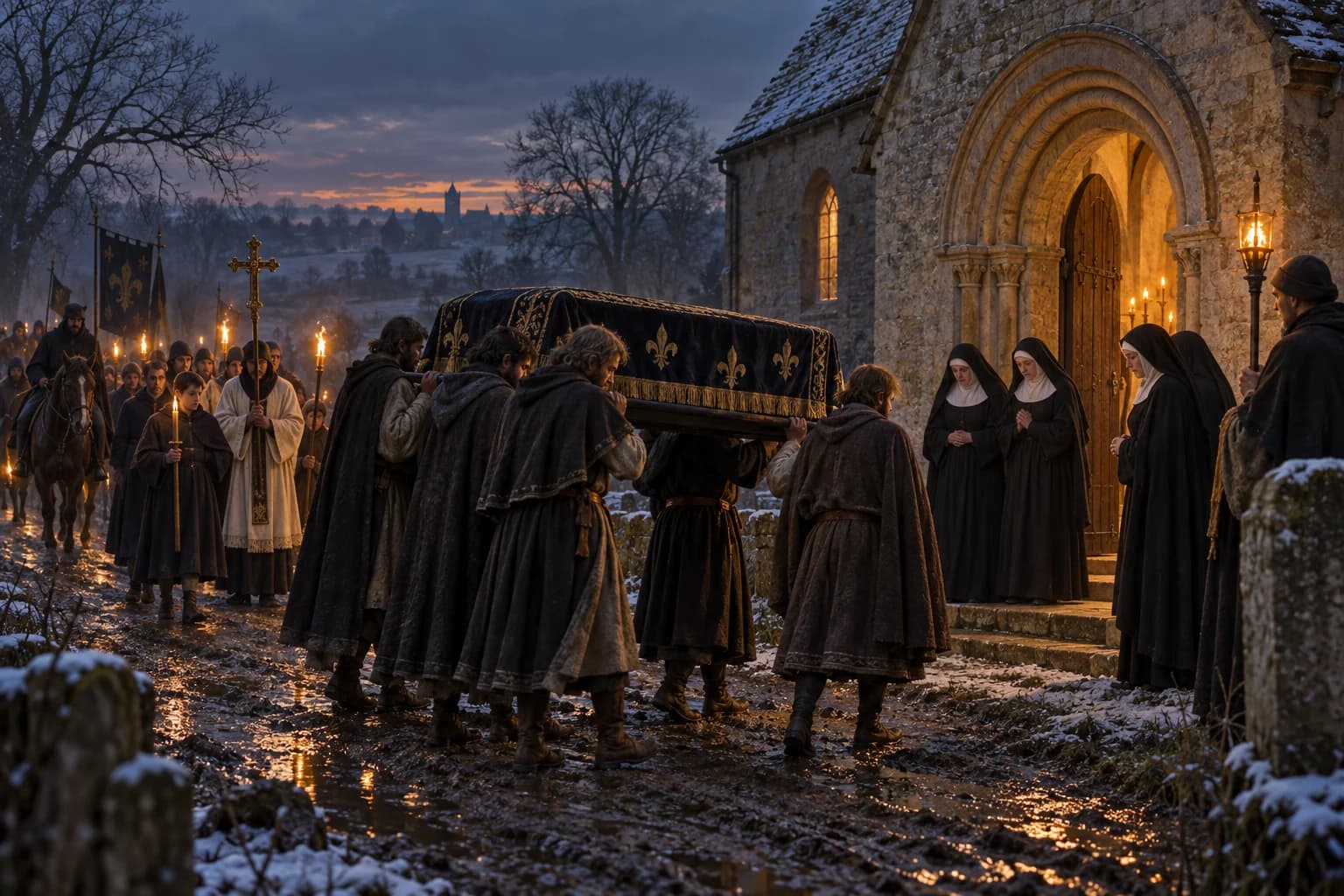
The Queen came to Delapré Abbey in a coffin. In December 1290, the funeral procession of reached Northampton on its journey south towards Westminster Abbey. For one night, the small religious community outside the town became part of a royal farewell. The woman inside the coffin had been queen of England. The man accompanying her was King Edward I.
Today, you might come to Delapré for its Christmas Fair, its gardens or an afternoon with family. The Cross beside London Road carries you back to another December: a queen's last journey, a night of prayer, and a husband determined that neither should be forgotten.
died on 28 November 1290 at Harby, a village in Nottinghamshire near Lincoln. Illness had stopped her travelling. The exact nature of that illness is uncertain, but its outcome was devastating. Edward had lost the companion who had shared his life for thirty-six years.
Their marriage had begun in 1254, long before Edward became king. had travelled with him overseas, including on crusade, and they had been crowned together at Westminster Abbey in 1274. She was more than the figure later remembered in stone: a queen with her own estates and interests, and a mother who had known the loss of children as well as the demands of royal life.
After her death, her body was taken to Lincoln and embalmed before the procession set out for London. What had been a lifetime of shared journeys became a final journey that Edward would make beside her coffin.
The route ran through Lincoln, Grantham, Stamford and Geddington before reaching Northampton. Further south lay Stony Stratford, Woburn, Dunstable, St Albans and Waltham, followed by London. Towns and religious houses became stopping places in a procession that joined private bereavement to the ceremony expected for a queen.
The cortège was not simply moving a coffin from one church to another. Services and vigils accompanied the journey. Each pause gave those attending the Queen a place to honour her, and people along the route a chance to witness the passing of a royal household in mourning.
On the night of 8–9 December 1290, 's body rested at Delapré Abbey. This was a Cluniac nunnery, not the country house that later grew on the site. The Abbey's account describes the Queen's body resting in its church under the vigil of Abbess Margery de Wollaston.
Imagine the contrast: outside, the demands of the road and the organisation of a royal procession; inside, a religious community whose life revolved around prayer. We cannot recover every detail of that night. We can locate it. Here at Delapré, the journey paused before continuing towards London.
's funeral took place at Westminster Abbey on 17 December. Her body had reached its destination. Edward's work of remembrance was only beginning.
Edward commissioned twelve stone crosses to mark the places where the procession had rested. Built in the years after 's death, they turned a temporary passage through England into a lasting chain of memorials. The final cross stood at Charing, giving Charing Cross its name.
These were elaborate monuments, with carved figures of and the emblems of her royal world. Their religious setting mattered. Remembrance in medieval England included prayer for the dead; a roadside memorial could keep a queen's name before people who would never visit her tomb. Edward's grief became visible far beyond Westminster.
The Northampton cross, also known as the Hardingstone cross, was built between 1291 and 1294. John of Battle, the King's master mason, directed its construction, with sculptural work by William of Ireland. Above an octagonal base, stone canopies shelter statues of . The memorial gives the Queen a presence on the road her coffin once travelled.
It stands beside London Road at the edge of Delapré's parkland, rather than inside the present Abbey building. It commemorates the overnight rest nearby; it does not mark 's grave. Only three original Eleanor Crosses remain standing, at Northampton, Geddington and Waltham Cross.
If you are visiting Delapré for the Christmas Fair, there is an extraordinary story just beyond the bustle. The Abbey describes a path through the trees alongside London Road, leading from the main driveway entrance towards the cross. Ask the visitor team about the route if you would like to see it.
You do not need to know every king or every battle to understand why it matters. A woman died. Her husband accompanied her home. A community sheltered her coffin for a night. Then masons made that passing moment endure. The procession moved on from Delapré more than seven centuries ago. The invitation to remember her is still there.