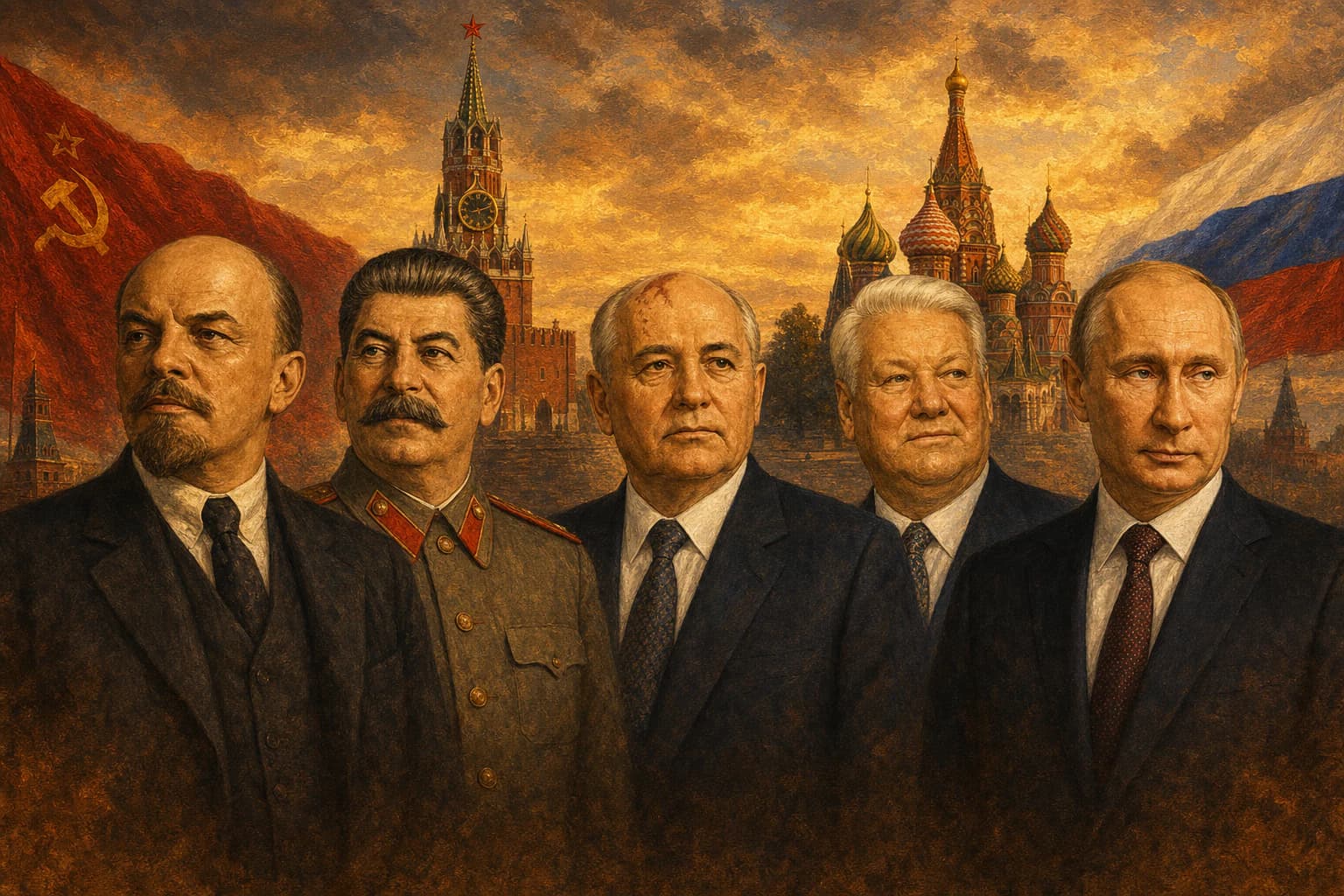
Soviet party-state leaders, then Russian presidents
The Soviet portion follows the figures who held decisive party-state authority: Vladimir Lenin, Joseph Stalin, Nikita Khrushchev, Leonid Brezhnev, Yuri Andropov, Konstantin Chernenko, and Mikhail Gorbachev. After the Soviet Union collapsed in 1991, the sequence switches to elected Russian Federation presidents: Boris Yeltsin, Vladimir Putin, Dmitry Medvedev, and Putin again.
Lenin led Soviet Russia from 1917, before the USSR was formally created in 1922. Because Soviet authority often ran through party leadership rather than a single constitutional office, this page tracks practical succession rather than every formal state title.
How leadership in Russia and the Soviet Union developed
The Soviet state grew out of the October Revolution of 1917, when Lenin's Bolsheviks seized power and dismantled the short-lived Provisional Government. Lenin established a one-party state governed by the Communist Party, and the USSR was formally created in 1922.
Following Lenin's death in 1924, Joseph Stalin outmanoeuvred his rivals to consolidate total control, ruling through terror and transforming the USSR into an industrial superpower at enormous human cost. The death of Stalin in 1953 opened a period of succession and reform, with Khrushchev, Brezhnev, Andropov, and Chernenko each leading the country through successive phases of the Cold War.
Mikhail Gorbachev's reformist policies in the late 1980s could not prevent the disintegration of the Soviet Union in 1991, which gave way to the Russian Federation under Boris Yeltsin. Vladimir Putin has dominated Russian politics ever since, serving as President, Prime Minister, and President again, overseeing a dramatic reassertion of Russian power on the world stage.
Frequently asked questions
Who was the first Soviet leader?
Vladimir Lenin was the first leader of Soviet Russia, serving as Chairman of the Council of People's Commissars from November 1917 until his death in January 1924.
Who was the last leader of the Soviet Union?
Mikhail Gorbachev was the last leader of the Soviet Union. He served as General Secretary of the Communist Party from 1985 and as President of the USSR from 1990 until the country dissolved in December 1991.
Who was the longest-serving Soviet leader?
Joseph Stalin dominated Soviet politics from the mid-1920s until his death in March 1953—a period of nearly three decades—making him the longest-serving Soviet leader. Among Russian presidents, Vladimir Putin has served the longest cumulative time in office.
Who are the Russian presidents in order?
The Russian presidents in order are Boris Yeltsin, Vladimir Putin, Dmitry Medvedev, and Vladimir Putin again. Putin served as President from 2000 to 2008, as Prime Minister from 2008 to 2012, and has served as President again from 2012 to the present.
What is the difference between Soviet leaders and Russian presidents?
Soviet leaders ruled the USSR through Communist Party power and state offices before 1991. Russian presidents lead the Russian Federation, the post-Soviet state that emerged after the USSR dissolved.