People

Yuri Gagarin

Yuri Gagarin was a Soviet cosmonaut who became the first human in space on 12 April 1961 aboard Vostok 1. His orbit made him a global symbol of the Soviet space programme and the Cold War space race.

Born
1934 CE
Died
1968 CE
Role
Cosmonaut

Soviet cosmonaut (1934-1968)

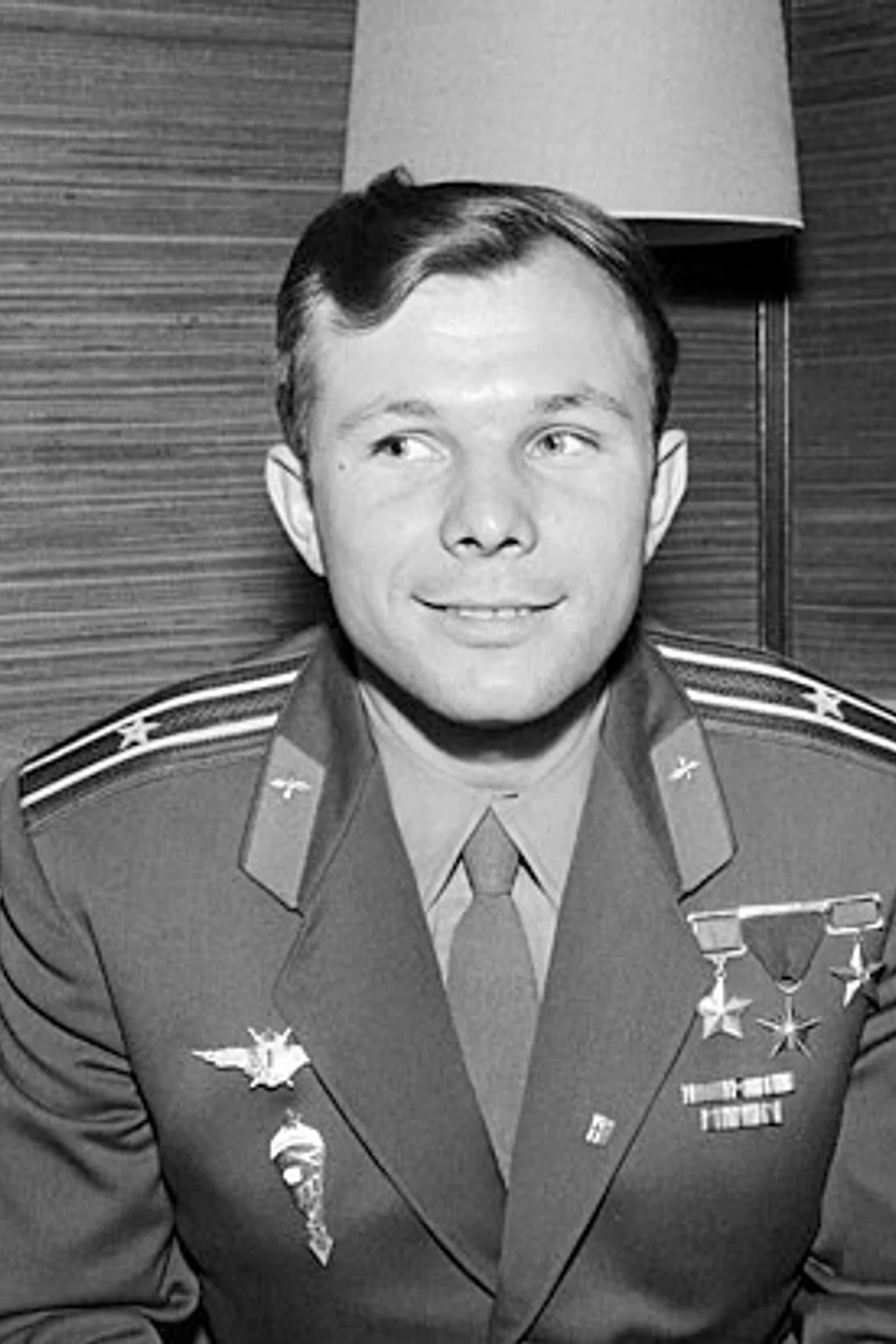
Portrait photograph of Yuri Gagarin
Historical photograph

A real historical or editorial image is used here. Source, licence and transformation details are publicly recorded. Image policy Attribution

Quick answer

Yuri Gagarin was a Soviet cosmonaut who became the first human in space on 12 April 1961 aboard Vostok 1. His orbit made him a global symbol of the Soviet space programme and the Cold War space race.

Born
1934 CE
Died
1968 CE
Role
Cosmonaut
Years
1934-1968 CE
Quick facts

Profile details

Additional identity and tagging details that are not already covered in the introduction.

Full name
Yuri Alekseyevich Gagarin
Also known as
Gagarin, first human in space
Facts

Yuri Gagarin timeline facts

Selected specifics from this profile's life story.

1934-1945
Village beginnings

Yuri Gagarin was born in 1934 in the village of Klushino, west of Moscow, and grew up through the upheaval of the Second World War.

1955-1960
Military pilot

Gagarin entered the Soviet Air Force, trained as a fighter pilot, and was selected for the first cosmonaut group.

1961-1963
Global icon

After the flight, Gagarin became an international celebrity and a symbol of Soviet scientific prestige during the space race.

1968
Crash and legacy

Gagarin died in a training flight crash in 1968, but his place as the first human in space made him a lasting global figure.

Life Journey

From village childhood to the first human orbit

Follow the story in a more continuous narrative, with a reading mode that matches how much depth you want.

Complete chronology

1934-1945

Village beginnings

Yuri Alekseyevich Gagarin was born on 9 March 1934 in Klushino, a village in western Russia. His childhood was shaped by poverty, rural life, and the German invasion of the Soviet Union. During the war his family endured occupation, displacement, and hardship. This background later mattered to the story Soviet propaganda told about him: Gagarin was not presented as an aristocrat of science, but as a child of ordinary Soviet society whose talent, discipline, and training had carried him into space.
1945-1955

Technical education

Gagarin's route toward flight passed through the Soviet world of technical education. He studied foundry work and industrial skills before entering a technical school in Saratov, where he joined an aeroclub and learned to fly. This path reflected a wider Soviet emphasis on engineering, discipline, and social mobility through training. Aviation offered glamour, danger, and service to the state. For Gagarin, it also opened a door beyond the limits of village life and wartime deprivation.

1955-1960

Military pilot

In 1955 Gagarin entered military aviation training and later served as a fighter pilot in the Soviet Air Force. He was not the most experienced pilot in the country, but early spaceflight demanded more than flying hours. Candidates needed physical resilience, technical aptitude, political reliability, and the capacity to remain calm inside experimental machines. In 1960 Gagarin joined the first group of Soviet cosmonauts. The selection process was intense because the programme was both scientific and political: whoever flew first would represent not only himself, but the Soviet Union before the world.

1961

Vostok 1

On 12 April 1961, Vostok 1 lifted Yuri Gagarin from the Baikonur Cosmodrome into orbit. The flight lasted 108 minutes and carried him once around Earth. It was short, dangerous, and astonishing. The spacecraft was heavily automated because no one knew how a human body and mind would respond to weightlessness and orbital flight. Gagarin's calm voice, safe return, and smiling public presence turned the mission into a triumph. For the first time, a human being had looked down on Earth from space.

1961-1963

Global icon

Gagarin's flight arrived at a perfect propaganda moment for the Soviet Union. Sputnik had already shocked the world in 1957, and Vostok 1 seemed to confirm that the USSR had seized the future. Gagarin toured widely, meeting crowds, leaders, workers, and students. His youth and warmth made him unusually effective as a public figure. Yet the achievement was not only symbolic. It proved that humans could survive orbital spaceflight and pushed the United States to accelerate its own programme, sharpening the Cold War space race.

1963-1968

After orbit

After Vostok 1, Gagarin's life became both privileged and constrained. He trained for future work, studied at the Zhukovsky Air Force Engineering Academy, and served as a public face of the Soviet space programme. But his symbolic value made officials reluctant to expose him to another dangerous mission. He was too valuable to risk and too much a pilot to be satisfied with ceremonial life alone. This tension followed many early space heroes: the state celebrated courage, then tried to preserve the people whose courage had become politically useful.

1968

Crash and legacy

On 27 March 1968, Gagarin died during a routine training flight with instructor Vladimir Seryogin. He was only thirty-four. The crash turned him from living hero into enduring myth. Monuments, stamps, schools, streets, and annual commemorations carried his image across the Soviet Union and beyond. His legacy remains larger than Cold War propaganda because the achievement itself remains elemental: before Gagarin, no human had crossed into space; after him, space became a place people could go.

Continue in context

Connected stories

Move from the profile into the wider events and settings this figure belongs to.

Tertiary paths

Content note

This profile is written for educational use and connects to related Stories of History pages. The main portrait uses a real historical or editorial image, with source and licence details recorded for attribution review. Image policy Image attribution

References

Sources & Further Reading

Reliable reference works, archives and reading paths connected to this profile.

Further reading

  1. Encyclopaedia Britannica, Search results for Yuri Gagarin,” accessed June 2026.Open source
  2. WorldCat, Books and library holdings for Yuri Gagarin,” accessed June 2026.Open source

Primary sources

  1. Library of Congress, Search results for Yuri Gagarin,” accessed June 2026.Open source

Reviewed claim sources

Loading reviewed claim sources...

A weekly route through history

Find out first about the latest published stories, feature notes and occasional Premium offers in one weekly email.