People

Wilbur Wright

Wilbur Wright was an American aviation pioneer who, with Orville Wright, developed the Wright Flyer, mastered flight control, and proved powered aviation.

Born
1867 CE
Died
1912 CE
Role
Aviation pioneer

American aviation pioneer (1867-1912)

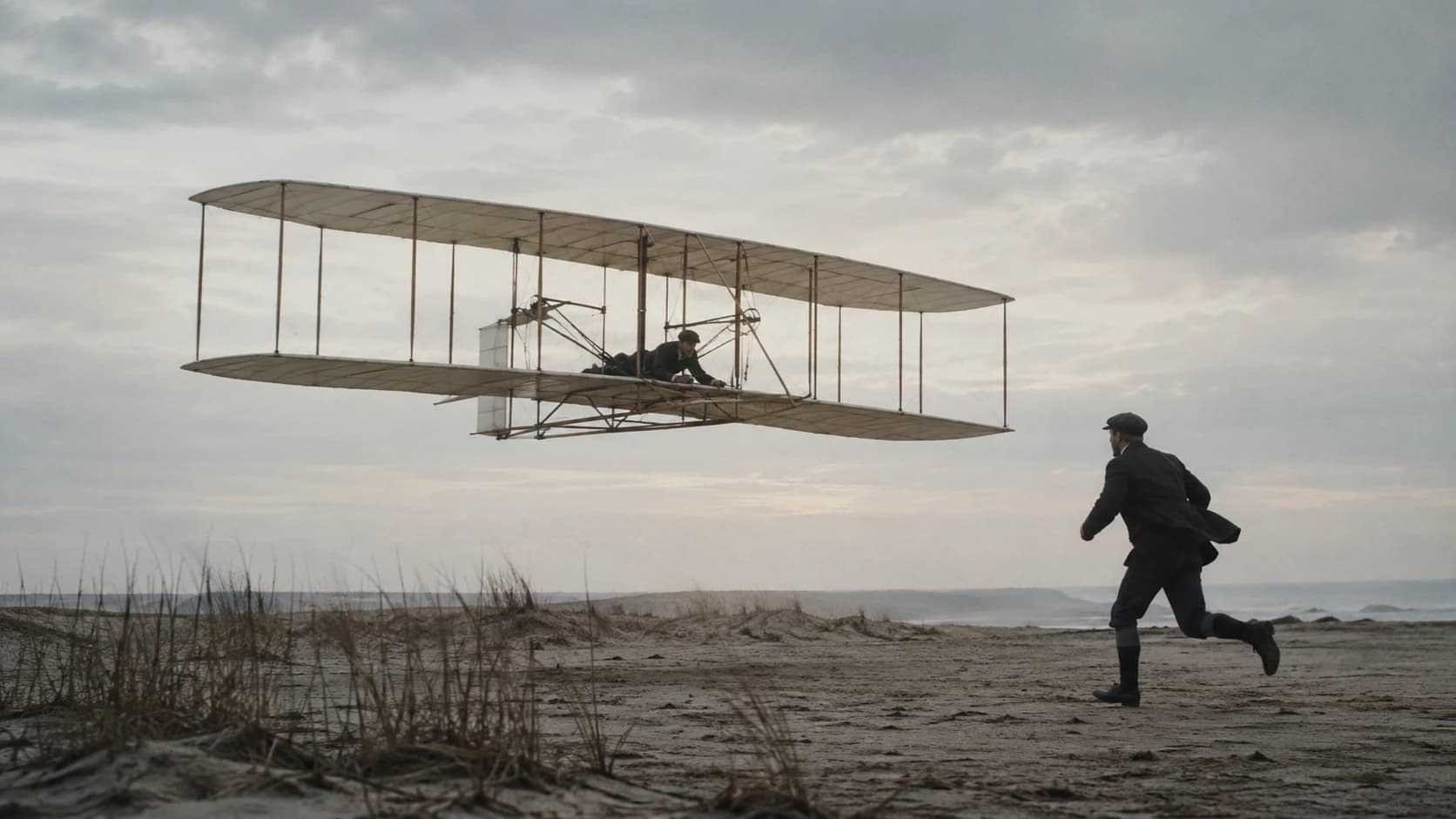
AI-generated portrait of Wilbur Wright with early aircraft in the background
AI-assisted historical reconstruction

An illustrative reconstruction based on historical context. It is not a photograph or documentary likeness. Image policy

Quick answer

Wilbur Wright was an American aviation pioneer who, with Orville Wright, developed the Wright Flyer, mastered flight control, and proved powered aviation.

Born
1867 CE
Died
1912 CE
Role
Aviation pioneer
Years
1867-1912 CE
Quick facts

Profile details

Additional identity and tagging details that are not already covered in the introduction.

Also known as
the Wright brothers
Facts

Wilbur Wright timeline facts

Selected specifics from this profile's life story.

1867
A restless mind in Ohio

Wilbur Wright was born in 1867 and grew into a disciplined, analytical thinker whose partnership with Orville turned curiosity into invention.

1900-1902
Gliders on the Outer Banks

Wilbur and Orville tested gliders at Kitty Hawk and Kill Devil Hills, using disappointment as evidence rather than defeat.

1904-1908
Making the world believe

Wilbur helped refine the airplane after 1903 and became its most persuasive public demonstrator in Europe.

1912
A short life, full of consequences

Wilbur died of typhoid fever in 1912, leaving Orville to guard the brothers' legacy as aviation accelerated beyond them.

Life Journey

A timeline of method, control and the making of flight

Follow Wilbur Wright from Dayton inventor to the public face of the airplane's breakthrough.

Complete chronology

1867

A restless mind in Ohio

Wilbur Wright was born on 16 April 1867 near Millville, Indiana, and grew up mainly in Dayton, Ohio. His family life mattered deeply to his later work. His father, Milton Wright, encouraged reading and independent judgement; his mother, Susan Koerner Wright, brought practical mechanical ability into the household. Wilbur was intelligent, serious, and intellectually hungry. A facial injury in his youth and the family responsibilities that followed helped keep him close to home, interrupting the more conventional route of college and professional advancement. That apparent narrowing of life became historically productive. In Dayton, Wilbur developed the habits that made him one of the most important aviation pioneers: patient reading, concentrated argument, exacting standards, and a willingness to rethink a problem from its foundations. He and Orville built businesses in printing and bicycles before turning to flight. The bicycle shop was not incidental. It trained them to think about balance, light frames, steering, friction, and the relation between a rider's body and a moving machine. Wilbur's biography shows that the path to the airplane did not run only through universities or armies. It also ran through local workshops and disciplined self-education.


1896-1899

Learning from failure

The death of German glider pioneer Otto Lilienthal in 1896 helped pull Wilbur toward aviation. Lilienthal had proved that gliding could be systematic, but his fatal crash also exposed the central unsolved problem: how could a pilot control an aircraft reliably? Wilbur studied what others had done, including Lilienthal, Octave Chanute, Samuel Langley, and other experimenters. He did not dismiss them; he learned from them. But he and Orville came to believe that many were putting too much emphasis on power and too little on control. This insight became the foundation of the Wright brothers' achievement. Wilbur imagined the pilot as an active operator, not cargo carried by a machine. Watching birds, he noticed how wings adjusted in the air. The brothers' wing-warping system grew from that observation and from their understanding of balance in cycling. Wilbur's importance lies partly in framing the problem correctly. He asked not just how to get into the air, but how to remain master of the machine once there.

1900-1902

Gliders on the Outer Banks

From 1900 to 1902, Wilbur and Orville carried their experiments to the windswept Outer Banks of North Carolina. The location offered steady wind, open sand, and privacy, but it also exposed every weakness in their designs. The 1900 and 1901 gliders did not perform as expected. Many inventors might have blamed bad luck, materials, or weather. The Wrights blamed the data. Published lift figures did not match their experience closely enough, so they built a wind tunnel in Dayton and tested wing shapes themselves. Wilbur's analytical discipline was crucial here. The brothers turned disappointment into measurement, and measurement into better design. Their 1902 glider was a major step toward the airplane because it gave them effective control in roll, pitch, and yaw through wing-warping, an elevator, and a movable rudder. This is why Wilbur Wright's achievements should not be reduced to a single day in 1903. He helped create the experimental method that made that day possible: test, measure, doubt, rebuild, and test again.

1903

The powered machine

The 1903 Wright Flyer brought together several hard problems at once. It needed a light engine, efficient propellers, a structure strong enough to fly, and controls that a pilot could manage. The brothers, with mechanic Charlie Taylor, built their own engine when existing options were too heavy or unsuitable. They designed propellers from first principles, treating them as rotating wings rather than simple paddles. This kind of thinking was typical of Wilbur and Orville: when available knowledge was inadequate, they worked out the problem themselves. Wilbur's role was not only conceptual. The Wright partnership was intensely practical, full of argument, shared labour, and mutual correction. The Flyer that emerged was not elegant in the later sense. It was unstable, demanding, and vulnerable to damage. But it joined power to control. That was the decisive combination. The airplane was no longer a dream of a motor strapped to wings; it was a system in which pilot, controls, engine, propellers, and airframe had to work together.

17 December 1903

Kitty Hawk proof

On 17 December 1903, Wilbur and Orville made four flights at Kill Devil Hills near Kitty Hawk. Orville piloted the first, covering 120 feet in 12 seconds, while Wilbur helped steady the machine at launch. Wilbur then took his own turns and made the fourth and longest flight of the day: 852 feet in 59 seconds. Soon afterward, a gust damaged the Flyer beyond further use. The day was brief, cold, and physically modest. It was also one of the great proofs in the history of technology. Wilbur's place in the event is sometimes overshadowed because Orville piloted the first flight, but the achievement belonged to their partnership. Wilbur's longest flight showed that the machine's success was repeatable, not a single accidental leap. The brothers had demonstrated powered, controlled, heavier-than-air flight with witnesses and a photograph. Later claims for other pioneers have continued to attract attention, but the Wrights' combination of evidence, control, repeatability, and technical development remains the reason their 1903 flights stand at the centre of aviation history.

1904-1908

Making the world believe

After Kitty Hawk, the Wrights faced a new problem: proving the airplane to governments, investors, scientists, and skeptics without surrendering their intellectual property. At Huffman Prairie near Dayton in 1904 and 1905, they improved their machines, learned to circle, extended flight times, and moved from first proof toward practical aircraft. Their secrecy frustrated observers, and some dismissed them as exaggerators. The brothers' caution was commercially understandable, but it delayed public acceptance. Wilbur changed that in 1908 with demonstrations in France, especially near Le Mans. European audiences that had doubted the Wrights watched him fly with a degree of control that transformed opinion. His calm command in the air made the airplane impossible to dismiss. He was not merely showing a machine; he was teaching the world what controlled flight looked like. Those demonstrations made Wilbur the international face of the Wright achievement and pushed aviation from disputed claim into public reality.

1909-1912

Business, patents and strain

By 1909, the Wright brothers had secured important contracts and formed the Wright Company. Success brought opportunity, but also legal conflict. Their patent claims, especially around control systems, became the centre of disputes with other aviators and manufacturers. Wilbur threw himself into the fight to defend the brothers' rights. Supporters saw this as necessary protection for inventors whose ideas could be taken by better-funded competitors. Critics argued that patent battles slowed aviation's development in the United States. The truth is more complicated than either courtroom pride or simple obstruction. The Wrights had genuinely solved crucial problems and deserved recognition. Yet aviation was becoming an industry too large for any two inventors to control. Wilbur's final years were consumed by travel, demonstrations, negotiation, management, and litigation. The same intensity that had helped solve flight now turned toward protecting its ownership. It took a toll.

1912

A short life, full of consequences

Wilbur Wright died in Dayton on 30 May 1912 after contracting typhoid fever. He was only forty-five. His father famously described his life as short but full of consequences, a judgement that has endured because it is exact. Wilbur did not live to see aviation's full transformation through world war, commercial travel, global air routes, and modern aerospace. Yet he had already helped create the essential turning point. Wilbur's legacy is not that he worked alone or that he sprang flight from nowhere. He and Orville built on earlier experimenters, collaborated with each other at extraordinary depth, and relied on practical workshop skills as much as theory. His particular contribution was intellectual severity: he defined the problem, distrusted weak data, insisted on control, and demonstrated the airplane so convincingly that skepticism collapsed. For anyone asking why Wilbur Wright was important, the answer is that he helped change flight from aspiration into engineered reality. The modern airplane begins not with one heroic leap, but with the disciplined method he and Orville brought to the air.

Continue in context

Connected stories

Move from the profile into the wider events and settings this figure belongs to.

Tertiary paths

Content note

This profile is written for educational use and connects to related Stories of History pages. The main portrait is an AI-assisted historical reconstruction, included as an illustrative aid rather than documentary evidence. Image policy

References

Sources & Further Reading

Reliable reference works, archives and reading paths connected to this profile.

Further reading

  1. Encyclopaedia Britannica, Search results for Wilbur Wright,” accessed June 2026.Open source
  2. WorldCat, Books and library holdings for Wilbur Wright,” accessed June 2026.Open source

Primary sources

  1. Library of Congress, Search results for Wilbur Wright,” accessed June 2026.Open source

Reviewed claim sources

Loading reviewed claim sources...

A weekly route through history

Find out first about the latest published stories, feature notes and occasional Premium offers in one weekly email.