Complete chronology
Full overview and deeper context for every journey step.
c. 1050 BCE
Humble Origins
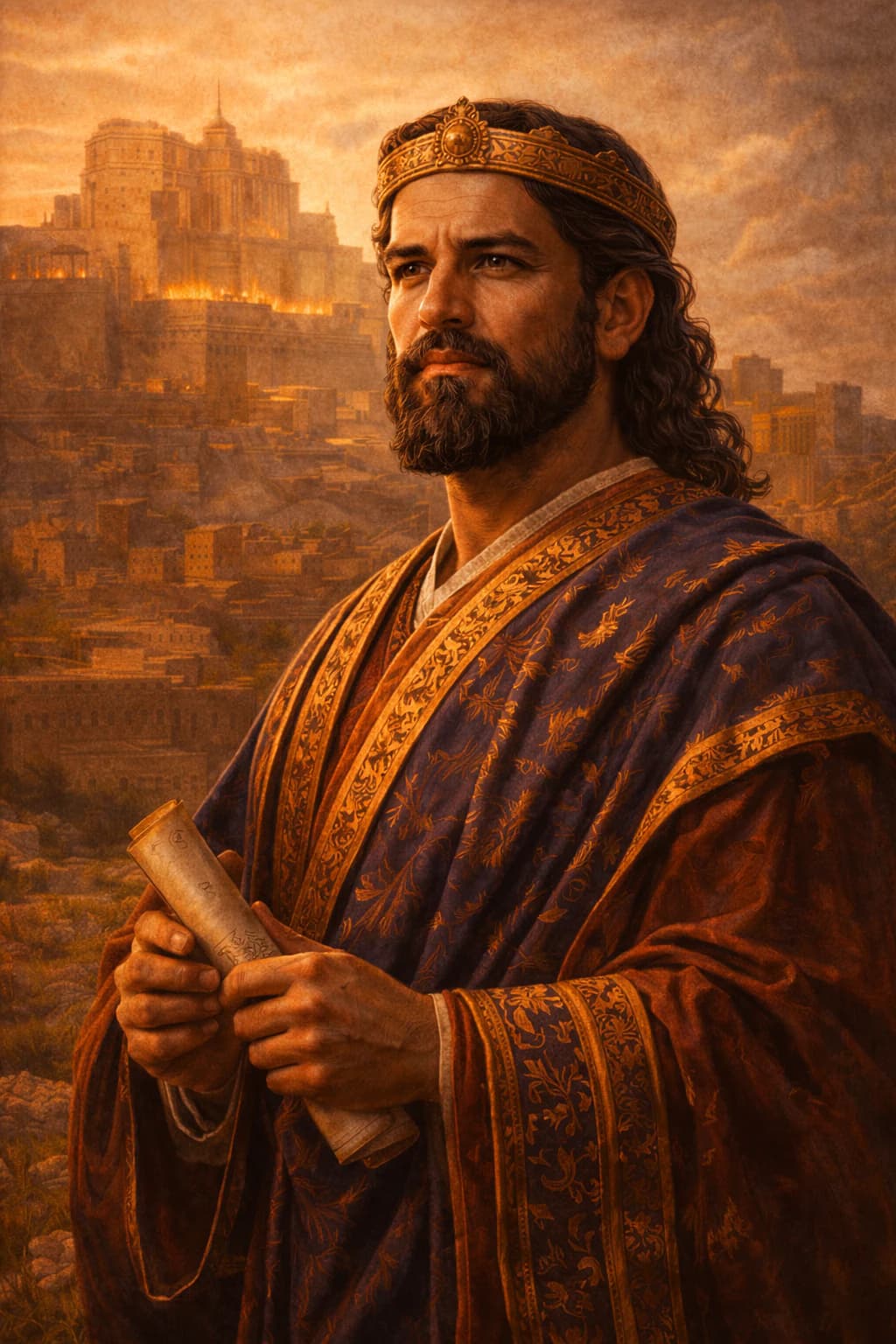
Saul's biography depends mainly on the biblical books of Samuel, where history, theology, memory, and political storytelling are tightly interwoven. He is introduced as the son of Kish from the tribe of Benjamin, a strikingly tall man from a family of some standing but not an obvious royal dynasty. The setting is a loose Israelite confederation under pressure from neighbours, especially the Philistines, with local judges and charismatic leaders unable to provide consistent military coordination. Saul's importance lies in that transition. He represents Israel's first experiment with kingship: a move from tribal emergency leadership toward a permanent crown, army, and court.
Leaders from modest beginnings can embody the broader identity of the people they represent.
c. 1020 BCE
Chosen as King
Saul's selection is told with deliberate tension. Israel asks for a king, but the request is treated as both practical and spiritually dangerous: practical because military threats were real, dangerous because kingship could imply distrust of divine rule. Samuel anoints Saul, lots confirm him publicly, and early hesitation gives way to recognition after military success. The story is not neutral political reporting. It asks what monarchy costs, who authorises power, and whether a human king can serve without becoming a rival to God. Saul begins as the answer to Israel's insecurity, but the narrative already carries doubt about the institution he embodies.
Moments of change often elevate individuals who represent strength and unity.
c. 1010s BCE
Early Success
The rescue of Jabesh-Gilead is Saul's first great success. When Nahash the Ammonite threatened the city, Saul rallied Israel's tribes, struck decisively, and transformed scepticism into support. The episode explains why monarchy could seem necessary. A king could summon men across tribal lines, respond quickly, and turn scattered communities into a fighting force. Saul also fought Philistines, Amalekites, Moabites, Edomites, and others in the biblical summary of his reign, though details vary. His early kingship was not simply failure waiting to happen. It was a real attempt to build military security in a dangerous landscape.
Early success can quickly build legitimacy for new forms of leadership.
later reign
Growing Pressure
Saul's crisis is theological as much as political. In one episode, he offers sacrifice before Samuel arrives, acting under military pressure but crossing a boundary the narrative treats as decisive. In another, he fails to destroy Amalek completely as commanded, sparing King Agag and valuable animals. Modern readers may find the commands themselves morally troubling, and the text should not be flattened into simple leadership advice. Within the biblical story, however, Saul's problem is that he cannot reliably obey the divine word mediated by Samuel. He is king, but not sovereign in the fullest sense. His authority is real and yet subordinate, a tension he never masters.
Maintaining leadership often requires different skills than gaining it.
later reign
Conflict with Authority
Once Samuel declares that Saul's dynasty will not endure, the narrative begins moving toward David. This does not mean Saul instantly loses power. He remains king, commands armies, has children, and retains followers. But the story's moral centre has shifted. Saul becomes a ruler under judgement, and every later decision is read through that shadow. The tragedy is that he knows enough to fear loss but not enough to recover trust. His attempts to maintain authority become more desperate because legitimacy has been withdrawn at a level deeper than public office. He still wears the crown, but the future has quietly left him.
Leadership is shaped as much by expectations as by personal decisions.
late reign
Rival Emerges
David enters Saul's life as musician, warrior, and eventually son-in-law, but he also embodies the future Saul has been told he will lose. The story of David and Goliath gives David heroic visibility; songs celebrating David's victories make Saul hear public comparison as threat. Saul's jealousy leads to attempts on David's life, while David repeatedly refuses to kill Saul when given the chance. The rivalry is written to contrast two models of kingship: Saul anxious and grasping, David patient and chosen. Historically, the details are hard to verify, but narratively the effect is powerful. Saul becomes a man fighting not only an enemy, but destiny.
Perceived threats can alter a leader’s behavior and destabilize their rule.
late reign
Decline in Stability
The late Saul narrative is psychologically dark. He pursues David across the wilderness, turns on perceived collaborators, and orders the massacre of priests at Nob after they unknowingly assist David. Near the end, with the Philistine threat growing and divine guidance unavailable, he seeks out the medium of Endor to summon Samuel's spirit, despite having banned such practices. The scene is one of the most haunting in the Hebrew Bible: the king who once stood tall before Israel now reaches into forbidden darkness for a word from the prophet who rejected him. The message is not rescue but doom.
Sustained pressure can erode even established authority if not managed carefully.
c. 1010 BCE
Final Battle
Saul's final battle at Mount Gilboa brings military disaster and dynastic collapse together. The Philistines defeat Israel, Saul's sons die, and Saul, wounded and fearing capture, takes his own life in the biblical account after his armour-bearer refuses to kill him. The aftermath is deliberately humiliating: the Philistines display the bodies, and only the courage of the men of Jabesh-Gilead preserves Saul's remains from total dishonour. That detail returns the story to his first triumph, when he saved Jabesh-Gilead. Saul's reign ends tragically, but not without memory of the leader he once was.
The end of a leader’s rule often reflects the cumulative pressures faced throughout their leadership.
after 1010 BCE
Legacy of First King
Saul remains one of the Bible's most tragic political figures. He is not a simple villain. He is courageous, chosen, publicly effective at first, and loved by figures such as Jonathan and Michal. Yet he is also insecure, violent, disobedient within the story's theological frame, and unable to accept the rise of another. His historical reality is debated, as archaeology cannot confirm the biblical portrait in detail, but the literary and religious significance is immense. Saul answers the question of why Israel wanted a king and then raises the question of what happens when kingship becomes fear. His life prepares the way for David, but it also keeps David's monarchy from looking inevitable or innocent.
Being first brings both the opportunity to shape a system and the burden of revealing its weaknesses.