Complete chronology
Full overview and deeper context for every journey step.
c. 427 BCE
Aristocratic Origins
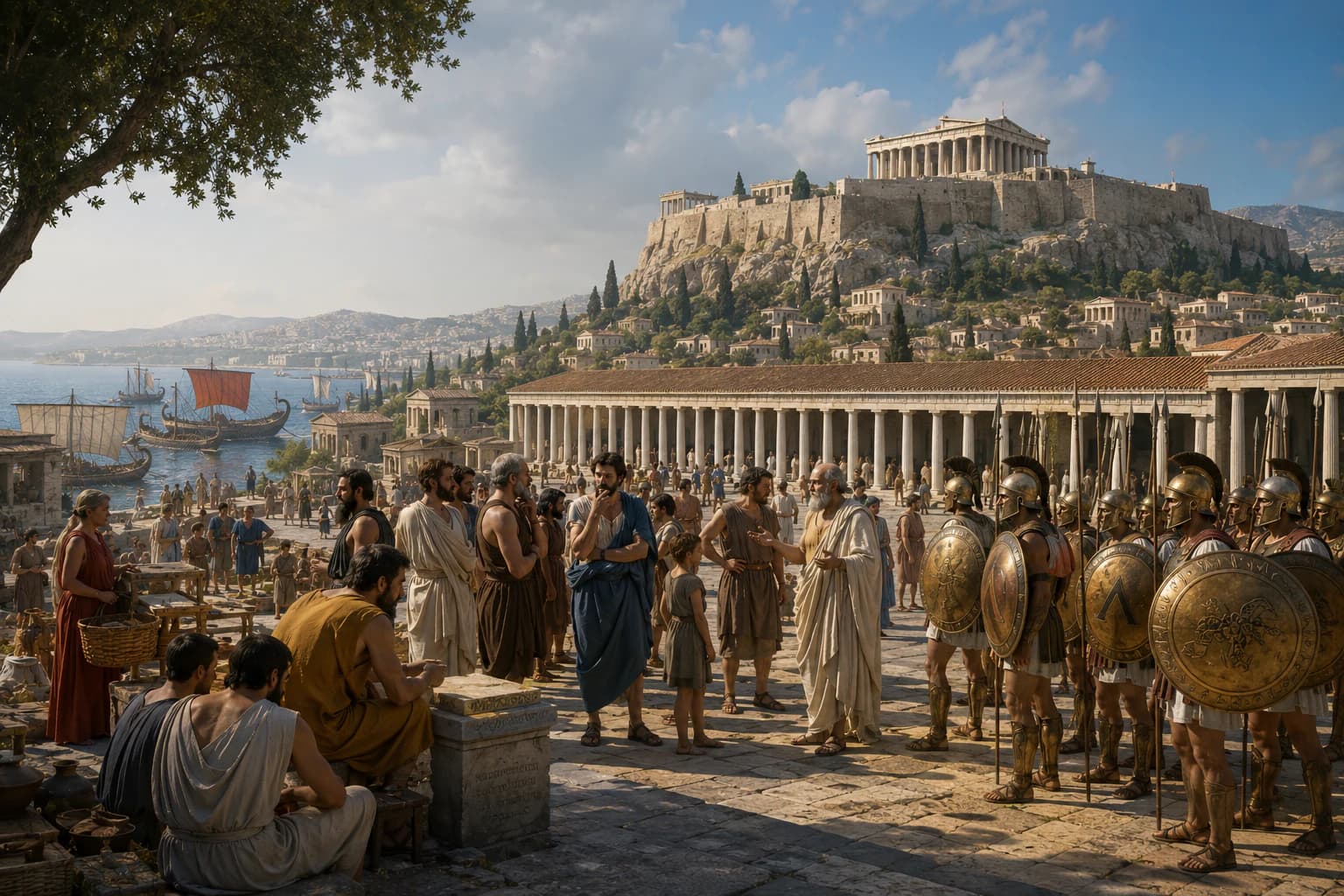
Plato was born around 427 BC into one of Athens's distinguished families, at a time when the city was fighting Sparta in the Peloponnesian War. His relatives connected him to aristocratic politics, including figures associated with the oligarchic coups that later wounded Athenian democracy. This background gave him access to education, poetry, athletics, public debate and the expectation of political life. But Athens also showed him instability: plague, war, imperial overreach, demagogic politics, oligarchic terror and democratic restoration. Plato's philosophy did not emerge from quiet abstraction. It grew from a city brilliant enough to produce tragedy, comedy and Socrates, yet unstable enough to condemn Socrates to death. His lifelong question was how human beings could know, govern and live well in a world so vulnerable to appetite, fear and opinion.
Early exposure to flawed systems can inspire a lifelong search for better alternatives.
c. 407 BCE
Meeting Socrates
Socrates changed the direction of Plato's life. He wrote nothing, founded no school in the later institutional sense and claimed no polished doctrine, yet his method of questioning exposed how little people understood the virtues they claimed to possess. Courage, justice, piety, knowledge and goodness became problems to be examined rather than slogans to be admired. Plato saw in Socrates a different kind of authority: not wealth, office or military command, but the moral pressure of reason. The encounter gave Plato both a hero and a literary form. In the dialogues, Socrates becomes speaker, questioner, irritant and martyr, though the exact boundary between the historical Socrates and Plato's own developed philosophy remains one of the great interpretive puzzles.
A single teacher can reshape not just what we think, but how we think.
399 BCE
Trial of Socrates
Socrates' trial in 399 BC was the trauma behind much of Plato's political thought. Athens had recently survived defeat, oligarchic violence and civil reconciliation; suspicion of subversive teachers was high. Socrates was charged with impiety and corrupting the young, found guilty by citizen jurors and executed by drinking hemlock. Plato was not merely grieving a teacher. He was watching a democracy kill the man he considered most just. The lesson he drew was severe: public opinion, even when legally expressed, could be ignorant, frightened and morally confused. That did not make Plato a simple enemy of all civic life, but it made him deeply suspicious of rule by untrained desire. Philosophy, for him, became a search for standards higher than the mood of the crowd.
Disillusionment with existing systems often drives the search for deeper principles.
390s BCE
Years of Travel
Ancient accounts describe Plato travelling to places such as Megara, southern Italy, Sicily and perhaps Egypt, though details are difficult to verify. What matters is that his mature thought shows deep engagement with Pythagorean mathematics, constitutional comparison and the possibility that order might be discovered through number as well as argument. His visits to Syracuse in Sicily were especially consequential and frustrating. There he tried, more than once, to influence tyrants toward philosophical rule, only to encounter the hard limits of theory in court politics. These journeys widened Plato's world and tested a dangerous hope: that philosophy might not only interpret power, but educate it. The failures made his political imagination more ambitious and more wary.
Encountering different cultures can challenge assumptions and deepen understanding.
c. 387 BCE
Founding the Academy
The Academy was not a modern university, but it became one of history's most important intellectual institutions. Founded near a sacred grove associated with Akademos, it gathered students for inquiry into mathematics, dialectic, ethics, politics, metaphysics and the nature of knowledge. Its existence changed philosophy from a circle of conversations into a continuing community. Aristotle studied there for around twenty years before founding his own school, and later Platonists treated the Academy as a lineage of argument rather than a museum of fixed doctrine. Plato understood that ideas survive better when given institutions, habits and successors. The Academy allowed philosophical questioning to outlive the charisma of any single teacher.
Creating institutions can extend ideas far beyond a single lifetime.
380s–360s BCE
Philosophical Dialogues
Plato's choice of dialogue was philosophically brilliant. Instead of handing readers doctrines in a straight line, he staged inquiry: Socrates questions, interlocutors resist, definitions collapse, myths illuminate what argument cannot finish, and readers must decide what has been proved. Works such as the Apology, Crito, Phaedo, Symposium, Meno, Gorgias, Republic and Timaeus explore justice, love, rhetoric, immortality, education, mathematics, politics and cosmology. The form matters because Plato knew that philosophy is not only possession of answers; it is training of the soul. His dialogues make confusion productive. They reveal how difficult serious thinking is, and why the desire for easy certainty is itself part of the problem.
Presenting ideas as questions can engage minds more deeply than presenting them as conclusions.
mid 4th century BCE
Theory of Forms
The theory of Forms is one of Plato's most famous and contested ideas. The visible world changes: beautiful things fade, just actions are mixed, equal objects are never perfectly equal. Plato argued that knowledge requires stable objects, so the mind must turn toward Forms: Beauty itself, Justice itself, Equality itself, and ultimately the Form of the Good. The cave allegory in the Republic gives this vision its most memorable image: human beings mistake shadows for reality until education turns the soul toward light. Critics from Aristotle onward challenged the theory's difficulties, but its power endured. Plato gave philosophy a vertical imagination, asking whether truth is something deeper than what the senses first report.
Seeking deeper patterns can reveal stability beneath a changing world.
c. 375 BCE
Political Vision
Plato's Republic asks what justice is by building an imaginary city in speech. Its answer is unsettling and influential: political order should reflect the ordered soul, with reason ruling spirit and appetite. The philosopher-king is not a technocrat but someone educated to love truth more than power. Yet Plato's ideal city includes censorship, communal arrangements among guardians and a severe hierarchy that modern readers often find authoritarian. That tension is essential. Plato's political philosophy grew from disgust at injustice, but his cure could look dangerous because he trusted knowledge more than liberty. His work remains alive because it forces hard questions: should rulers be experts, can virtue be taught, and what happens when democracy rewards persuasion without wisdom?
Imagining ideal systems can highlight the weaknesses of real ones.
after 347 BCE
Enduring Influence
Plato died around 347 BC, but his work became one of the deep structures of later thought. Aristotle defined himself partly by arguing with him. Neoplatonists turned his metaphysics into a vast spiritual system. Christian, Jewish and Islamic thinkers drew on Platonic language to discuss soul, creation, goodness and divine reality. Political philosophers returned again and again to the Republic, sometimes as inspiration, sometimes as warning. Even modern arguments about education, censorship, expertise, democracy, mathematics and objective truth carry Platonic echoes. Plato's greatness lies not in being safely correct about everything. It lies in the scale of the questions he made unavoidable. To read him is to enter a conversation that has not ended.
Lasting influence often comes from shaping how people think, not just what they think.