Complete chronology
Full overview and deeper context for every journey step.
1894–1917
Rural beginnings
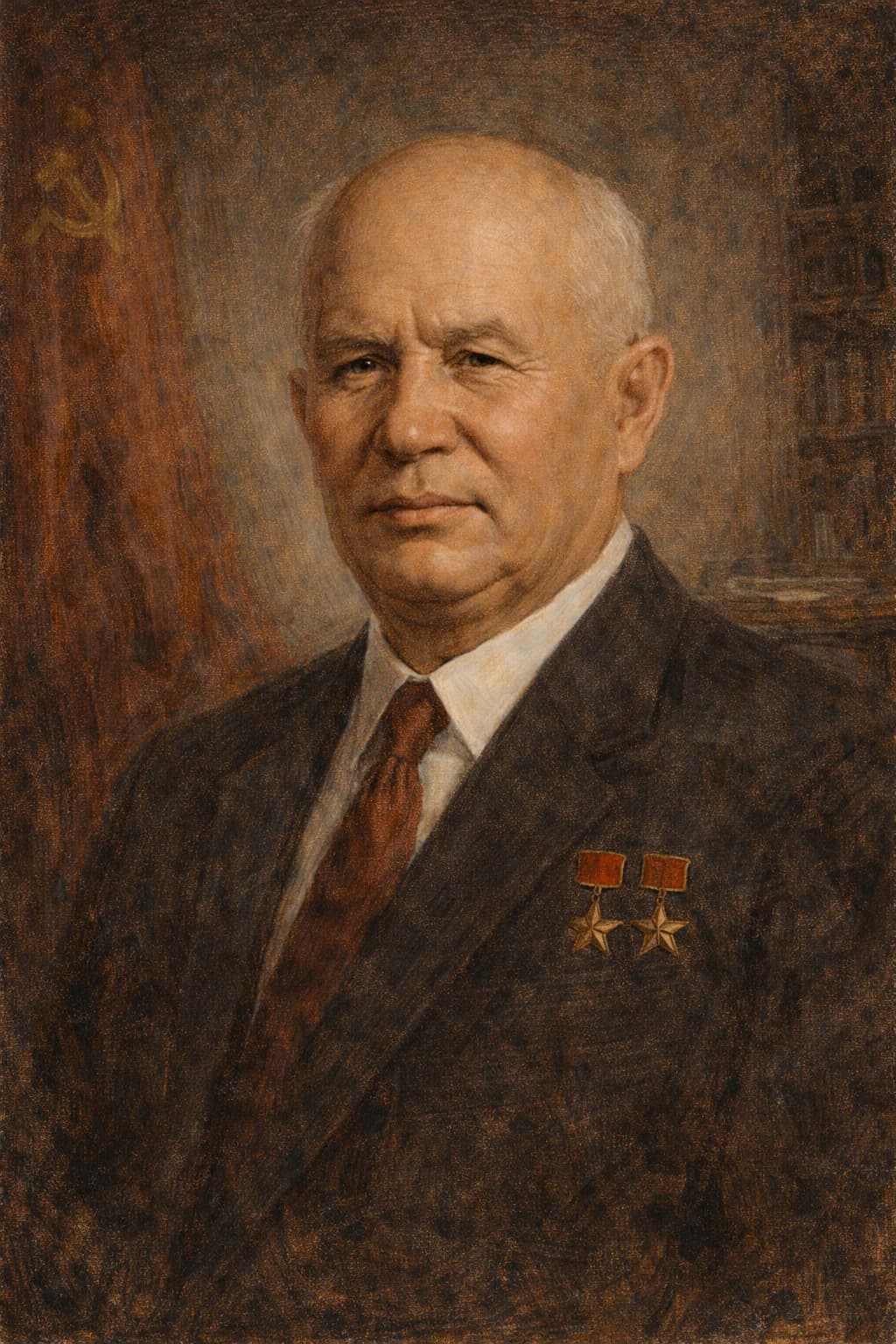
Nikita Sergeyevich Khrushchev was born in Kalinovka in 1894, in a poor rural household on the edge of the Russian Empire's social order. His family moved for work, and Khrushchev spent formative years in the Donbas, where mining, metalwork and industrial labour exposed him to the rough world of workers before the Revolution. He had little formal schooling and never lost the bluntness of a self-made party man. That background mattered. Khrushchev's later politics mixed genuine concern for ordinary living standards with administrative impatience and theatrical confidence. He understood poverty from experience, but he also came to believe that vast social change could be driven from above by men with willpower, slogans and machinery.
His early poverty gave him a lifelong sensitivity to inequality, even as he later ruled from immense power.
1917–1920s
Joining revolution
The Bolshevik Revolution gave Khrushchev a route into power that the old empire would never have offered. He joined the party in 1918 and served as a political worker during the Civil War, absorbing the habits of command, mobilisation and ideological loyalty. He was not a theorist like Lenin or Trotsky. His strength was practical organisation: getting work done, pleasing superiors, managing local cadres and speaking the language of class ascent. In the 1920s he built a career in the Ukrainian party apparatus and continued his education through party channels. Khrushchev belonged to the generation for whom the Soviet system was both liberation and ladder. It lifted him, trained him and taught him ruthlessness.
His rise showed that political survival often depended more on loyalty and timing than ideology alone.
1930s
Climbing ranks
Khrushchev's 1930s career cannot be separated from Stalinism. He advanced in Moscow party politics, became a member of the Central Committee, and later served as party boss in Ukraine. Advancement during the Great Purge required loyalty, denunciation and willingness to implement central orders. Khrushchev was not merely a frightened bystander. He signed arrest lists and helped enforce a political culture that destroyed thousands of lives. Later, in power, he would denounce Stalin's crimes and release many prisoners, but he never fully escaped the moral shadow of his own participation. This contradiction is central to his biography: the reformer was made by the system he tried to soften.
He survived a brutal system that eliminated many, shaping both his caution and later reforms.
1941–1945
War leadership
The German invasion in 1941 placed Khrushchev in the centre of Soviet catastrophe and recovery. As a senior political figure in Ukraine, he witnessed the rapid collapse of Soviet positions, the loss of Kyiv and the brutal occupation of lands he knew well. He later served at Stalingrad and other fronts as a political representative, not a battlefield commander, but one whose job was to maintain party control, morale and communication with Stalin's centre. The war strengthened his standing because he survived disaster, remained visible near the front and associated himself with victory. It also reinforced his belief that mass mobilisation and sacrifice could achieve the impossible when directed with enough urgency.
War reinforced his reputation as a dependable figure in moments of extreme national stress.
1953–1955
Seizing leadership
Stalin's death in March 1953 left the Soviet leadership terrified of both one another and the system he had built. Lavrentiy Beria controlled the security apparatus, Georgy Malenkov appeared powerful in government, and Khrushchev initially looked less formidable. He survived because he understood the party machine. Beria was arrested and executed, Malenkov was gradually pushed aside, and Khrushchev built support among officials who feared a return to uncontrolled police terror. His rise was not inevitable or gentle. It was a struggle inside a dictatorship trying to become less murderous without becoming democratic. By 1955-1956, Khrushchev had the authority to do something no predecessor had dared: attack Stalin's legacy from the centre of Soviet power.
His ascent reflected political skill rather than inevitability, shaped by careful alliance-building.
1956
Rejecting terror
Khrushchev's Secret Speech to the Twentieth Party Congress in February 1956 was one of the twentieth century's great political shocks. He condemned Stalin's cult of personality, purges, torture, deportations and disastrous wartime judgement, while carefully preserving Lenin, socialism and the Communist Party from full responsibility. The speech was secret in form but soon known across the communist world. It opened prisons, encouraged criticism and made limited cultural thaw possible. It also destabilised Soviet authority. In Poland and especially Hungary, reform demands surged; Soviet tanks crushed the Hungarian Revolution later that year. Khrushchev wanted to humanise Soviet rule, not surrender control. De-Stalinization therefore carried both liberation and violence from the start.
By confronting past abuses, he opened space for change but also exposed the system’s fragility.
1958–1962
Global confrontation
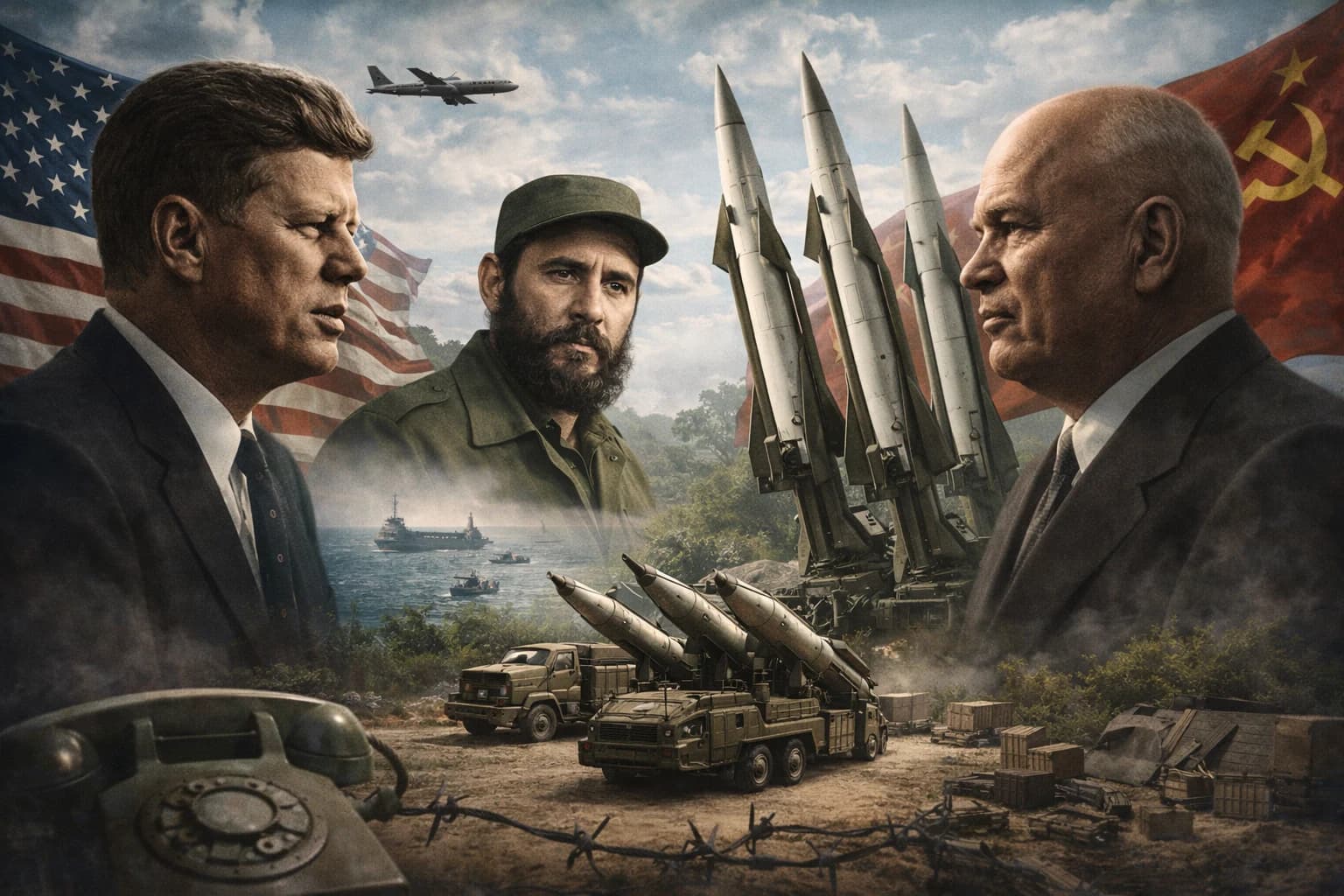
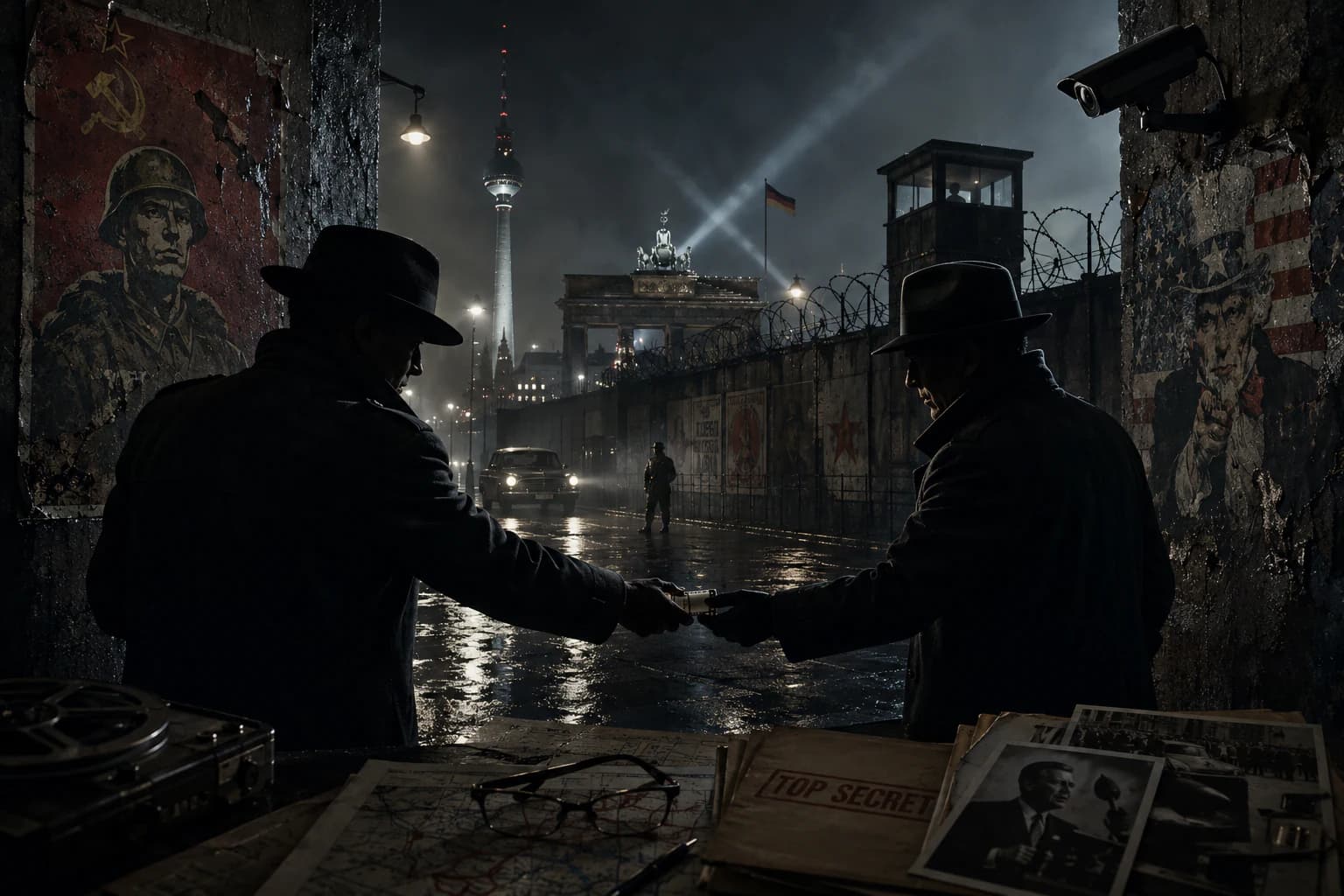
Khrushchev's Cold War style was explosive, improvisational and sometimes effective. He boasted that socialism would overtake capitalism, celebrated Sputnik in 1957 as proof of Soviet modernity, and challenged the Western position in Berlin. He also visited the United States and argued for peaceful coexistence because nuclear war could destroy both systems. The contradiction peaked in Cuba. By placing Soviet nuclear missiles on the island in 1962, Khrushchev tried to protect Fidel Castro, redress the strategic imbalance with the United States and force Washington to respect Soviet power. The gamble nearly produced nuclear war. He withdrew the missiles in return for a U.S. pledge not to invade Cuba and a quieter removal of American Jupiter missiles from Turkey. He had risked catastrophe, then chosen retreat.
He pushed confrontation to the edge but ultimately chose restraint over destruction.
1962–1964
Losing support
Khrushchev's domestic record was restless. He promoted housing construction on a huge scale, improving everyday life for millions, but his agricultural schemes lurched from enthusiasm to disappointment. The Virgin Lands campaign initially raised grain output, then suffered from erosion and poor planning. His obsession with maize became a symbol of overconfident improvisation. He reorganised party and economic structures repeatedly, irritating officials who valued predictability. After the Cuban Missile Crisis, many colleagues concluded that he had embarrassed the Soviet Union abroad and unsettled it at home. In October 1964, while he was away on holiday, Leonid Brezhnev and others organised his removal. Unlike Stalinist transitions, he was pensioned off rather than killed. That was itself evidence of a changed Soviet system.
His fall showed that even strong leaders could be replaced when instability outweighed loyalty.
1964–1971
Lasting impact
Khrushchev spent his final years in enforced obscurity, dictating memoirs and watching the Brezhnev leadership slow or reverse parts of his experiment. His legacy is impossible to reduce to a single verdict. He was complicit in Stalinism, then became the man who made Stalinism discussable. He loosened terror, expanded housing, encouraged science and space achievement, and gave Soviet society more room to breathe. He also crushed Hungary, bullied artists, mismanaged agriculture and brought the world close to nuclear war. To ask why Khrushchev was important is to see a Soviet leader who tried to reform a command system without abandoning its monopoly of power. He disrupted the USSR more than he stabilised it, and the consequences lasted long after his fall.
His legacy lies in disruption rather than resolution, leaving behind a system partly changed but still unsettled.