Complete chronology
Full overview and deeper context for every journey step.
1901
Elite family roots
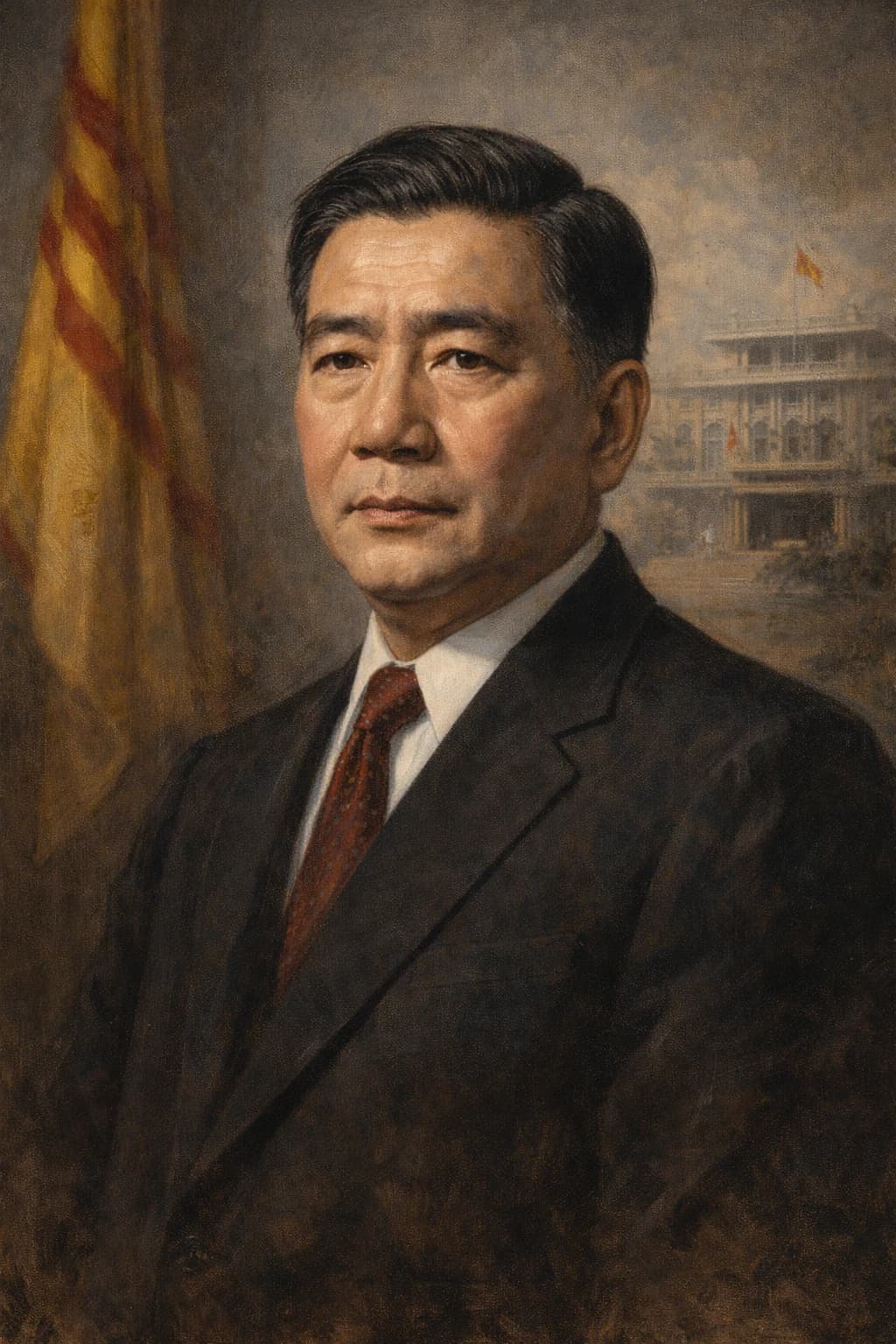
Ngo Dinh Diem was born in 1901 near Hue into a prominent Vietnamese Catholic family connected to the Nguyen imperial administration. His father, Ngo Dinh Kha, had served the court, and the family combined Confucian ideas of hierarchy and duty with a Catholic identity that set them apart in a majority Buddhist society. This background gave Diem confidence, discipline and a strong sense of moral mission. It also narrowed his political instincts. He saw authority as something exercised from above by principled men, not negotiated through broad participation. Diem's later nationalism was real, but it was never populist in the style of Ho Chi Minh. It was mandarin, Catholic, anti-communist and intensely personal.
His upbringing blended privilege and isolation, planting the seeds for both confidence and rigidity in his leadership style.
1920s–1930s
Early government service
Diem entered imperial administration under French colonial rule and rose rapidly, becoming known for personal austerity and administrative seriousness. But the imperial system offered Vietnamese officials responsibility without real sovereignty. France retained decisive power, while the Nguyen court operated within colonial limits. Diem resigned in 1933 after concluding that reform from inside the system was impossible. The resignation gave him nationalist credibility, but it also showed a pattern that would recur throughout his career: he preferred withdrawal or confrontation to compromise he considered dishonourable. His anti-colonial stance was sincere, yet he rejected the communist-led revolutionary movement that increasingly dominated Vietnamese nationalism.
Leaving power early showed his willingness to sacrifice position for principle, but also revealed a tendency toward uncompromising decisions.
1940s
Anti-communist stance
During the upheavals of Japanese occupation, the August Revolution, French return and the First Indochina War, Diem occupied a difficult nationalist space. He opposed French colonialism, rejected Japanese puppet politics and refused cooperation with Ho Chi Minh's communist-led Viet Minh. This left him morally independent but politically isolated. He spent periods under threat, in exile and in search of international support. For American Catholics, anti-communists and policymakers looking for a non-communist Vietnamese nationalist, Diem became attractive precisely because he was neither French colonial client nor communist revolutionary. The weakness was equally clear: he had a reputation, a family network and foreign admirers, but no mass movement comparable to the Viet Minh.
By opposing both sides, he gained moral independence but limited his immediate political support.
1954
Return to power
The Geneva Accords of 1954 temporarily divided Vietnam at the seventeenth parallel after France's defeat at Dien Bien Phu. Emperor Bao Dai appointed Diem prime minister of the State of Vietnam, and the United States gradually backed him as the best available anti-communist alternative in the south. His position was fragile. Saigon politics included sect armies, the Binh Xuyen criminal-political force, French influence, displaced northern Catholic refugees, religious communities and rival nationalists. Diem survived because he moved ruthlessly against opponents, won American support and presented himself as the builder of a sovereign southern state. His breakthrough was not democratic legitimacy. It was consolidation under crisis conditions.
His rise depended not only on personal conviction but also on strategic international backing.
1955
Becoming president
In 1955 Diem defeated Bao Dai in a referendum widely regarded as manipulated and proclaimed the Republic of Vietnam with himself as president. He refused the nationwide elections envisioned at Geneva, arguing that free elections were impossible in the communist north and fearing, with reason, that Ho Chi Minh would probably win a national vote. Diem built a state around central authority, anti-communism and personal loyalty. His brother Ngo Dinh Nhu became a crucial strategist, controlling the Can Lao party and security networks, while other family members held influence that fed accusations of nepotism. The new republic gained order in some areas, but its political foundations were narrow and coercive from the start.
His consolidation of power created stability but also narrowed the system around his personal authority.
late 1950s
Authoritarian rule
Diem's South Vietnam faced a real communist insurgency, but his response often blurred security with political repression. Former Viet Minh networks, land grievances and anger at local officials fed resistance that became the Viet Cong insurgency. Diem's Strategic Hamlet Program, designed to separate rural populations from guerrillas, was unevenly implemented and often alienated peasants by forcing relocation or relying on corrupt local power. Opposition parties, journalists and religious critics faced surveillance and prison. Diem valued moral order and national discipline, but he distrusted pluralism. American advisers pressed for reform while expanding support. The contradiction became fatal: Washington wanted Diem strong enough to fight communism, but flexible enough to win legitimacy. He was much better at the first than the second.
Efforts to enforce stability through control often deepened the very tensions he aimed to suppress.
1963
Buddhist unrest
The Buddhist crisis of 1963 exposed the depth of Diem's isolation. After authorities restricted Buddhist flags during Vesak celebrations in Hue, protests erupted; government forces fired on demonstrators, killing civilians. Buddhist leaders demanded religious equality, compensation and an end to repression. The regime's response was defensive and often brutal. The self-immolation of Thich Quang Duc in Saigon produced one of the most powerful images of the twentieth century, shocking global opinion. Nhu's special forces later raided pagodas, deepening outrage. The issue was not simply religion. It symbolised a wider perception that Diem's Catholic-dominated inner circle treated much of the population with suspicion and contempt.
The unrest showed that legitimacy cannot be sustained when large groups feel excluded or targeted.
1963
Coup and death
By late 1963, South Vietnamese generals were plotting against Diem with signals from American officials that the United States would not necessarily protect him. Washington did not simply order the coup, but it created the political environment in which conspirators believed they could act. On 1 November 1963, military leaders moved against the palace. Diem and Nhu escaped briefly to Cholon but were captured and killed the next day in an armoured personnel carrier. Their assassination shocked even some who had accepted the coup. Removing Diem did not solve South Vietnam's problems. It shattered the existing state structure and opened a cycle of military governments, coups and deeper American involvement.
When authority loses both internal trust and external support, its collapse can be swift and irreversible.
Post-1963
Contested legacy
Ngo Dinh Diem's legacy remains contested because the choices around him were genuinely hard. He was not merely an American puppet; he was a Vietnamese nationalist with his own convictions, anti-colonial credentials and stubborn independence. He also built an authoritarian, family-centred regime that alienated many of the people it needed to mobilise. Supporters argue that he held South Vietnam together during its most fragile founding years and resisted both communism and foreign domination. Critics answer that his repression, nepotism and failure to broaden legitimacy strengthened the insurgency and made collapse more likely. His death did not end the Vietnam War. It removed one flawed centre of authority and left the United States more responsible for everything that followed.
His story illustrates how leadership choices can define both the rise and unraveling of a nation.