Complete chronology
Full overview and deeper context for every journey step.
-135
Royal beginnings
Mithridates VI Eupator was born around 135 BC into a dynasty that claimed descent from Persian nobility while ruling a kingdom deeply connected to Greek cities and Black Sea trade. Pontus sat at a crossroads: Anatolian hinterland, Hellenistic court culture, mountain strongholds, coastal commerce and the expanding shadow of Rome. His father, Mithridates V, was assassinated, reportedly by poison, leaving a young heir in a dangerous court. Later stories say Mithridates fled into the countryside, hardened his body, learned many languages and experimented with small doses of poisons to protect himself. Some details may be legend, but they reveal how ancient writers understood him: a ruler formed by suspicion, survival and the conviction that power belonged to those prepared for treachery.
A childhood shaped by danger often produces leaders who value control above all else.
-120s
Seizing control
Mithridates' accession was not a peaceful inheritance so much as a seizure of adult authority. His mother, Laodice, appears to have held power during his minority and favoured another son. Mithridates eventually removed her and his brother from the political equation, an act that set the tone for his kingship. He would be intelligent, energetic and culturally sophisticated, but never gentle toward threats inside his own house. Once secure, he reorganised Pontic resources around his personal rule. He cultivated the image of a Hellenistic monarch, a Persian heir and a liberator of Greek cities, using whichever identity suited the audience. In a world of dynastic murder and Roman intervention, he learned that legitimacy had to be performed and defended.
Power seized early often defines the methods a ruler uses for the rest of their life.
-110s
Building a kingdom
Once secure at home, Mithridates pushed Pontic influence across the Black Sea and into Anatolia. He took control of Colchis, extended power into the Bosporan Kingdom in Crimea, intervened in Cappadocia and Paphlagonia, and used marriage diplomacy to connect his dynasty with neighbouring rulers. This was not random expansion. The Black Sea grain routes, ports, mountain passes and buffer kingdoms gave him wealth, soldiers and strategic depth. He also presented himself as a champion of Greek cities against Roman greed. That appeal mattered because Roman tax collectors and allied kings had made Roman influence deeply unpopular in parts of Asia Minor. Mithridates was building more than a kingdom. He was building an anti-Roman alternative.
Expansion can bring strength, but it also invites powerful enemies to take notice.
-88
Challenging Rome
The First Mithridatic War began from overlapping ambitions in Asia Minor, where Rome backed client rulers and Mithridates backed his own candidates. In 88 BC he moved with breathtaking audacity. He overran Roman-aligned territories, entered Roman Asia and ordered or encouraged coordinated killings of Romans and Italians across the province, an event later remembered as the Asiatic Vespers. Ancient casualty numbers may be inflated, but the political message was unmistakable: Roman rule could be uprooted. Greek cities in Asia and parts of Greece welcomed him as a liberator, partly from conviction and partly from fear. The attack shocked Rome, already divided by civil conflict between Marius and Sulla. Mithridates had turned regional rivalry into a war for the eastern Mediterranean.
A bold strike can reshape a conflict instantly, but it also commits both sides to a deeper struggle.
-80s
Holding ground
Rome's response came through Lucius Cornelius Sulla, who crossed into Greece while Roman politics at home remained violently unstable. Mithridates' armies suffered major defeats at Chaeronea and Orchomenus in 86 BC, and his hold over Greece collapsed. Yet Sulla needed to return to Italy to fight his Roman enemies, so the peace of Dardanus in 85 BC was surprisingly lenient. Mithridates surrendered conquests, ships and money, but kept his throne. That outcome reveals both his resilience and Rome's distraction. He had failed to expel Rome, but he had survived the first round against a Republic that usually destroyed defeated enemies. The lesson he drew was dangerous: Rome could be resisted when its own politics were fractured.
Endurance becomes the true measure of strength when quick victories fade.
-74
Roman resurgence
The decisive phase began in 74 BC when King Nicomedes IV of Bithynia left his kingdom to Rome. Mithridates saw Roman annexation as a direct threat and struck again. Lucius Licinius Lucullus led the Roman counterattack with skill, pushing deep into Pontus and then pursuing Mithridates into Armenia, where the Pontic king found refuge with his son-in-law Tigranes the Great. The war became a test of endurance across difficult terrain, long supply lines and shifting loyalties. Mithridates could still raise armies and recover after defeats, but Rome's manpower and command structure kept returning. Lucullus won brilliant victories, yet his troops tired of endless campaigning. Mithridates survived because Rome's strength was immense but never perfectly coordinated.
When momentum shifts, even powerful leaders must learn to adapt or decline.
-66
Defeat and retreat
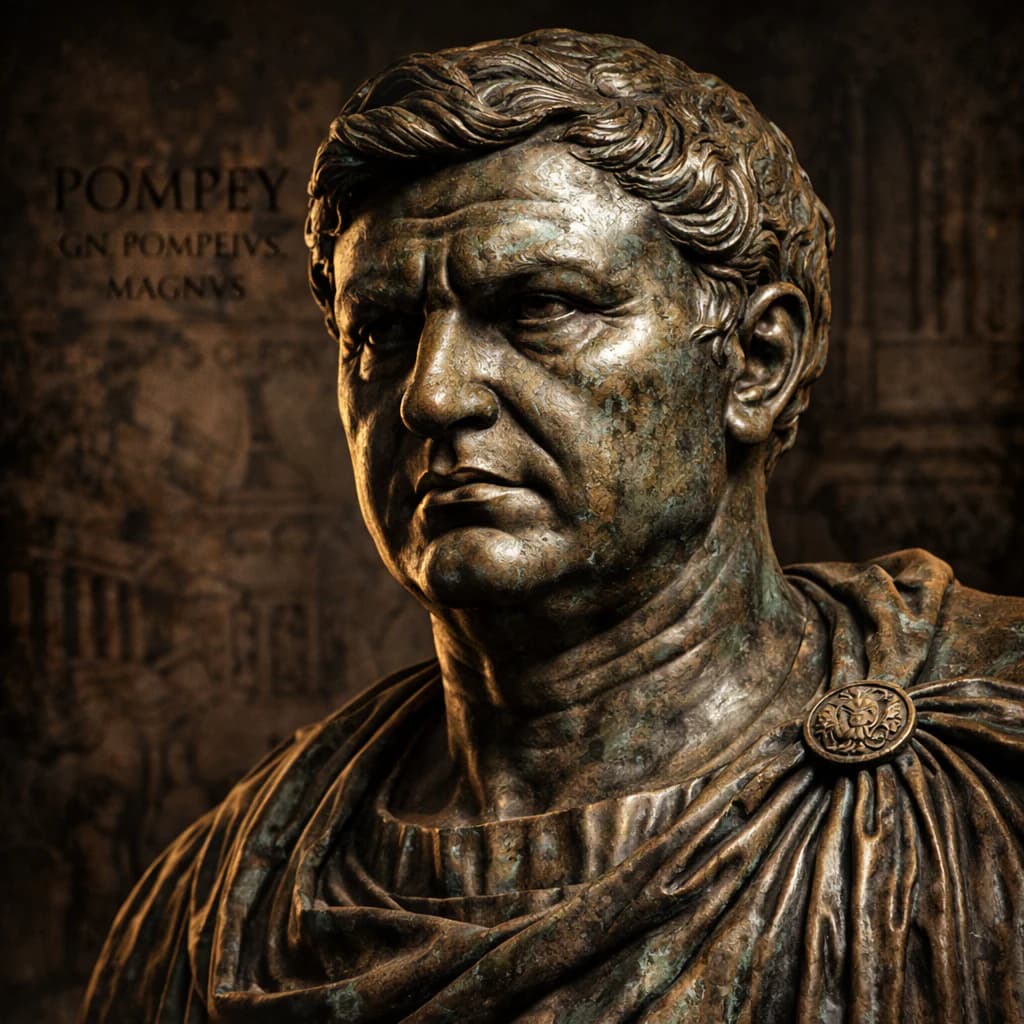
The Roman command eventually passed to Pompey, who combined military pressure with diplomatic settlement. In 66 BC Pompey defeated Mithridates and pursued him through the Caucasus world, stripping away allies and leaving the old king with fewer choices. Mithridates fled to the Bosporan Kingdom in Crimea, still refusing surrender. Ancient sources claim he imagined a vast northern campaign through the Balkans and into Italy, a plan that may have been more fantasy than strategy by this point. Yet even the idea shows the scale of his defiance. Most kings beaten by Rome negotiated for survival. Mithridates kept looking for a way to make the war global, even as his resources, age and family loyalty failed him.
Defeat does not always end resistance, but it narrows the paths available.
-63
Last stand
Mithridates' final enemy was not a Roman general but political exhaustion. His son Pharnaces rebelled, and the soldiers who had followed the king through decades of war no longer wanted another impossible campaign. Cornered at Panticapaeum in 63 BC, Mithridates chose death. The famous story says poison failed because he had long accustomed his body to antidotes and small doses, forcing him to ask a guard to kill him with a sword. The details may be shaped by legend, but they are perfectly fitted to the memory of the man: the poison king whom poison could not end. His death closed the Mithridatic Wars and allowed Rome to reorganise the east on a scale impossible while he lived.
A long fight can end not with a final battle, but with the collapse of support.
After -63
Enduring legacy
Mithridates VI mattered because he made Rome fight for the east. He was not a doomed local rebel but a serious Hellenistic monarch with money, fleets, languages, propaganda, dynastic alliances and the ability to turn resentment of Roman exploitation into war. He also committed atrocities and ruled with suspicion, killing relatives and enemies when survival demanded it. His legacy therefore resists romance. He was a cultured king and a brutal one, a liberator to some Greek cities and a terrifying master to others. Rome defeated him, but the struggle forced Roman commanders to think in continental terms and accelerated Pompey's reorganisation of the eastern Mediterranean. Mithridates lost his wars, yet for nearly thirty years he made the Roman Republic look vulnerable.
Legacy is often defined less by victory than by the scale of the challenge posed.