Complete chronology
Full overview and deeper context for every journey step.
1869
Porbandar childhood
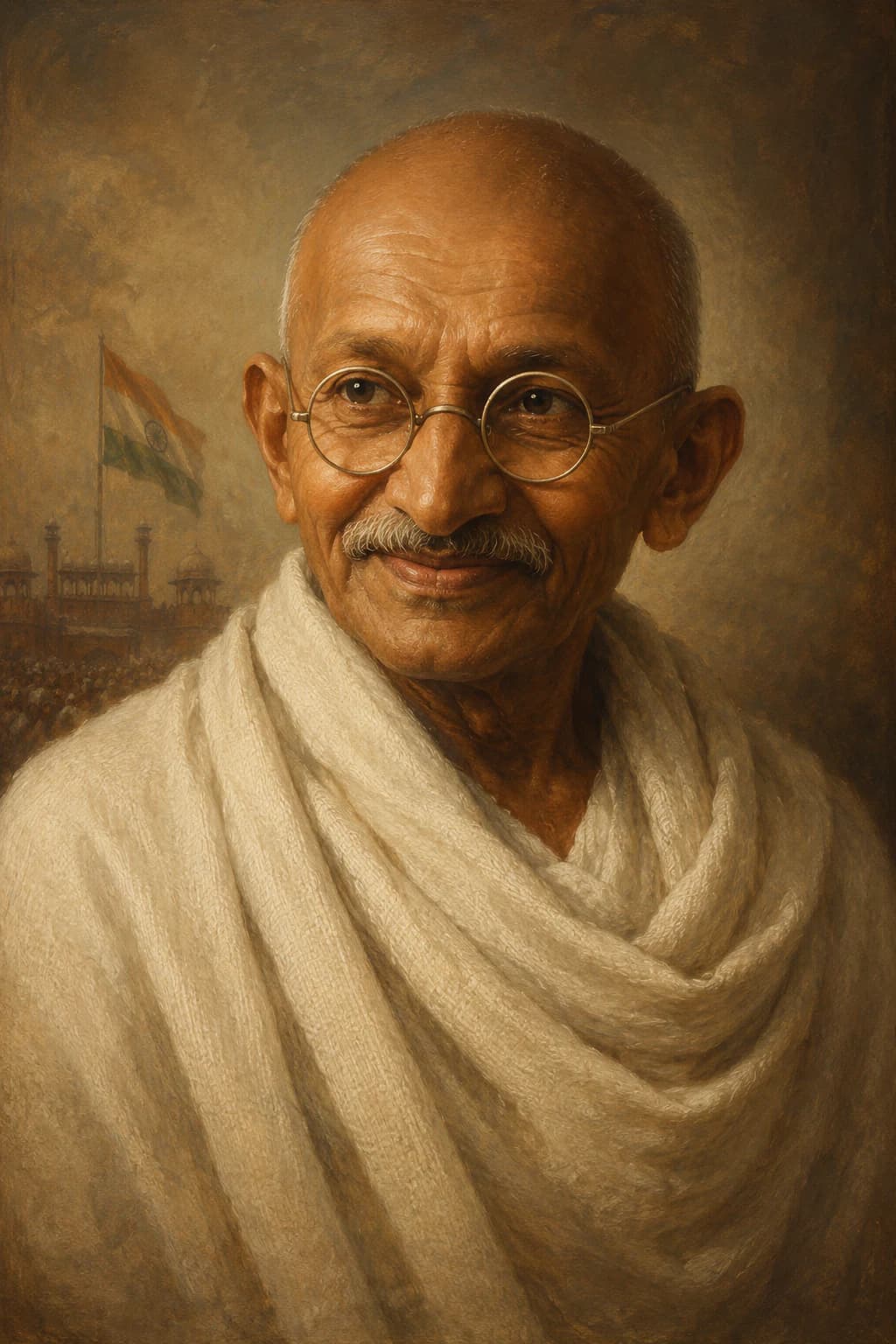
Mohandas Karamchand Gandhi was born on 2 October 1869 in Porbandar, in present-day Gujarat. His father, Karamchand Gandhi, served as a diwan, or chief minister, in small princely states, while his mother Putlibai's religious discipline left a deep impression on him. Gandhi grew up inside a world shaped by Hindu devotional practice, Jain-influenced ideas of restraint and the layered politics of British paramountcy over Indian princely rule. He was not born a national leader. His early life was provincial, religiously textured and socially conventional, including a childhood marriage to Kasturba.
The moral language of his politics drew partly from habits and disciplines learned long before he entered public life.
1888-1891
London training
In 1888, Gandhi travelled to London to study law at the Inner Temple. The move exposed him to imperial Britain from the inside: its manners, institutions, reform movements and confidence. He struggled with identity, diet, religion and social expectations, joining vegetarian circles and reading widely. London did not make him a radical nationalist, but it broadened his sense of moral experimentation. He returned to India as a barrister in 1891, professionally trained but uncertain, and struggled to establish a legal career. His transformation would come not in Britain or India, but in South Africa.
Legal training gave him tools, but displacement gave him a political education.
1893
South African awakening
Gandhi arrived in South Africa in 1893 to work on a legal case for an Indian merchant firm. There he encountered the racial hierarchy of a settler society that treated Indians as inferior regardless of education or status. The famous incident in which he was removed from a first-class railway compartment at Pietermaritzburg became a symbol of this awakening, though it was one episode in a wider pattern of discrimination. Gandhi began organising Indian communities, petitioning authorities and learning how law, publicity and disciplined protest could be combined.
South Africa turned Gandhi from an uncertain lawyer into a public organiser.
1906
Satyagraha
In South Africa, Gandhi developed the method he called satyagraha, often translated as truth-force or soul-force. It was not passive submission. It demanded refusal, discipline, willingness to suffer and insistence on the moral dignity of the opponent as well as the protester. Campaigns against discriminatory registration laws and other restrictions tested this method in practice. Gandhi also created communal experiments such as Phoenix Settlement and Tolstoy Farm. These years refined his beliefs about self-rule, simplicity, celibacy, labour and public ethics, though some of his early views, especially on race, remain rightly scrutinised by historians.
Satyagraha made protest a test of character as well as a strategy of pressure.
1915
Return to India
Gandhi returned to India in 1915, already known among politically aware Indians but not yet the central figure of nationalism. He travelled, observed and learned before plunging into major national agitation. Campaigns in Champaran, Kheda and Ahmedabad brought him into contact with peasants, workers and local grievances. These struggles showed his distinctive method: link immediate suffering to wider injustice, discipline protest to avoid uncontrolled violence, and use personal austerity to build trust. By the end of the First World War, Gandhi was becoming the figure who could connect elite nationalism with mass participation.
His rise in India came because he made national politics feel local, ethical and participatory.
1920-1922
Non-cooperation
After the Rowlatt Acts and the Jallianwala Bagh massacre of 1919, Gandhi's politics hardened against British rule. The Non-Cooperation Movement called on Indians to boycott titles, schools, courts, cloth and institutions tied to imperial authority. It was a massive escalation, drawing students, workers, peasants and urban activists into a shared campaign. Gandhi linked it with the Khilafat movement, a decision that expanded mobilisation but also carried religious and political risks. In 1922, after violence at Chauri Chaura, he suspended the movement, insisting that means mattered as much as ends. Many supporters were frustrated, but Gandhi would not separate freedom from discipline.
He made mass politics powerful, then showed he would halt it when it violated his principles.
1930
Salt March
In 1930, Gandhi chose the British salt monopoly as the focus for civil disobedience. The choice was brilliant because salt touched every Indian life, rich or poor, Hindu, Muslim, Sikh or Christian. Gandhi walked from Sabarmati Ashram to Dandi on the Arabian Sea, gathering attention with every mile. When he made salt in defiance of the law, the act was simple, visual and politically devastating. Repression followed, but so did worldwide publicity. The Salt March did not immediately win independence; it made the British Empire appear morally vulnerable before a global audience.
Gandhi's genius lay in finding symbols ordinary enough to be universal and sharp enough to wound empire.
1942
Quit India
The Second World War placed India's future under extreme pressure. Britain had entered India into the war without Indian consent, while Japanese advances in Asia made imperial vulnerability visible. In 1942, Gandhi and the Indian National Congress launched the Quit India movement, demanding immediate British withdrawal. The colonial state arrested Gandhi and Congress leaders, and unrest spread across the country. Gandhi's wife Kasturba died in detention in 1944. The movement was suppressed, but the war changed everything: Britain's resources, legitimacy and ability to maintain empire were weakening rapidly.
Quit India showed that British rule could survive repression but not recover its old authority.
1947-1948
Partition and assassination
India became independent in August 1947, but freedom arrived with Partition, mass migration and terrible violence between communities. Gandhi did not hold office in the new state. Instead, he moved through places of fear and grief, fasting and pleading for peace in Bengal and Delhi. He opposed hatred against Muslims and insisted that moral responsibility did not end with independence. On 30 January 1948, Nathuram Godse, a Hindu nationalist who blamed Gandhi for weakening Hindu interests, assassinated him in Delhi. Gandhi's death sealed his global image as a martyr of nonviolence, but his legacy remains more demanding than a slogan: he forced politics to answer to conscience.
His final struggle was not against foreign rule, but against the violence that freedom had failed to contain.