Complete chronology
Full overview and deeper context for every journey step.
-2600–-2589
Royal birth
Khufu, also known by the Greek form Cheops, belonged to the royal family of Egypt's Old Kingdom, a period when kingship was presented as the hinge between human order and divine stability. He was probably the son of Sneferu, the pharaoh whose own pyramid projects helped perfect the techniques later used at Giza, and Queen Hetepheres I. That inheritance mattered. Khufu did not begin from nothing; he came to power after generations of administrative growth, agricultural taxation, skilled craft organization, and royal monument building. In Egyptian ideology, the king was responsible for maintaining maat, the right order of the world. In practical terms, that meant controlling land, labor, officials, cults, quarries, transport, and food supplies. Khufu's early world was therefore both sacred and bureaucratic, where a ruler's afterlife project could become a national act of coordination.
In some societies, leadership is shaped as much by belief as by power.
-2589
Ascending the throne
Khufu's accession placed him at the head of one of the most organized states in the ancient world. Egypt's Nile valley gave the crown predictable agricultural wealth, but a pyramid reign still required more than abundance. Officials had to assess harvests, move stone, feed workers, supervise craftsmen, and keep religious and provincial elites tied to the court. The surviving evidence for Khufu as a person is thin, which is why his biography must be built carefully from archaeology, inscriptions, later traditions, and the monument itself. What can be said with confidence is that he ruled as a powerful Fourth Dynasty pharaoh, likely for more than two decades, and that his government had the capacity to turn royal intention into a landscape-altering project.
Taking power successfully often depends on balancing continuity with personal authority.
-2589–-2580
Strengthening authority
The Great Pyramid can make Khufu seem like a solitary will imposed on stone, but its construction reveals a system. Work gangs, supply teams, scribal records, planned settlements, bakeries, breweries, harbors, and causeways all point to a highly managed labor force. The old image of a pyramid built by anonymous slaves is misleading; current evidence points instead to organized workers, many likely serving through seasonal or state labor obligations, supported by rations and specialist crews. Khufu's authority rested on this administrative machinery. He could not personally cut stone or calculate alignments, but he could command a state that made those tasks continuous. His achievement was not only architectural. It was governmental: turning agriculture, tax, skilled labor, logistics, and belief into a single sustained enterprise.
Strong organization is often the unseen foundation of visible achievements.
-2580
Vision of monument
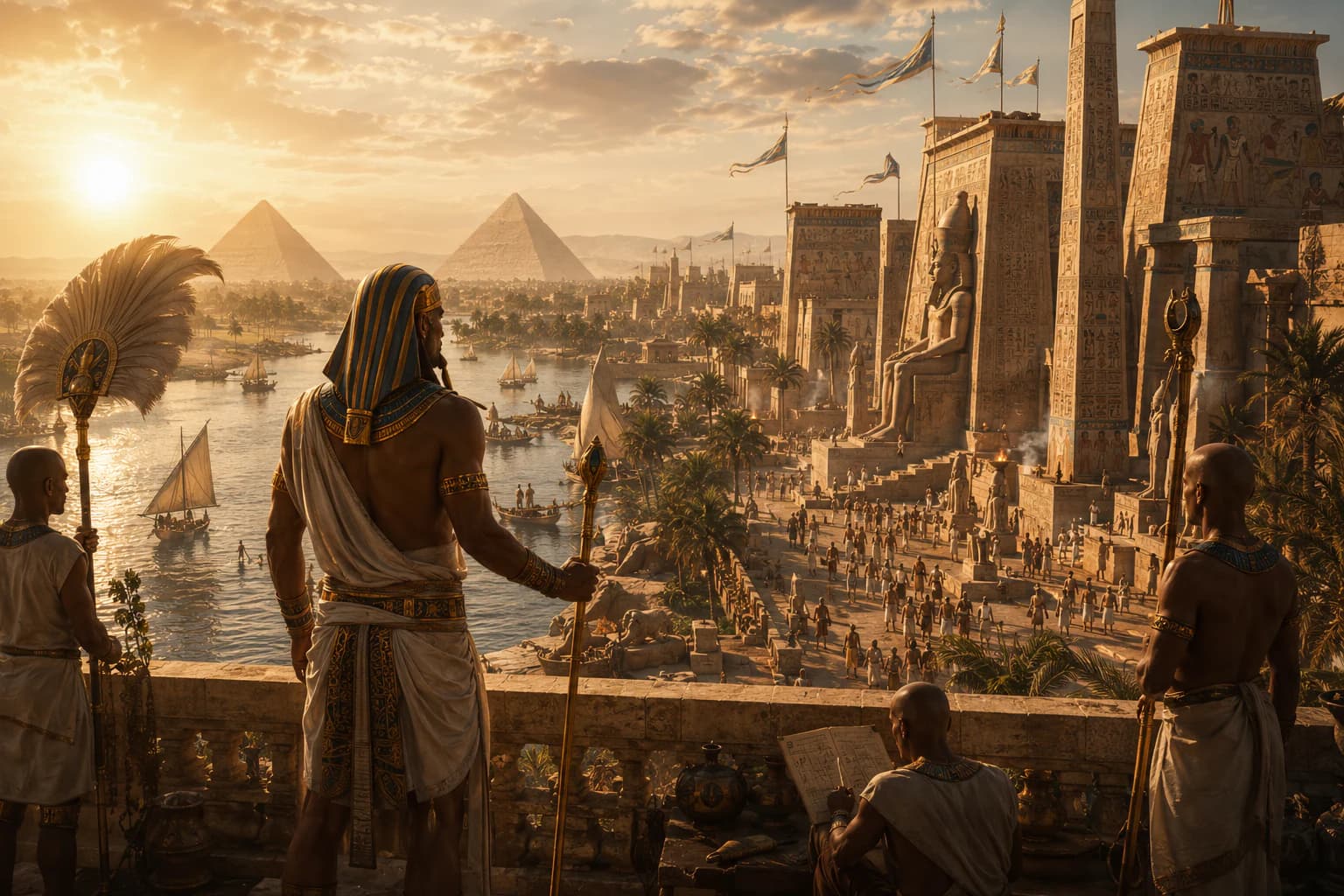
The decision to build at Giza was spiritual, political, and practical at once. A pyramid was not just a tomb. It was the center of a mortuary complex with temples, causeways, subsidiary burials, ritual spaces, and a place in the sacred geography of kingship. Its shape pointed toward the sky and the solar language that was becoming central to royal ideology. Its scale announced that Khufu's authority could command distance, time, and labor. Giza also offered high bedrock, visibility, and access to Nile transport routes when the river flooded near the plateau. The project was therefore not an isolated structure but a planned royal environment. To ask why Khufu mattered is to see how one reign crystallized the Old Kingdom's confidence: the state could make stone speak for eternity.
Monumental projects often serve both spiritual and political purposes.
-2580–-2570
Pyramid construction
The pyramid's numbers still unsettle the imagination: millions of stone blocks, a base aligned with remarkable precision, and a finished height originally around 146 meters. The limestone core was quarried largely nearby; finer Tura limestone casing came from across the Nile; granite used in internal chambers was brought from Aswan far to the south. How every block was moved and raised remains debated, with ramp systems, levers, sledges, water management, and staged platforms all discussed by specialists. The uncertainty should not be filled with fantasy. The important point is clearer: Egyptians possessed the surveying skill, organizational discipline, and practical engineering experience to solve immense problems with the tools available to them. Khufu's pyramid is not evidence of mystery replacing human ability. It is evidence of human ability organized at royal scale.
Large achievements are often the result of coordinated effort rather than individual action.
-2570–-2568
Peak authority
Giza became a courtly and administrative world as well as a burial ground. Around Khufu's pyramid were cemeteries for queens, princes, high officials, and those whose status was tied to the royal project. Tomb inscriptions and mastabas show how careers, family honor, and afterlife hopes were connected to service near the king. This is one reason Khufu's reign matters beyond the pyramid itself. It shows how Old Kingdom power bound elite ambition to royal monument building. To be close to the king in death was to be close to cosmic and political order. Yet later Egyptian and Greek traditions sometimes remembered Khufu harshly, portraying him as oppressive or impious. Those stories reveal later attitudes toward enormous royal projects, but they cannot be read simply as eyewitness biography.
Power becomes most visible when it can shape both systems and symbols.
-2568–-2566
Completion of pyramid
When finished, Khufu's pyramid would have gleamed with smooth casing stones and dominated the western horizon near Memphis. It was a tomb, a ritual machine, a royal statement, and a feat of mathematical and logistical control. Its internal passages, chambers, relieving spaces, and sealed routes show careful design, even where modern observers still debate the purpose of particular features. Completion did not merely mark the end of construction. It secured Khufu's name in a way no inscription alone could have done. Many pharaohs left fuller records, fought more visible wars, or governed in periods with richer documentation. Khufu left a structure that made forgetting him almost impossible.
Lasting monuments can extend a leader’s influence far beyond their lifetime.
-2566
Final years
The silence around Khufu's personality is one of the striking facts of his biography. We have no detailed court chronicle, no personal memoir, and only limited contemporary inscriptions. Later tales, including stories preserved in the Westcar Papyrus and accounts by Greek writers, offer a more colorful Khufu, but they were composed long after his lifetime and reflect the concerns of later audiences. He was succeeded by members of the Fourth Dynasty, including Djedefre and Khafre, though the exact family politics remain debated. What survives most securely is the pattern of rule: royal monument building, centralized administration, elite service, and the continued use of Giza as a dynastic sacred landscape.
Even when details fade, major achievements can preserve a leader’s presence in history.
-2566 onward
Enduring legacy
Khufu remains famous less because we know him intimately than because his reign produced one of history's most enduring objects. That makes his legacy unusual. He is everywhere in the world's imagination and almost nowhere as a fully knowable person. The Great Pyramid shaped ancient travel writing, medieval wonder, modern archaeology, nationalist memory, and global tourism. It also challenges easy assumptions about early civilization. Its builders were not primitive laborers stumbling into greatness; they were members of a sophisticated kingdom with surveyors, administrators, sailors, quarry teams, artisans, priests, and a worldview powerful enough to justify decades of effort. Khufu's achievement was therefore double. He secured his own royal afterlife, and he gave later history one of its clearest measures of what centralized ancient Egypt could do.
A single extraordinary achievement can define how history remembers an entire life.