Complete chronology
Full overview and deeper context for every journey step.
1818
Birth in Trier
Karl Marx was born in Trier, in the Prussian Rhineland, into a household that sat at the crossroads of education, social mobility, and political restriction. His father Heinrich Marx was a lawyer of Jewish background who converted to Lutheranism in a society where professional opportunity was shaped by confessional rules. That family history gave Marx early exposure to law, rational criticism, and the pressure of institutions on private life. Trier had also been influenced by French revolutionary and Napoleonic reforms, leaving behind memories of civil rights, bureaucracy, and modern state power. Marx did not grow up as an industrial worker, and his later authority did not come from personal poverty alone. It came from a restless ability to connect philosophy, politics, and economic life into one argument about who controls society and why.
Marx’s later radical ideas grew from a childhood shaped more by education than hardship.
1835–1841
University Years
Marx's university years turned intellectual brilliance into combativeness. He studied law first, but philosophy drew him more strongly, especially the legacy of G. W. F. Hegel. Among the Young Hegelians, Marx encountered a style of criticism that treated religion, monarchy, and inherited authority as historical products rather than eternal truths. His doctoral work on ancient Greek philosophy did not yet make him the Marx of Das Kapital, but it shows the habit that would define him: abstract questions mattered only when they revealed how human beings made and remade their world. The failure to gain an academic career pushed him toward journalism, where theory met censorship, landlords, poverty, and state power.
His shift from law to philosophy marked the moment he chose ideas over convention.
1842–1843
Radical Journalism
Marx's work for the Rheinische Zeitung made him a political writer before he became a world-historical theorist. He wrote about press freedom, law, wood theft, poverty, and the limits of liberal reform under Prussian rule. The experience was decisive because it forced him away from philosophy as a purely academic pursuit. Questions of property were no longer abstractions; they shaped whether poor people could gather fuel, whether newspapers could speak, and whether the state defended public reason or elite interest. When the paper was suppressed in 1843, Marx learned a lesson that marked his entire career: criticism of society would be met not only by argument, but by police power, censorship, and exile.
Confronting censorship convinced Marx that deeper systemic change was necessary.
1844
Paris Encounter
Paris gave Marx what Prussia denied him: contact with socialists, workers' organizations, political refugees, and the arguments of European radicalism. There he deepened his critique of alienation, private property, and the modern state. The decisive encounter was Friedrich Engels, the son of a textile manufacturer who had seen industrial capitalism in Manchester at close range. Engels brought factory observation, knowledge of English political economy, and lifelong financial support. Marx brought philosophical aggression and a gift for systematic critique. Their partnership was not decorative. It changed the scale of Marx's project, pulling him from democratic radicalism toward historical materialism: the claim that economic relations and class struggle are central drivers of historical change.
Marx’s ideas gained clarity when paired with Engels’ grounded perspective.
1848
Communist Manifesto
The Communist Manifesto appeared in the revolutionary year of 1848, when old regimes across Europe were already under pressure. Its force came from compression. Marx and Engels argued that history had been shaped by class conflict, that the bourgeoisie had revolutionized production and society, and that capitalism created its own opponent in the modern working class. The text was not a neutral textbook. It was a political weapon written for the Communist League, urgent, theatrical, and deliberately international. Its predictions did not unfold exactly as written, and Marx later revised some tactical assumptions, but the manifesto gave socialism a language of world history. It made capitalism appear dynamic, creative, exploitative, and unstable all at once.
The manifesto turned abstract theory into a direct call for collective awareness.
1849–1860s
Years in Exile
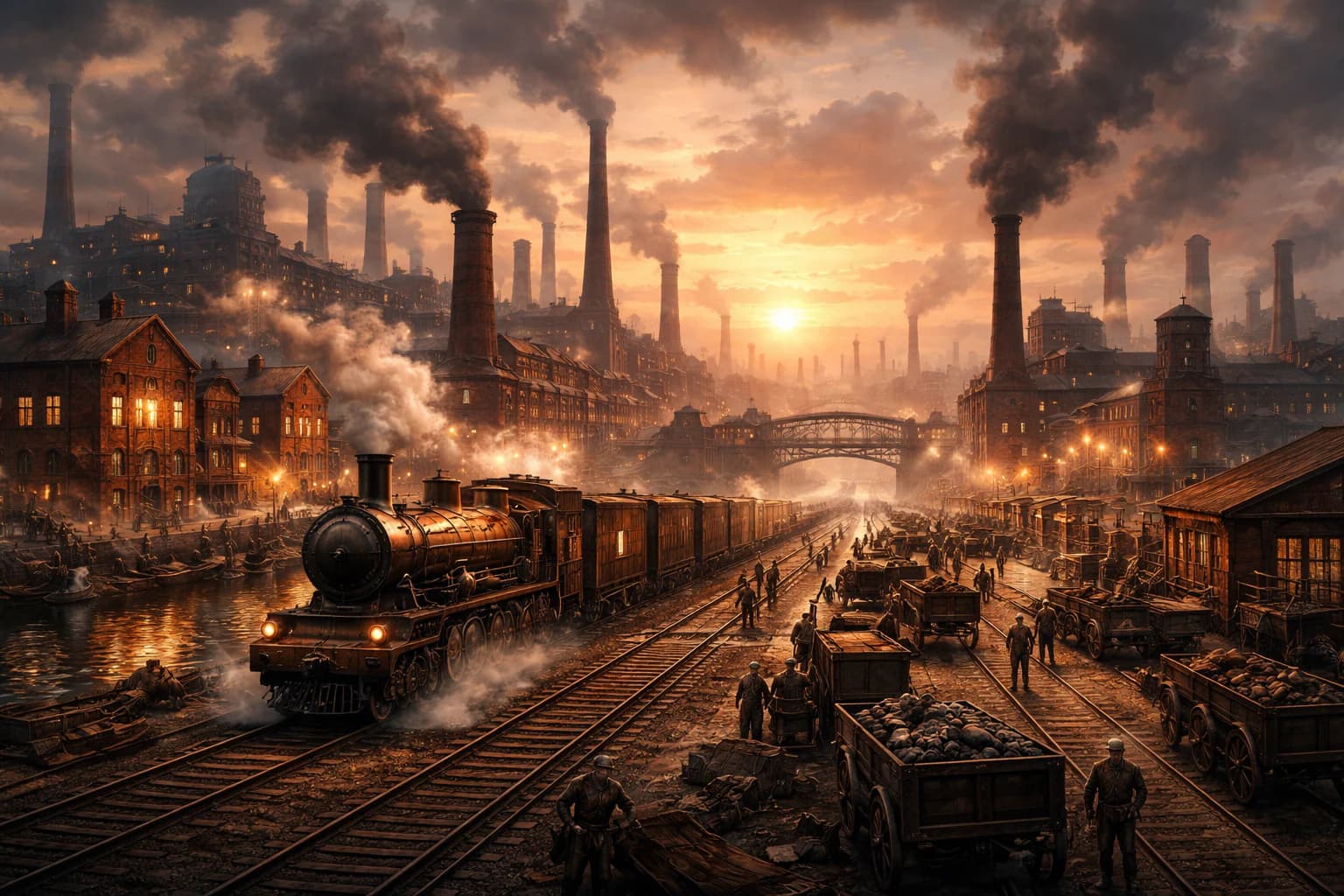
London was both refuge and punishment. Marx arrived after expulsions and failed revolutionary hopes, then spent decades in cramped conditions, recurring debt, illness, and dependence on Engels. Several of his children died young, and his household endured hardship that sat painfully beside his ambition to explain the modern economy. Yet London also gave him the best laboratory in the world. It was the capital of an industrial and imperial economy, home to financial markets, factories, docks, global trade, parliamentary reports, and the British Museum's vast collections. Marx read obsessively, filling notebooks on economics, technology, history, agriculture, colonialism, and crises. Exile narrowed his practical power but widened his intellectual field.
Material hardship sharpened his focus on the realities he was studying.
1867
Writing Capital
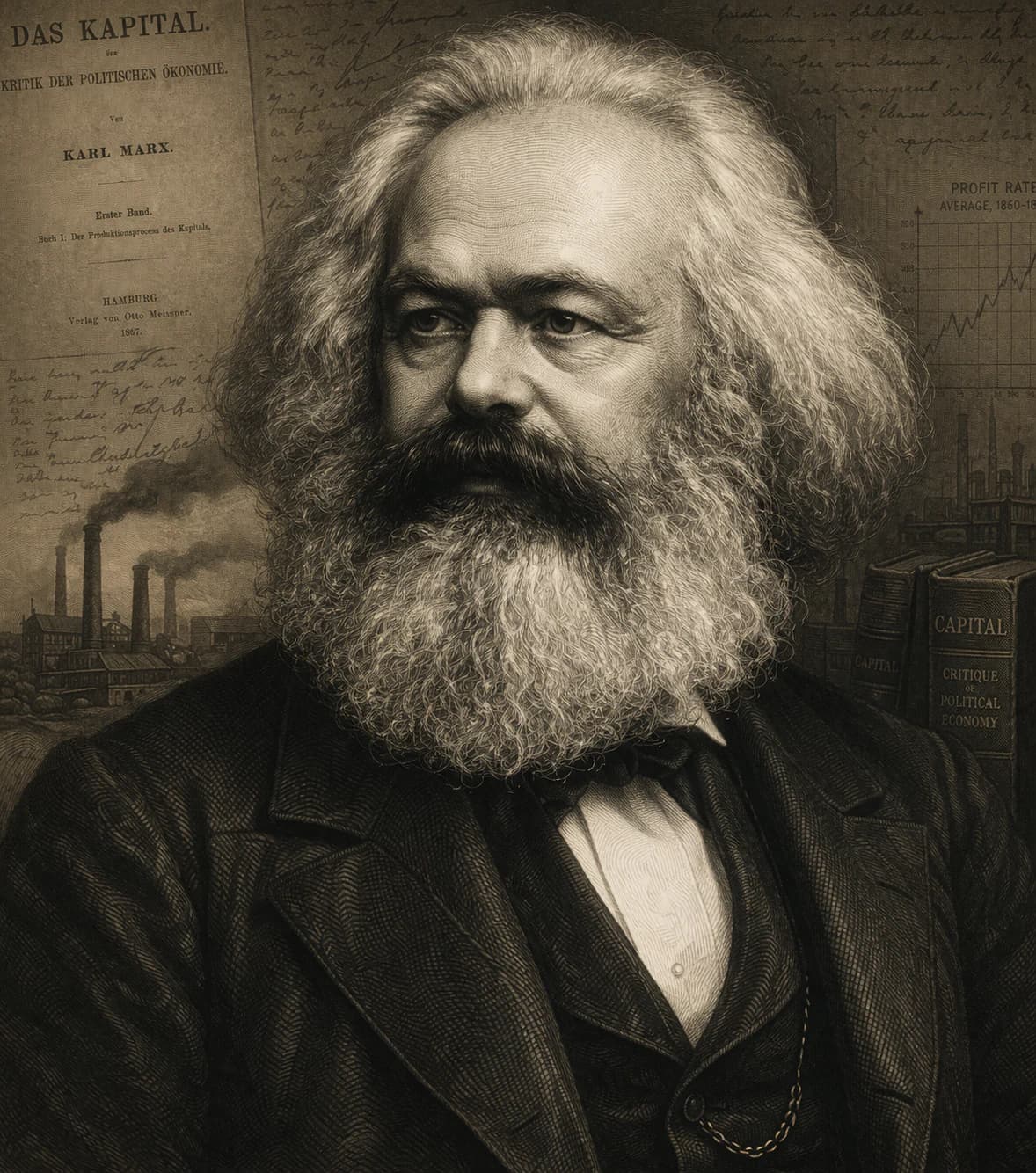
The first volume of Das Kapital appeared in 1867 after years of delay, illness, rewriting, and research. Marx wanted to show that capitalism was not simply a collection of greedy individuals or bad policies. It was a system with its own logic. He began with the commodity, then moved through value, labor power, surplus value, the working day, machinery, accumulation, and the concentration of capital. His argument was difficult and often polemical, but its central claim was clear: profit depended on social relations that appeared natural because market exchange disguised them. Later economists have challenged many parts of Marx's analysis, but his insistence that economies are historical systems of power, not neutral machines, remains one reason his work endures.
Marx transformed economic observation into a structured critique of power.
1870s–1883
Later Influence
Marx was never only a writer in a library. He was deeply involved in the International Working Men's Association, where he drafted addresses, argued strategy, and clashed with anarchists such as Mikhail Bakunin. He followed the Paris Commune of 1871 closely, praising its radical experiment while drawing lessons from its defeat. At the same time, his own work remained unfinished. Volumes two and three of Capital were assembled and published after his death by Engels from manuscripts and notes. Marx also became more interested in non-Western societies, Russia, agriculture, and possible paths that did not fit a simple industrial sequence. The later Marx was more searching and less mechanically predictable than many later Marxists allowed.
His influence expanded not through office, but through ideas carried by others.
Post-1883
Enduring Legacy
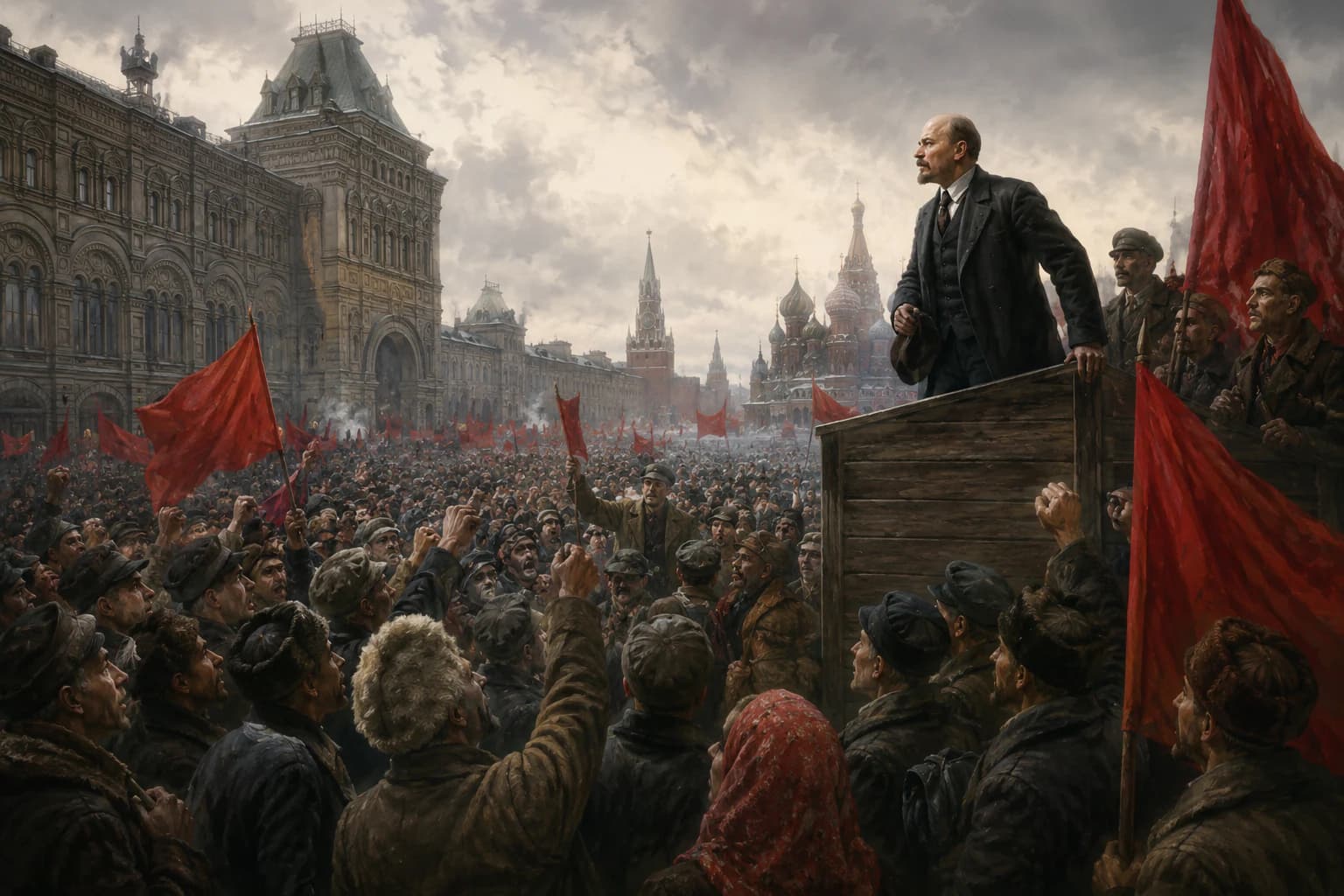
Marx died in London in 1883, known within radical circles but not yet the giant later history would make of him. His posthumous life is vast and contested. Social democratic parties used him to argue for labor organization and reform. Lenin, Mao, and other revolutionaries claimed him for one-party states and violent transformations he did not design in detail. Critics hold Marxism responsible for regimes that ruled in its name; defenders separate Marx's analysis from later authoritarian uses. Scholars continue to use and dispute his concepts of class, ideology, alienation, commodity fetishism, and capital accumulation. Marx's legacy is therefore not a single doctrine but a battlefield. To understand modern politics, labor movements, Cold War ideology, and critiques of inequality, he remains impossible to ignore.
Marx’s true impact emerged after his lifetime, shaped by those who interpreted his ideas.