Complete chronology
Full overview and deeper context for every journey step.
1859
A difficult birth
Wilhelm II entered the world at the meeting point of Europe's royal families and Prussia's military state. His mother, Victoria, was the eldest daughter of Queen Victoria of Britain; his father, Crown Prince Frederick, represented liberal hopes inside a monarchy dominated by army prestige and conservative power. A traumatic breech birth left Wilhelm's left arm permanently impaired. That disability should not be treated as a simple explanation for his reign, but it did matter in a court culture obsessed with uniforms, riding, drill and masculine authority. Wilhelm grew up under intense pressure to appear strong. The result was a personality often hungry for recognition, quick to perform confidence, and deeply sensitive to slights. Those private tensions would later play out on a public stage.
Early insecurity can shape ambition in ways that influence both personal behavior and national decisions.
1860s–1870s
Military-focused education
Wilhelm's upbringing pulled him in different directions. His parents hoped he might inherit something of British constitutional liberalism, while the Prussian court and army offered a clearer emotional language: obedience, hierarchy, honor, uniform, and command. He learned to love military ceremony and to imagine kingship as personal leadership rather than restrained constitutional duty. This did not make him unintelligent; Wilhelm could be energetic, curious, and well informed in flashes. The problem was judgment. He preferred dramatic gestures to patient coalition-building, and he often confused noise with strength. In a Germany whose constitution already gave the emperor real influence over foreign policy and the military, that temperament mattered.
An upbringing centered on force can narrow the range of strategies a leader considers effective.
1888
Becoming emperor
Wilhelm came to the throne after the death of his grandfather Wilhelm I and the brief reign of his father Frederick III, who died of cancer after only ninety-nine days as emperor. The new Kaiser inherited a Germany that was young, industrializing rapidly, militarily formidable, and diplomatically managed by Otto von Bismarck. The empire's strength concealed deep tensions: Social Democracy was growing, Catholics and liberals had fought the state in earlier decades, federal princes guarded privileges, and Europe's alliance system depended on careful restraint. Wilhelm wanted to be more than a ceremonial monarch. He believed the emperor should rule actively, speak boldly, and embody Germany's destiny. That ambition collided almost immediately with the old chancellor who had built the empire.
Rapid ascension to power can encourage bold moves before experience has time to develop.
1890
Dismissing Bismarck
The fall of Bismarck was one of the turning points of Wilhelm's reign. The chancellor had dominated German politics since unification, balancing repression and welfare at home while keeping France isolated abroad. Wilhelm found that dominance intolerable. Their disagreements included anti-socialist policy, ministerial authority, and who ultimately controlled the empire. When Bismarck resigned in 1890, Germany gained a freer Kaiser but lost a strategic mind of rare discipline. Wilhelm did not personally design every later policy failure, but after Bismarck the empire's direction became less coherent. The lapse of the Reinsurance Treaty with Russia, the pursuit of global prestige, and the sharper edge of German public rhetoric all contributed to a Europe increasingly unsure what Berlin wanted.
Removing experienced guidance can shift a system from stability to uncertainty almost overnight.
1890s
Expanding global ambitions
Wilhelm's Germany wanted a place in the sun. That phrase captured Weltpolitik, the turn toward global power, overseas influence, and naval expansion. The most dangerous part was the fleet. Admiral Alfred von Tirpitz built a naval program designed to make Britain take Germany seriously, but Britain interpreted it as a direct challenge to the security foundation of its empire. The result was not admiration but counter-mobilization. Britain expanded its own naval building, moved closer to France and Russia, and became less willing to treat Germany as a manageable continental power. Wilhelm's public persona worsened the effect. Speeches, interviews, and symbolic gestures often made German policy sound more aggressive than it needed to be. Prestige became a strategic liability.
Ambition on a global scale often triggers equal and opposite reactions from rivals.
Early 1900s
Mounting tensions
The road to war was not built by Wilhelm alone. It ran through imperial rivalry, military planning, nationalism, alliance commitments, Balkan instability, arms races, and fear in every capital. Yet Wilhelm's reign helped harden those conditions. Germany's support for Austria-Hungary, confrontations with France over Morocco, and naval competition with Britain fed the image of an ambitious power that demanded status without offering reassurance. Wilhelm sometimes urged caution in private and theatrical firmness in public, a damaging combination because other governments had to interpret signals quickly. He could be impulsive one moment and hesitant the next. In a Europe where mobilization timetables and alliance expectations left little room for ambiguity, inconsistency was dangerous.
When alliances tighten under pressure, they can transform local disputes into wider crises.
1914–1918
First World War
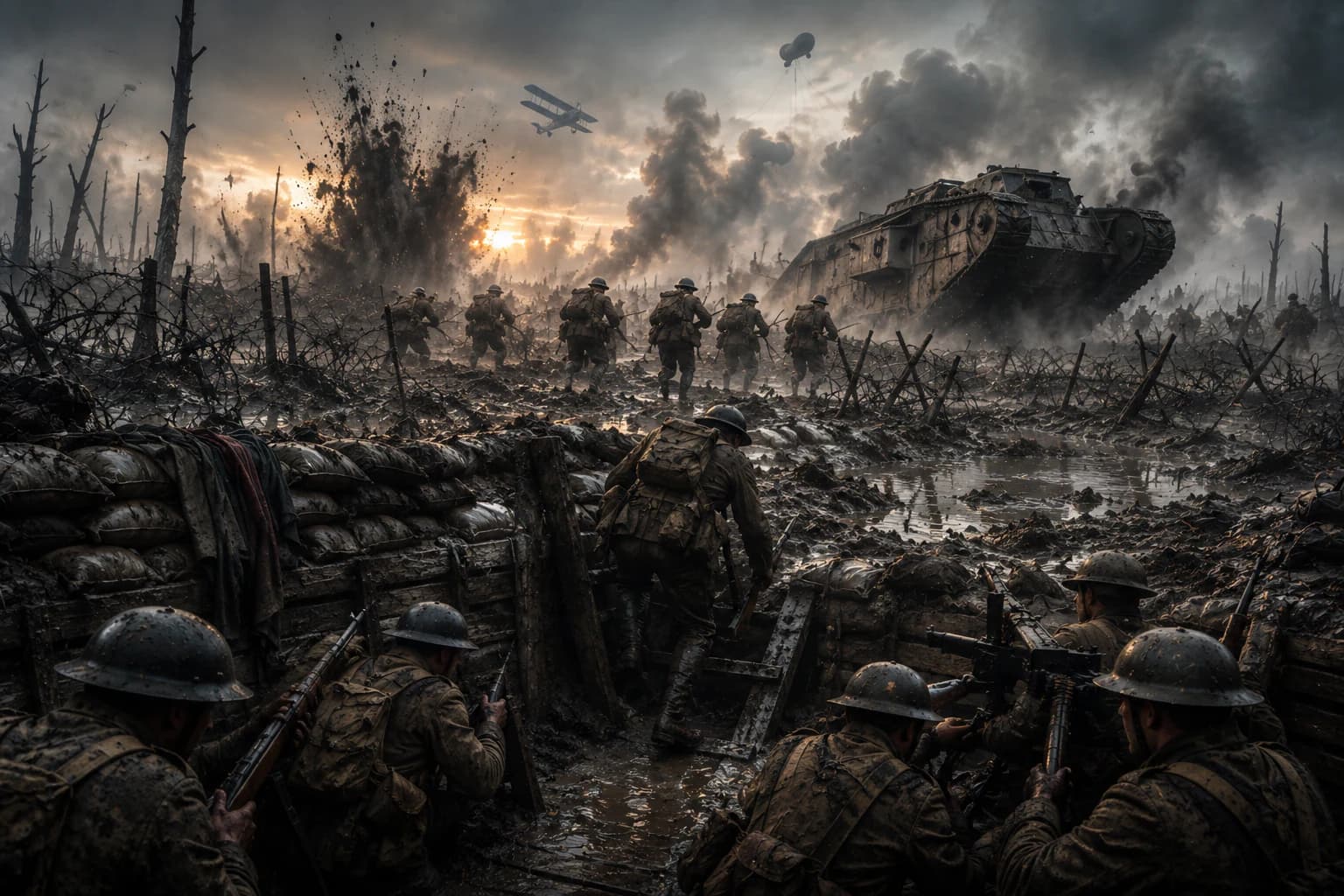
The July Crisis of 1914 exposed the weakness of Wilhelm's leadership. Germany gave Austria-Hungary strong backing after the Sarajevo assassination, hoping to preserve its ally and manage the risk of wider war. Wilhelm later showed moments of alarm and tried to slow events, but by then military plans, diplomatic commitments, and fear of losing advantage had taken over. Once war began, Germany fought Britain, France, Russia and later the United States in a conflict far beyond the short decisive campaign many had imagined. Wilhelm remained symbolically central, but real authority shifted increasingly to generals, especially Paul von Hindenburg and Erich Ludendorff. The Kaiser who had loved command became, in practice, a diminished figure inside a militarized state.
Leaders may begin wars with confidence, but control often slips once conflict expands beyond initial plans.
1918
Abdication and exile
By autumn 1918 Germany was exhausted. The army was retreating, the home front was strained by blockade and hardship, sailors mutinied, workers and soldiers' councils spread, and politicians tried to secure an armistice before total collapse. Wilhelm hoped at moments to remain King of Prussia even if he lost the imperial crown, but events moved faster than his wishes. His abdication was announced on 9 November 1918, and he crossed into the Netherlands the next day. The Hohenzollern empire ended not in a final battlefield gesture but in political evaporation. In exile at Doorn, Wilhelm lived until 1941, writing memoirs, receiving visitors, and watching Germany pass through republic, crisis, and Nazi dictatorship without his restoration.
Power can disappear quickly when public support and military success both collapse at once.
After 1918
A contested legacy
Kaiser Wilhelm II is easy to caricature and difficult to assess fairly. He was vain, impulsive, militaristic in style, and often reckless in speech. He also operated within a system shaped by generals, ministers, industrialists, aristocrats, voters, newspapers, alliances, and rival empires. The strongest interpretation holds both truths together. Wilhelm was not the sole cause of the First World War, but his personality and choices mattered because they amplified structural dangers. He dismissed Bismarck, encouraged naval expansion, personalized diplomacy, and helped create an atmosphere in which Germany appeared both powerful and insecure. His fall ended the German Empire and opened the uncertain Weimar era. His biography is therefore a warning about performative strength: a ruler can project command so loudly that he disguises how little control he truly has.
Historical impact often lies in the interaction between personal decisions and wider systems beyond any single leader’s control.