Complete chronology
Full overview and deeper context for every journey step.
1743
Born in Neuchatel
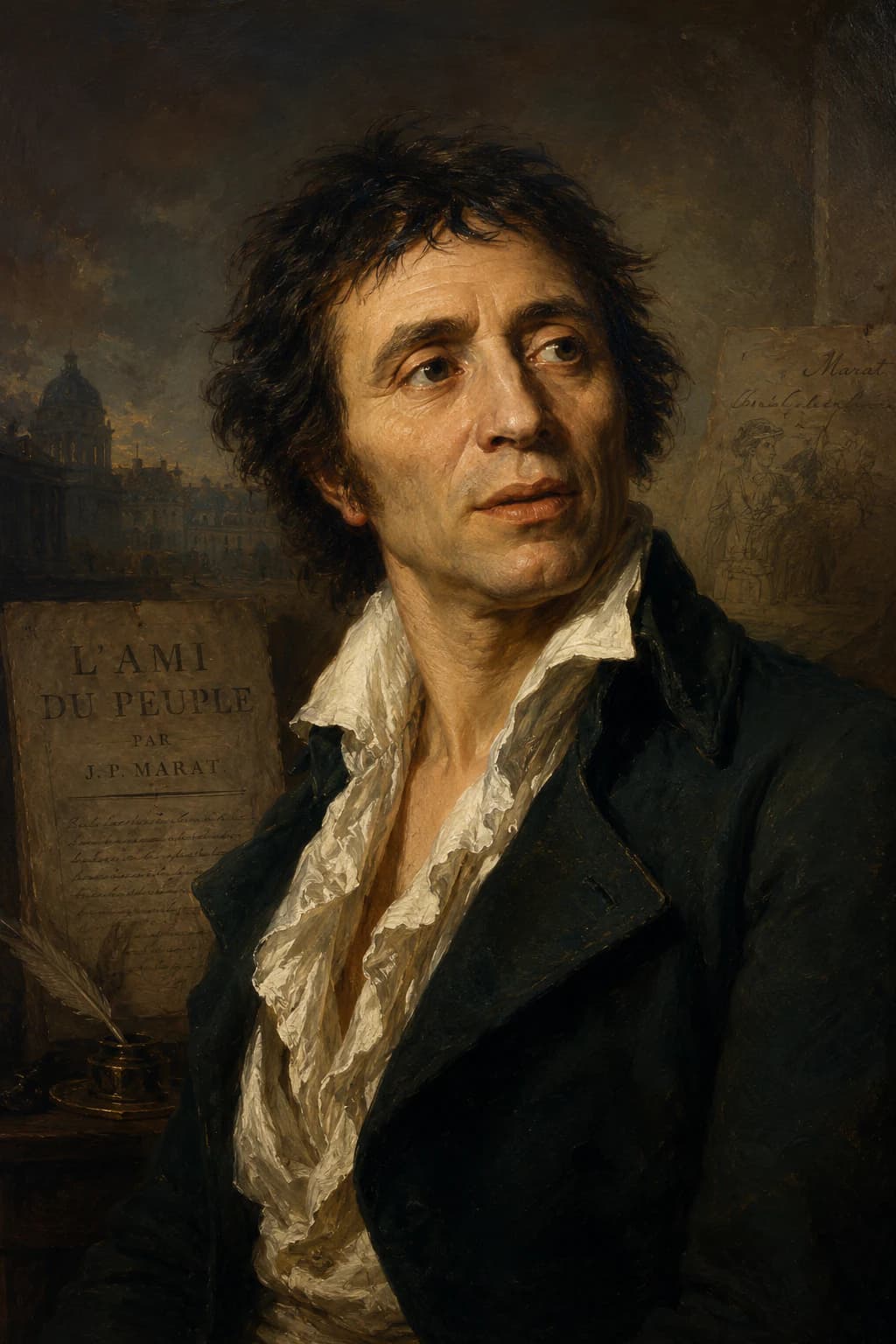
Jean-Paul Marat was born in 1743 in Boudry, near Neuchatel, then outside the kingdom of France. His background was not that of a Parisian political insider. Before the Revolution, he lived a restless intellectual life, working in medicine, writing on science and seeking recognition in learned circles. He spent time in Britain and published works that showed both ambition and resentment toward established authorities. That outsider's impatience would later find a powerful outlet in revolutionary journalism.
Before he became a revolutionary voice, Marat was an ambitious outsider frustrated by elite recognition.
1770s-1780s
Doctor and writer
Marat's pre-revolutionary career mixed medicine, political theory and scientific controversy. He served as a physician and wrote on electricity, optics and criminal law, often challenging established experts. His desire to expose error and corruption became a pattern. In scientific circles, that combative style brought more conflict than lasting prestige. Yet the same qualities that hindered him in academies made him effective in revolutionary politics: suspicion of elites, confidence in his own judgement and a fierce appetite for public argument.
His habits of accusation and exposure were formed before he entered revolutionary politics.
1789
L'Ami du peuple
In 1789, Marat launched the newspaper best known as L'Ami du peuple, or The Friend of the People. It became his weapon and identity. Through it he attacked ministers, aristocrats, moderates, speculators and supposed traitors with extraordinary intensity. He wrote for readers who believed the Revolution was always in danger of betrayal. His journalism was direct, urgent and often violent in its recommendations. To supporters, he said what timid politicians would not. To enemies, he fed paranoia and bloodshed. Either way, he showed that print could move the streets.
Marat made journalism feel immediate, personal and dangerous.
1791-1792
Voice of the sans-culottes
As the Revolution deepened, Marat spoke to the anger of the sans-culottes: artisans, workers and militants who feared hunger, hoarding and betrayal. He distrusted constitutional monarchists and moderate revolutionaries, arguing that enemies of the people had to be exposed before they destroyed liberty. His writings helped create a political atmosphere in which vigilance became a civic duty. He did not command Paris alone, but his words amplified its most radical instincts. The more unstable France became, the more persuasive his warnings sounded to those who felt abandoned by cautious leaders.
His power came from translating popular fear into revolutionary accusation.
1792
Convention deputy
In 1792, Marat entered the National Convention as a deputy for Paris. He joined the Montagnards, the radical faction opposed to the more moderate Girondins. His role in national politics was shaped by the same uncompromising style that had defined his journalism. He supported the execution of Louis XVI and denounced opponents as threats to the Republic. The September Massacres of 1792, in which prisoners were killed by crowds fearing counter-revolution, darkened his reputation because critics linked his rhetoric to the climate that made such violence possible. Marat rejected moderate restraint as fatal weakness.
In the Convention, his journalism and politics became almost inseparable.
1793
Girondin enemy
The struggle between Montagnards and Girondins reached crisis in 1793. Marat's repeated denunciations made him a central target of Girondin anger. He was brought before the Revolutionary Tribunal and acquitted, an outcome that turned his return to the Convention into a triumph among supporters. Soon afterward, leading Girondins were purged from national power. To radicals, Marat had helped expose enemies of the people. To opponents, he had helped destroy representative politics through intimidation. His body was already weakened by a painful skin disease, but politically he remained explosive.
Marat's enemies feared not office or command, but the mobilising force of his accusations.
1793
Assassinated
On 13 July 1793, Charlotte Corday, a young woman from Normandy sympathetic to the Girondins, gained entry to Marat by claiming to have information about enemies of the Republic. Marat was working from a medicinal bath, where he often sought relief from his skin condition. Corday stabbed him to death. She believed killing him would help end civil conflict and radical violence, but the effect was almost the opposite. Marat's supporters transformed him into a martyr of the people, and Jacques-Louis David's famous painting fixed his death in revolutionary memory.
Corday killed the man, but helped create the martyr.
Long-term
Revolutionary memory
Jean-Paul Marat's legacy is inseparable from the moral difficulty of the French Revolution. He gave voice to people who believed elites would betray them, and he understood the emotional force of hunger, fear and exclusion. He also encouraged a politics in which enemies were named before they were judged, and violence could appear as vigilance. His assassination made him sacred to radicals for a time, but later reactions against the Terror darkened his name. Marat matters because he shows how media, anger and crisis can combine to make denunciation a form of power.
His story is a study in how revolutionary speech can defend the vulnerable and endanger justice at the same time.