People

James Watt

James Watt was a Scottish inventor. His improvements to the steam engine provided the mechanical power that drove the Industrial Revolution.

Born
1736 CE
Died
1819 CE
Role
Scottish inventor

Scottish inventor (1736–1819)

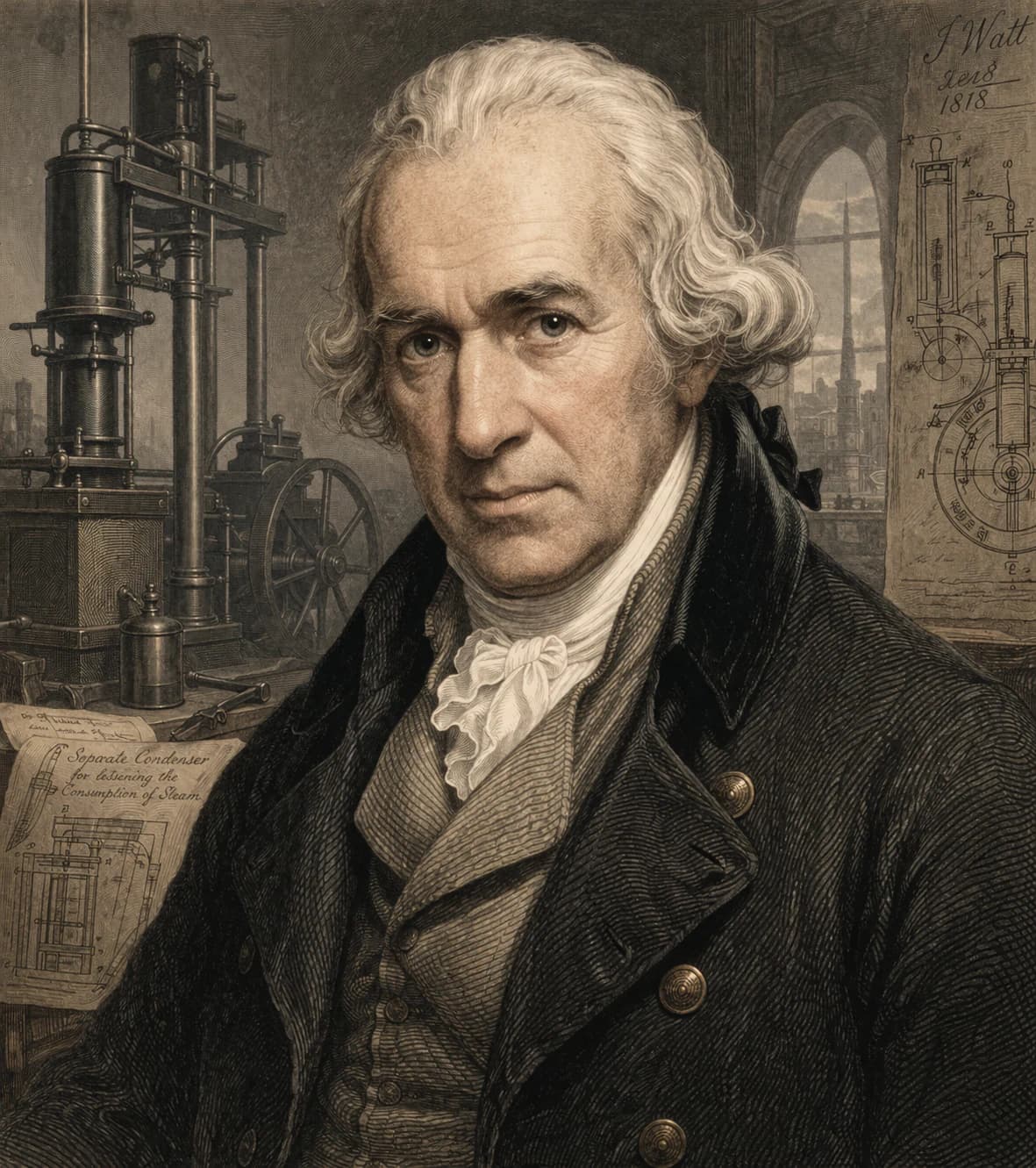
AI-generated portrait of James Watt in 18th-century scholarly attire
AI-assisted historical reconstruction

An illustrative reconstruction based on historical context. It is not a photograph or documentary likeness. Image policy

Quick answer

James Watt was a Scottish inventor. His improvements to the steam engine provided the mechanical power that drove the Industrial Revolution.

Born
1736 CE
Died
1819 CE
Role
Scottish inventor
Years
1736-1819 CE
Facts

James Watt timeline facts

Selected specifics from this profile's life story.

1736–1754
Curious beginnings

Born in Scotland, Watt showed early curiosity for tools and mechanics, developing practical skills that would later shape his inventive work.

1763–1765
Engine problem

While repairing a model steam engine, Watt noticed its inefficiency, leading him to rethink how steam power could be used more effectively.

1775–1790
Industrial expansion

Watt’s engines spread across mines and factories, powering machinery and accelerating the growth of industrial production.

1819–present
Enduring legacy

Watt’s improvements to steam power helped launch the Industrial Revolution, leaving a lasting influence on engineering and global industry.

Life Journey

From instrument maker to engine pioneer

Follow the story in a more continuous narrative, with a reading mode that matches how much depth you want.

Complete chronology

1736–1754

Curious beginnings

James Watt grew up in a household where craftsmanship was part of daily life, surrounded by tools, instruments, and problem-solving tasks. His health often kept him from formal schooling, but this allowed him to explore learning in his own way. He spent long hours experimenting with small mechanical devices and observing how things worked. These early experiences built a deep familiarity with precision work and careful thinking. Rather than following a strict academic path, he absorbed knowledge through hands-on practice, forming habits that would later define his approach to engineering challenges.


1754–1756

Apprentice training

Watt’s apprenticeship in London exposed him to the demanding standards of instrument making, where accuracy could not be compromised. He learned to construct delicate devices used in navigation and measurement, requiring steady hands and disciplined focus. The work demanded patience and a deep understanding of materials and mechanics. Though the training period was short due to health issues, it left a lasting mark. Watt returned to Scotland with skills that set him apart, able to produce instruments with remarkable accuracy. This expertise would later influence how he approached mechanical design and refinement.

1757–1763

University connections

At the University of Glasgow, Watt found himself in an environment rich with intellectual exchange. Though not a formal academic, he interacted with leading thinkers who were exploring the nature of heat, gases, and motion. These conversations broadened his perspective beyond craftsmanship into scientific reasoning. He repaired instruments for professors and discussed their experiments, gradually connecting theory with practice. This period helped him see machines not just as objects, but as systems governed by underlying principles. It was this blend of skill and theory that positioned him to recognize flaws others had overlooked.

1763–1765

Engine problem

When asked to repair a small model of an existing steam engine, Watt observed that it consumed far more fuel than necessary. The design required repeated heating and cooling of the same chamber, wasting energy each cycle. This inefficiency stood out sharply to someone trained in precision and careful observation. Watt began experimenting with ways to separate these processes, exploring how steam could be handled more intelligently. His insight did not come from inventing steam power itself, but from recognizing a critical flaw in its use. This moment marked the turning point from craftsman to innovator.

1765

Key breakthrough

Watt’s solution was elegantly simple yet transformative: instead of cooling the main cylinder, he introduced a separate chamber where steam could condense. This allowed the primary cylinder to remain hot, preserving energy and improving performance. The idea required careful design to ensure airtight connections and reliable operation. It was not just a concept but a practical system that could be built and tested. This improvement reduced fuel consumption significantly, making steam power more economical. It turned a limited technology into something capable of driving large-scale industrial activity.

1775

Business partnership

Watt’s ideas required resources he did not have on his own, and his partnership with Matthew Boulton proved decisive. Boulton brought business acumen, capital, and access to manufacturing facilities. Together, they created a system for producing and installing improved engines across Britain. This collaboration allowed Watt to focus on refining designs while Boulton handled commercial expansion. Their agreement also introduced new ways of charging for engine use, linking payment to fuel savings. This business model helped spread adoption and ensured steady income. The partnership transformed invention into industry.

1775–1790

Industrial expansion

As improved steam engines were installed in mines, they pumped water more efficiently, allowing deeper extraction of resources. Soon, their use expanded into factories, where they powered machinery that previously relied on water or manual labor. This shift enabled production to move away from rivers and into urban centers. Watt continued refining his designs, introducing rotary motion that allowed engines to drive a wider range of machines. The technology became a cornerstone of industrial growth, increasing output and changing how goods were produced. Entire industries reorganized around this new source of power.

1790–1810

Later refinements

Watt did not stop after his initial success; he remained deeply engaged in improving efficiency and reliability. He worked on mechanisms that controlled engine speed and made operation smoother and safer. Though others began to build on his work, he maintained a strong influence over the direction of steam technology. He also explored inventions beyond engines, showing a restless curiosity that never faded. Even as he stepped back from daily business operations, his ideas continued to guide development. His later years reflected both satisfaction and continued intellectual engagement.

1819–present

Enduring legacy

By the time of his death, Watt’s engines had already transformed industries and influenced how societies produced goods. His approach to efficiency and system design became a model for future engineers. The spread of steam power accelerated transportation, manufacturing, and urban growth. His name was later given to a unit of power, reflecting the depth of his impact on how energy is understood and measured. More broadly, his work helped establish engineering as a discipline grounded in both theory and practice. His influence continues to shape modern technology and industrial thinking.

Continue in context

Connected stories

Move from the profile into the wider events and settings this figure belongs to.

Tertiary paths

Content note

This profile is written for educational use and connects to related Stories of History pages. The main portrait is an AI-assisted historical reconstruction, included as an illustrative aid rather than documentary evidence. Image policy

References

Sources & Further Reading

Reliable reference works, archives and reading paths connected to this profile.

Further reading

  1. Encyclopaedia Britannica, Search results for James Watt,” accessed June 2026.Open source
  2. WorldCat, Books and library holdings for James Watt,” accessed June 2026.Open source

Primary sources

  1. Library of Congress, Search results for James Watt,” accessed June 2026.Open source

Reviewed claim sources

Loading reviewed claim sources...

A weekly route through history

Find out first about the latest published stories, feature notes and occasional Premium offers in one weekly email.