Complete chronology
Full overview and deeper context for every journey step.
1485–1504
Rural upbringing
Cortes came from Extremadura, a hard frontier region that produced many conquistadors. His family belonged to the lower nobility, respectable but not rich enough to guarantee him a grand future. He was sent to study at Salamanca, though he did not become the lawyer or learned professional his family may have imagined. Instead, he was drawn toward the Atlantic world opening after Columbus. The young Cortes combined literacy, legal awareness, appetite for status, and a willingness to gamble. These qualities mattered later. He was never simply a swordsman. He understood documents, legitimacy, persuasion, and how to turn bold disobedience into official recognition after the fact.
Ambition often grows strongest where opportunity seems most limited.
1504–1518
Journey abroad
The Caribbean was Cortes's training ground. On Hispaniola and then Cuba he worked within the Spanish colonial order as notary, settler, and participant in conquest. He gained land and Indigenous labour through the encomienda system, which tied Spanish wealth to the exploitation of Native communities. He also learned how fragile colonial authority could be. Governors needed ambitious men, but ambitious men could become rivals. In Cuba, Cortes developed a reputation for ability, sociability, and opportunism under Governor Diego Velazquez. The world he entered was violent, legalistic, entrepreneurial, and deeply unequal. It taught him that conquest required paperwork and alliances as much as weapons.
Early exposure to systems of power can shape how individuals later choose to wield it.
1519
Unauthorized mission
Cortes's expedition began in defiance. Diego Velazquez appointed him to lead a mission to the mainland, then tried to pull the command back when Cortes seemed too independent. Cortes sailed anyway. Once on the coast, he created the municipality of Villa Rica de la Vera Cruz, a legal manoeuvre that allowed his men to recognise him as captain-general under the authority of Charles I rather than Velazquez. The famous story that he burned his ships is better understood as the deliberate disabling or scuttling of vessels to prevent retreat and bind the expedition to the inland gamble. From the beginning, Cortes fused rebellion, law, theatre, and survival.
Breaking rules can lead to success, but it also sets a pattern of justifying bold actions by their outcomes.
1519–1520
Strategic alliances
The conquest of Mexico was not achieved by a few hundred Spaniards acting alone. Cortes succeeded because he entered a political world already full of tensions. The Mexica, often called Aztecs, ruled an empire of tribute and intimidation from Tenochtitlan, and many communities had reasons to fear or resent them. After fighting the Tlaxcalans, Cortes turned them into indispensable allies. Thousands of Indigenous warriors, porters, guides, and informants made the campaign possible. Malintzin, also known as La Malinche or Dona Marina, was crucial as interpreter, cultural broker, and political adviser. Any account that centres Cortes alone misses the coalition that carried him inland.
Success in unfamiliar environments often depends more on alliances than raw strength.
1519
Meeting the emperor
Tenochtitlan stunned the Spaniards. Built on an island in Lake Texcoco, linked by causeways, supplied by markets, gardens, canals, temples, and tribute networks, it was larger and more ordered than many European cities Cortes's men knew. The meeting with Moctezuma II was wrapped in diplomacy and uncertainty. Later Spanish accounts often claimed Moctezuma believed Cortes divine, but historians treat that tradition with caution; it reflects Spanish interpretation and post-conquest justification more than secure evidence. What is clear is that both sides were testing possibilities under enormous risk. Cortes soon seized Moctezuma, turning guesthood into coercive control. The balance could not hold.
First encounters between cultures often carry hidden tensions that shape what follows.
1520
Conflict erupts
Crisis erupted while Cortes was away confronting a force sent by Velazquez to arrest him. In his absence, Pedro de Alvarado's massacre of celebrants during a festival ignited revolt in Tenochtitlan. Cortes returned, but control was collapsing. Moctezuma died in disputed circumstances, remembered differently in Spanish and Indigenous traditions, and the Spaniards and their allies fled the city during the bloody retreat later called La Noche Triste. Many died on the causeways. Cortes's campaign came close to destruction. Its recovery depended on Tlaxcalan support, reinforcements, smallpox devastating Indigenous populations, and Cortes's ability to rebuild a coalition for siege.
Setbacks can become turning points when leaders adapt rather than withdraw.
1521
Fall of Tenochtitlan
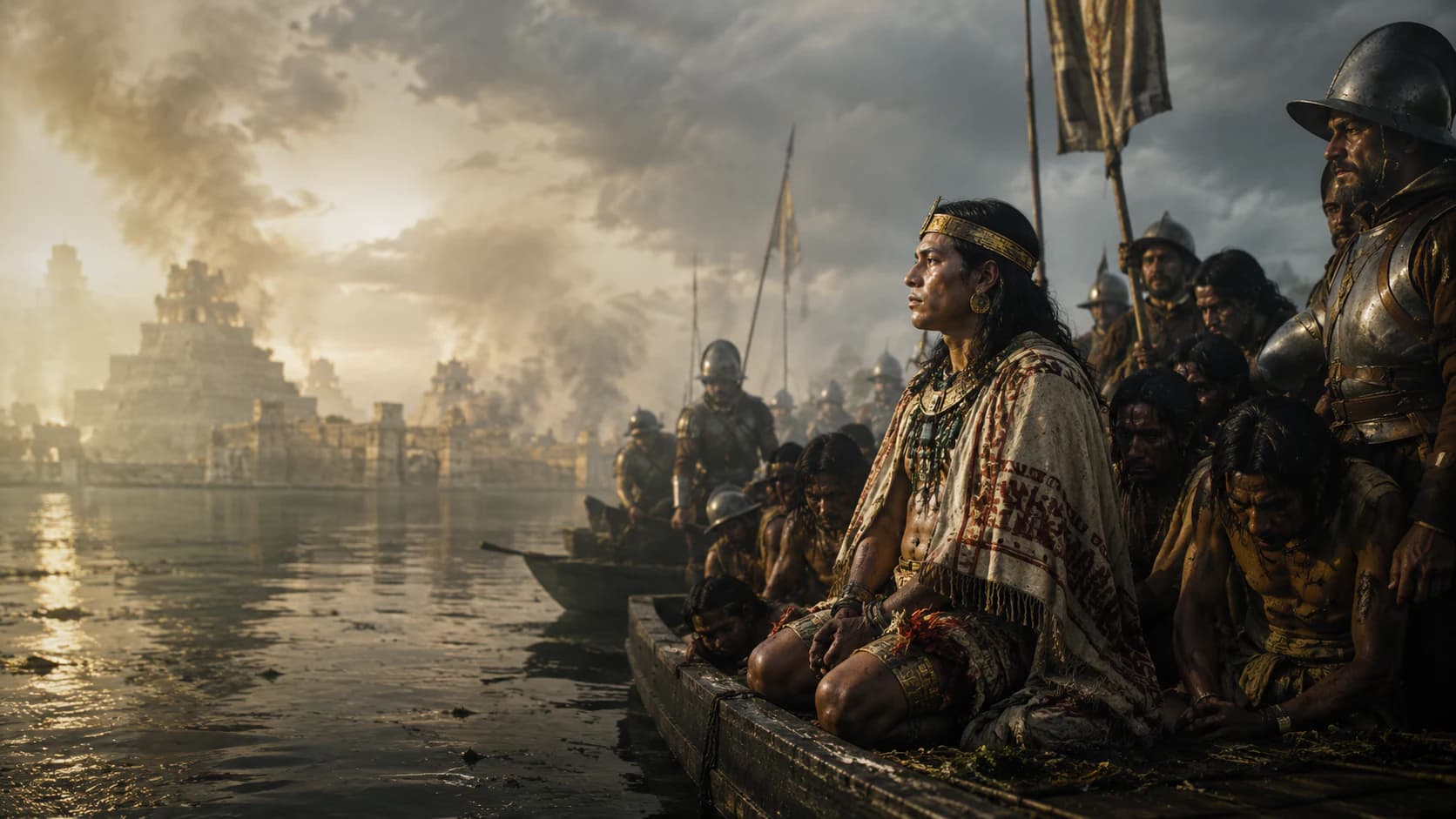
The siege of Tenochtitlan was catastrophic. Cortes built brigantines to control the lake, cut causeways and supplies, and advanced with thousands of Indigenous allies whose role was decisive. Smallpox had already torn through the region, killing many, including Cuitlahuac, Moctezuma's successor, and weakening resistance before the final assault. Cuauhtemoc led a desperate defence as hunger, disease, and destruction consumed the city. When Tenochtitlan fell in August 1521, it was not simply a Spanish victory over an empire. It was a civil and imperial war inside Mesoamerica, exploited by outsiders whose arrival brought new weapons, new diseases, and a new colonial order. The human cost was immense.
Victory in conquest often brings transformation built on profound loss.
1521–1540
Colonial authority
After the conquest, Cortes oversaw the rebuilding of Mexico City on the ruins of Tenochtitlan and distributed rewards, encomiendas, and authority among his followers. But conquerors were useful to the Spanish crown only up to a point. Charles V wanted wealth and territory, not an independent warlord in Mexico. Royal officials arrived, investigations multiplied, and Cortes's enemies accused him of abuse, ambition, and misrule. He was granted the title Marquis of the Valley of Oaxaca, a huge reward, but not the unrestricted power he believed he deserved. He launched further expeditions, including to Honduras and Baja California, yet his political centrality declined. Conquest had made him famous; empire made him manageable.
Power gained through bold action can be difficult to maintain within formal systems.
1547–present
Enduring impact
Cortes's legacy cannot be reduced to either lonely genius or simple villainy, though the violence of conquest must remain central. He was a brilliant opportunist, a skilled negotiator, and a ruthless commander who understood how to exploit divisions inside a powerful empire. But he did not conquer Mexico alone, and the world that followed was shaped as much by Indigenous decisions, disease, forced labour, evangelisation, resistance, and adaptation as by Spanish command. New Spain became a centre of global exchange, linking American silver, European monarchy, African slavery, and Asian trade through the Pacific. For many Indigenous peoples, the conquest brought catastrophe: demographic collapse, dispossession, and coercion. Cortes matters because his career marks one of history's great turning points, where local ambition became global transformation.
Historical figures can embody both achievement and harm, forcing later generations to confront uncomfortable truths.