Complete chronology
Full overview and deeper context for every journey step.
1781
Humble beginnings
George Stephenson was born on 9 June 1781 at Wylam in Northumberland, in a coalfield world where steam engines were working machines before they were symbols of progress. His father operated a pumping engine at a colliery, and the family lived with little money and no spare path into schooling. Stephenson worked from childhood, herding cows, picking stones from coal and eventually tending engines. He learned to read and write as a young adult through night lessons paid for from wages. This matters because his genius was not the polished theory of a university engineer. It was practical intelligence formed in mines, workshops, rails, boilers and the daily need to make machinery reliable enough to earn its keep.
Limited opportunity in youth can sharpen practical intelligence and drive when curiosity is allowed to grow.
1790s–1810s
Learning engineering
Stephenson's engineering education came through repair. At Killingworth Colliery he worked as brakesman and enginewright, mastering the pumping engines, winding gear and wagonways that kept coal moving. Mines were unforgiving schools: a broken pump could flood workings, a poor rail could stop production, and a weak lamp could kill men. Stephenson became known as someone who could diagnose faults and improve performance. He also developed a safety lamp for miners, in rivalry with Humphry Davy's better-known version, leading to controversy over credit. The episode shows the class politics of invention in industrial Britain. Stephenson had practical authority, but gentlemen of science often received public recognition more easily.
Mastery often emerges from repeated exposure and problem-solving rather than structured instruction alone.
1814
First locomotive ideas
Stephenson did not invent the steam locomotive alone. Richard Trevithick and others had already experimented with high-pressure engines on rails. Stephenson's importance was in making locomotive traction more useful in ordinary industrial conditions. In 1814 he built Blucher for Killingworth, a locomotive designed to haul coal wagons. It was slow and imperfect, but it demonstrated that steam power could replace horses on colliery lines if engine, rail and operation were treated as one system. Stephenson kept refining adhesion, wheel design, steam exhaust and mechanical reliability. His achievement was cumulative: less a single flash of invention than the hard engineering of dependable use.
Turning theory into dependable practice is what transforms an idea into a turning point.
1810s
Killingworth success
Killingworth gave Stephenson a proving ground. He learned that locomotives could not be separated from the permanent way beneath them. Weak rails broke, poor gradients wasted power, and bad alignment turned promise into breakdown. He improved track, experimented with coupled wheels and used the blastpipe principle to strengthen the fire by directing exhaust steam up the chimney, increasing boiler efficiency. These improvements were not glamorous, but they made railways credible. Investors, mine owners and engineers needed evidence that steam haulage could work day after day. Killingworth supplied that evidence, and Stephenson's reputation moved beyond the coalfield.
Innovation often succeeds when systems are improved as a whole rather than in isolated parts.
1825
Stockton and Darlington
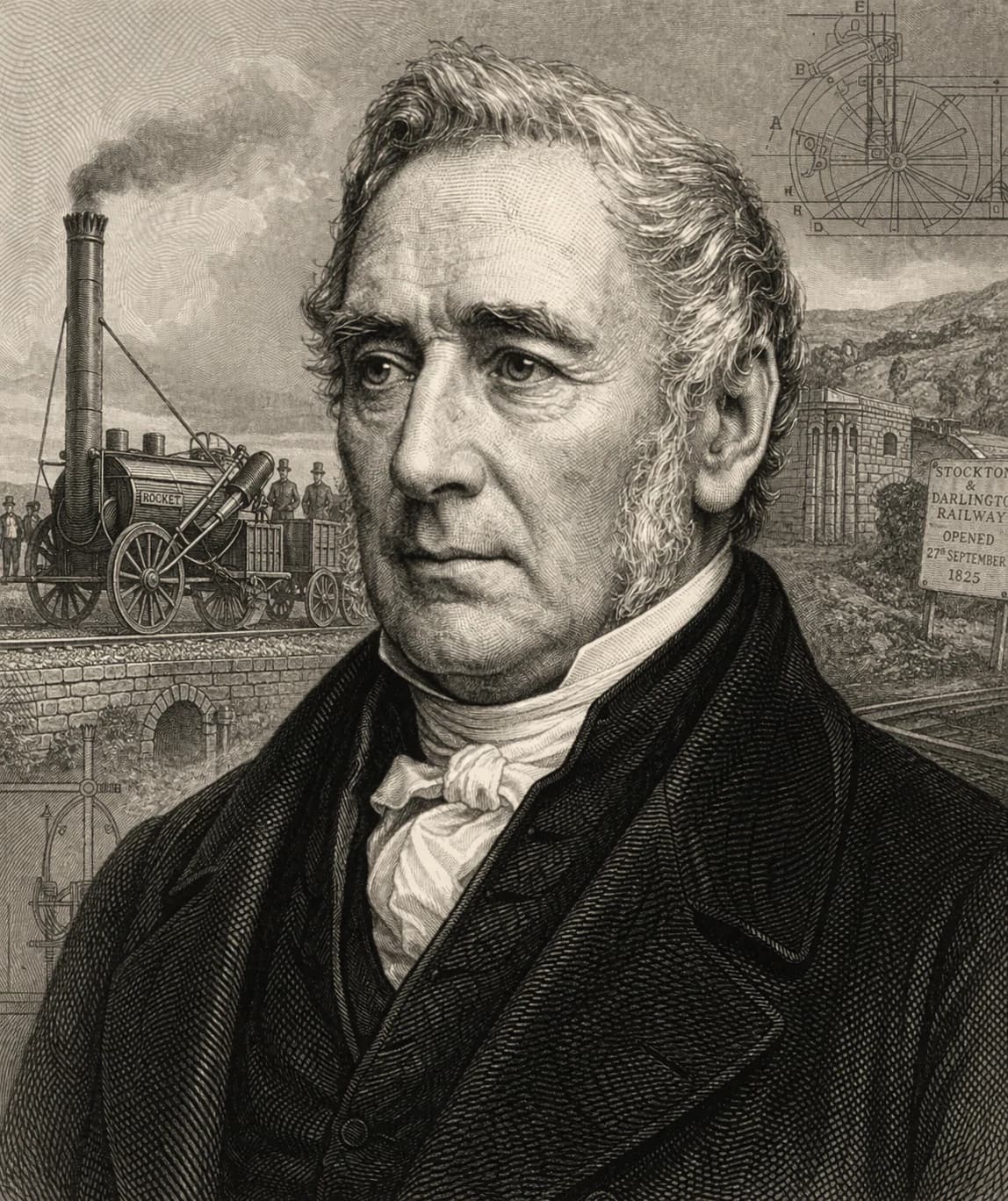
The Stockton and Darlington Railway opened on 27 September 1825 and became a landmark in transport history. Built primarily to move coal from County Durham to the River Tees, it was also a public railway carrying passengers, and Stephenson served as its engineer. His locomotive Locomotion No. 1 hauled the opening train before large crowds. The line still mixed old and new methods, including horse haulage on some sections, so it was not yet the fully modern railway system. But it proved that a public railway using steam locomotives could operate at scale. The psychological effect was immense. Railways ceased to be colliery curiosities and became infrastructure.
Public demonstration can shift perception faster than technical argument alone.
1829
Rocket triumph
The Rainhill Trials of 1829 decided the locomotive question for the Liverpool and Manchester Railway, the first major intercity railway built for both passengers and freight. George worked with his son Robert Stephenson, whose role in designing the Rocket was crucial. Rocket combined a multi-tube boiler, effective blastpipe and light design in a way that delivered speed and reliability superior to its competitors. Its victory did not mean all later engines copied it exactly, but it established the direction of locomotive engineering. Rainhill was a public technical contest with commercial consequences: after Rocket, steam locomotion looked not merely possible but investable.
A single well-timed success can establish a lasting template for an entire industry.
1830s
Railway expansion
The Liverpool and Manchester Railway opened in 1830 and changed the scale of the railway idea. It connected two major industrial cities, carried passengers in large numbers and demonstrated that speed itself could reorganize business and daily life. Stephenson became the most famous railway engineer in Britain, advising on lines, gradients, bridges, tunnels and track standards. His preferred gauge of 4 feet 8.5 inches became widely adopted and later standard across much of the world. Railway expansion was not painless: it displaced land, frightened landowners, injured workers and generated speculative mania. Yet its transformative force was undeniable. Stephenson helped turn industrial transport into a national network.
Scaling an innovation requires not just invention but repeatable methods others can adopt.
1840s
Later influence
In the 1830s and 1840s Stephenson became both engineer and symbol. Younger, more mathematically trained engineers sometimes criticized his caution, especially over steep gradients and atmospheric railways, and not every judgment he made was correct. But his experience carried weight because he had solved problems from the ground up. He invested in coal, iron and locomotive works, including the Robert Stephenson and Company works at Newcastle, which exported railway technology abroad. His partnership with Robert also complicates the heroic image of one solitary inventor. The railway age was collaborative, industrial and capital-hungry. George Stephenson's achievement was to stand near its practical beginning and give it workable form.
Enduring influence often comes from setting standards that outlive direct involvement.
1848 and beyond
Lasting legacy
Stephenson died on 12 August 1848, by which time the railway had moved from daring experiment to the central technology of the industrial age. His legacy is sometimes compressed into the title 'Father of Railways,' which is useful but too simple. He did not invent every component, and he depended on miners, mechanics, investors, surveyors, navvies and his brilliant son Robert. His importance lies in synthesis: locomotive, rail, route, public confidence and commercial use brought together into systems that could spread. Railways changed timekeeping, commuting, markets, warfare, journalism and the relationship between city and countryside. To ask why George Stephenson was important is to ask how practical engineering remade modern life.
Transformative figures reshape daily life in ways that continue long after their time.