Complete chronology
Full overview and deeper context for every journey step.
1904
Midwestern beginnings
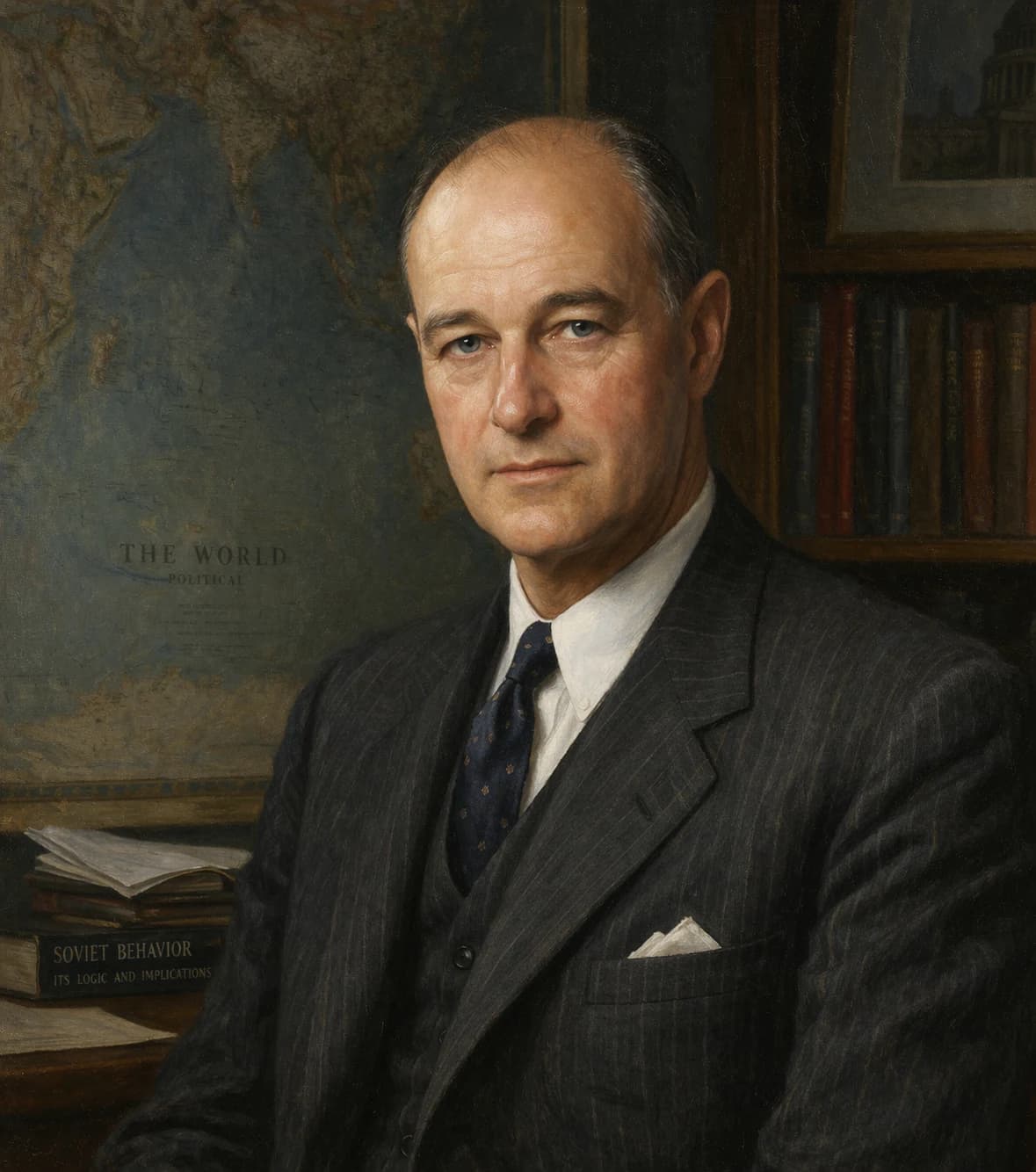
George Frost Kennan was born in Milwaukee, Wisconsin, on 16 February 1904. His mother died soon after his birth, and that early absence became part of the loneliness and reserve that marked him for life. Kennan grew up intelligent, self-critical and often uncomfortable in ordinary social settings. He was drawn to history, landscape, language and the long memory of nations. This temperament could make him severe, even gloomy, but it also gave him the patience to observe foreign societies without expecting them to behave like America. His later writing on Russia came from this habit: look beneath slogans, study fear and memory, and treat policy as the product of culture as well as ideology.
His early emotional distance helped cultivate the observational detachment that defined his strategic thinking.
1921–1925
Princeton years
Kennan attended Princeton, graduating in 1925. He was not the effortless clubman of elite mythology; he often felt like an outsider among wealthier, more socially assured classmates. The experience sharpened his inwardness and his dislike of superficial confidence. He studied history and developed a style of thinking that valued continuity, motive and tragedy over quick moral formulas. Princeton did not make him a Soviet expert, but it prepared him to become one by training his mind toward historical explanation. Kennan would later argue that Americans, protected by geography and optimism, often underestimated how insecurity shaped older powers. That insight began before Moscow.
His academic focus on history gave him a long view that resisted simplistic political judgments.
1926
Entering diplomacy
Kennan joined the U.S. Foreign Service in 1926 and entered a profession still small enough for individual expertise to matter. He studied Russian in the State Department's specialist training program and served in posts across Europe, including Germany and the Baltic region. Language was not decorative for him. It was an entry into assumptions, anxieties and political reflexes that translations missed. When the United States recognized the Soviet Union in 1933, Kennan joined the first American embassy staff in Moscow. He entered Soviet affairs not as a Cold War ideologue, but as a trained observer trying to understand a secretive revolutionary state from the inside.
His commitment to understanding cultures on their own terms set him apart from more reactive policymakers.
1933–1946
Inside the Soviet world
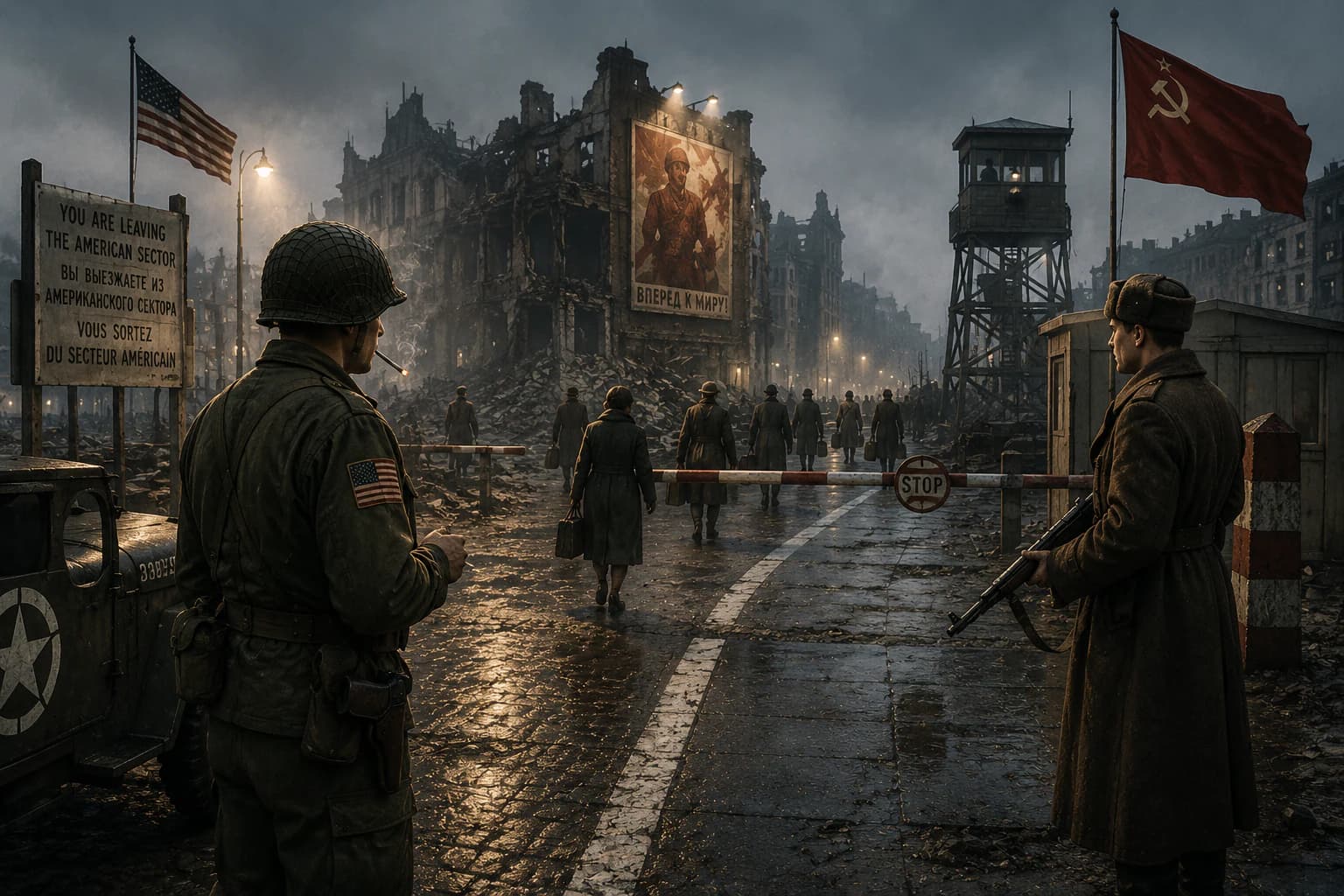
Kennan's Moscow years exposed him to Stalinism at close range: purges, fear, surveillance, propaganda and the difficulty of normal diplomacy with a regime that treated foreign contact as danger. He came to believe Soviet behavior combined Marxist-Leninist ideology with older Russian insecurity and a ruling system that needed external hostility to justify internal control. During World War II, when the United States and the Soviet Union were allies against Nazi Germany, Kennan remained skeptical that wartime cooperation would produce lasting trust. His view was not that Moscow was irrational. It was that Soviet leaders operated inside a worldview in which capitalist encirclement, party discipline and suspicion of compromise reinforced one another.
Firsthand exposure allowed him to see Soviet behavior as driven as much by fear as by ambition.
1946
The Long Telegram
On 22 February 1946, Kennan sent the Long Telegram from Moscow, more than five thousand words answering why the Soviet Union resisted postwar cooperation. The telegram became famous because it gave anxious officials a framework. Kennan argued that Soviet power was politically committed to rivalry, opportunistic rather than reckless, and sensitive to firm resistance at points of real importance. He did not call for preventive war. He called for patience, confidence, political strength and a refusal to be panicked by Soviet pressure. The message arrived when Washington was searching for coherence after World War II. Kennan supplied not just analysis, but a usable grammar for the coming conflict.
He reframed the challenge as a long game, not a sudden clash.
1947
Shaping containment
In 1947 Kennan published 'The Sources of Soviet Conduct' in Foreign Affairs under the signature X. The article introduced containment to a wider policy audience. Its central idea was that the United States should apply counter-pressure at vital political and strategic points until the Soviet system moderated, mellowed or changed under its own contradictions. Kennan's containment was selective and political. It emphasized Western recovery, confidence, alliances, economic strength and psychological steadiness. It was not meant to justify intervention everywhere a communist movement appeared. Yet the word containment proved more portable than Kennan's nuance, and soon belonged to a larger national security system he could not control.
His concept became policy, though often in a more forceful form than he originally imagined.
1947–1950
Government influence
As the first director of the State Department's Policy Planning Staff, Kennan helped shape the Marshall Plan and early Cold War thinking at a moment when Europe was exhausted and politically vulnerable. He saw economic recovery as the strongest answer to Soviet influence. But policy moved in directions he disliked. NATO, the division of Germany, NSC-68's military buildup and the globalizing of Cold War commitments all suggested to him that containment was becoming too armed, too universal and too moralized. Kennan was not soft on Stalin. He simply feared that America might answer a political challenge with a permanent war posture. By 1950, his influence inside government was shrinking.
He found himself outpaced by the very policies his ideas had helped inspire.
1950s–1980s
Scholar and critic
Kennan later served briefly as ambassador to the Soviet Union and to Yugoslavia, but his longer life unfolded as a scholar at the Institute for Advanced Study and as a public critic of American overreach. He wrote major works on Russian-American relations, won Pulitzer Prizes, and warned against nuclear arms racing, Vietnam, moral crusading and policies that confused prestige with interest. His criticisms could be prophetic, but also austere and sometimes undemocratic in tone; Kennan often distrusted mass politics and public emotion. That tension is part of his importance. He was a defender of restraint who did not always sound comfortable with the democratic society he wanted to guide.
Distance from power allowed him to challenge the direction his own ideas had taken.
2005
Enduring influence
Kennan lived until 2005, long enough to see the Soviet Union collapse and to oppose NATO expansion after the Cold War, warning that it could revive Russian insecurity. Not all his judgments were accepted, and some remain debated. His legacy is nonetheless enormous. He gave the United States its most influential early Cold War concept, then spent decades trying to rescue that concept from simplification. The Kennan biography is therefore a warning about policy language: once an idea enters government, it may travel farther and harder than its author intended. To ask why George F. Kennan was important is to ask how strategy can combine insight, restraint and unintended consequence.
His lasting contribution lies less in a fixed doctrine than in a disciplined way of thinking about power and restraint.