Complete chronology
Full overview and deeper context for every journey step.
1162–1177
Harsh beginnings
Genghis Khan was born Temujin, probably around 1162, into the fluid and violent politics of the Mongolian steppe. The exact details of his early life come through later Mongol tradition, especially The Secret History of the Mongols, so some episodes carry the shape of heroic memory as well as historical information. His father Yesugei was poisoned by Tatars, and Temujin's family was abandoned by its followers, leaving his mother Hoelun to keep the children alive in poverty. These years were not a simple origin myth. They taught Temujin that kinship could fail, hunger could humiliate noble birth, and survival depended on attracting loyalty beyond inherited status. That lesson became the foundation of his later revolution in steppe politics.
Early insecurity pushed him to rely on earned loyalty rather than inherited power.
1177–1186
Building alliances
Temujin's rise depended on relationships made under pressure. He secured the support of Toghrul, ruler of the Kerait, and formed an intense early bond with Jamukha, an anda or sworn brother who later became his rival. Most importantly, he built a following by rewarding ability and loyalty rather than relying only on aristocratic lineage. Men from defeated or marginal groups could rise if they served well. This was not modern equality, but it was a major challenge to older steppe hierarchies. Temujin also understood the power of shared hardship: followers who had survived danger with him became personally invested in his success. His leadership grew because he made allegiance feel more profitable and more secure than old tribal fragmentation.
Expanding beyond tribal loyalty gave him access to broader strength and talent.
1186–1201
Rivalries emerge
The struggle with Jamukha and other steppe leaders was more than a personal feud. It tested competing visions of authority. Jamukha represented a more traditional aristocratic order; Temujin increasingly offered a system in which loyalty to the leader and the war band mattered more than clan prestige. The conflict was brutal, and Temujin suffered defeats before he prevailed. He also learned to absorb enemies after victory, sometimes punishing betrayal harshly while incorporating useful warriors and families into his own structure. This ability to destroy rival leadership without wasting all rival manpower became central to Mongol expansion. Temujin did not merely win battles. He reorganized the social material left behind by them.
His conflict with rivals reflected a larger shift from tradition to merit-based rule.
1206
Unifying tribes
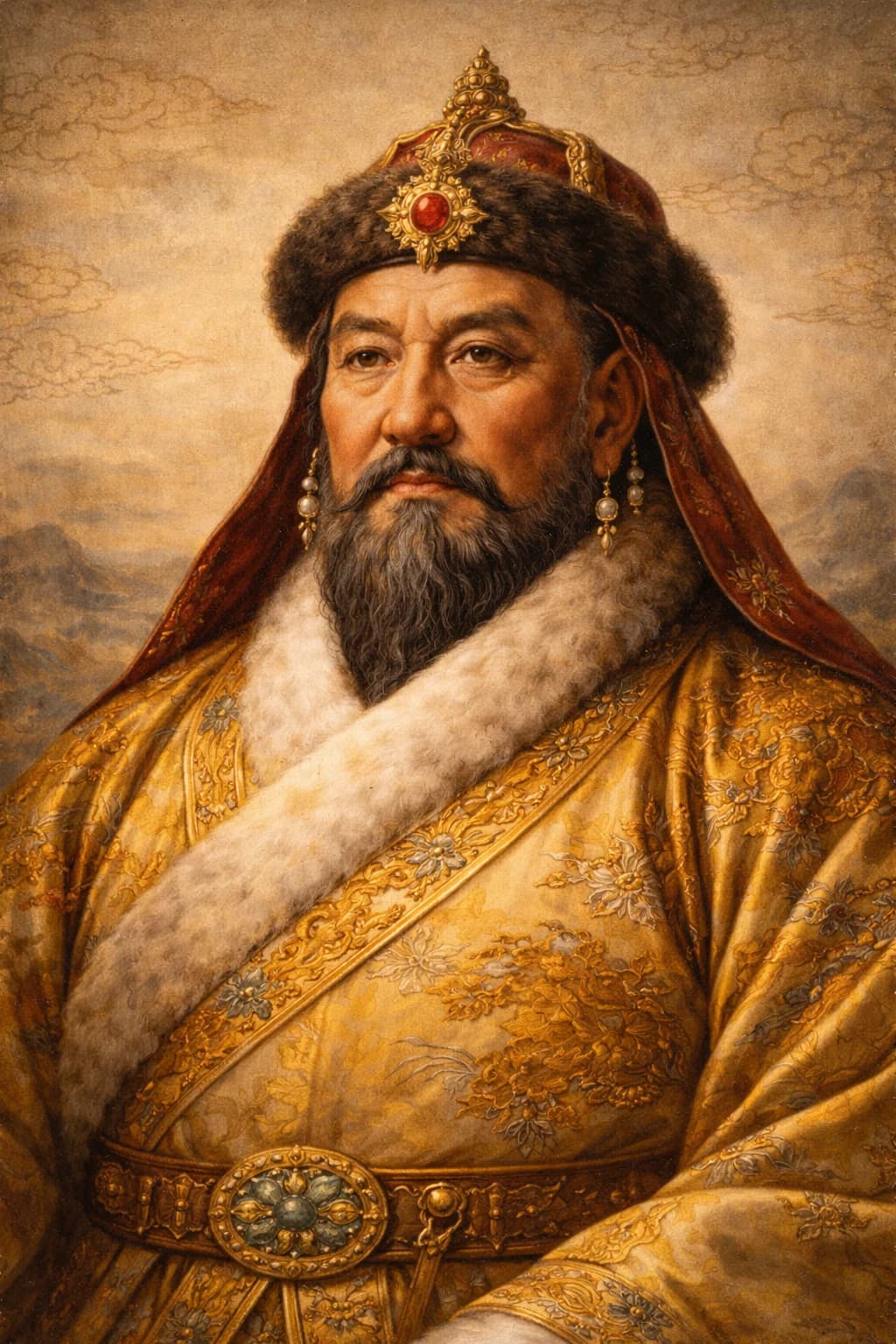
In 1206 a great assembly, or kurultai, proclaimed Temujin as Genghis Khan. The title's precise meaning is debated, but the political meaning was unmistakable: he had become the supreme ruler of the united Mongols. He reorganized people into decimal military units, mixing clan groups so that loyalty flowed upward through command rather than sideways through lineage. He elevated trusted companions, protected envoys and messengers, and enforced discipline through a body of customary law often associated with the Yassa, though later writers probably systematized it more than the evidence allows. The achievement of 1206 was not just unity. It was the creation of a war-making state able to move, communicate and punish with extraordinary coherence.
Unity under a single vision transformed scattered groups into a coordinated power.
1206–1215
Campaigns begin
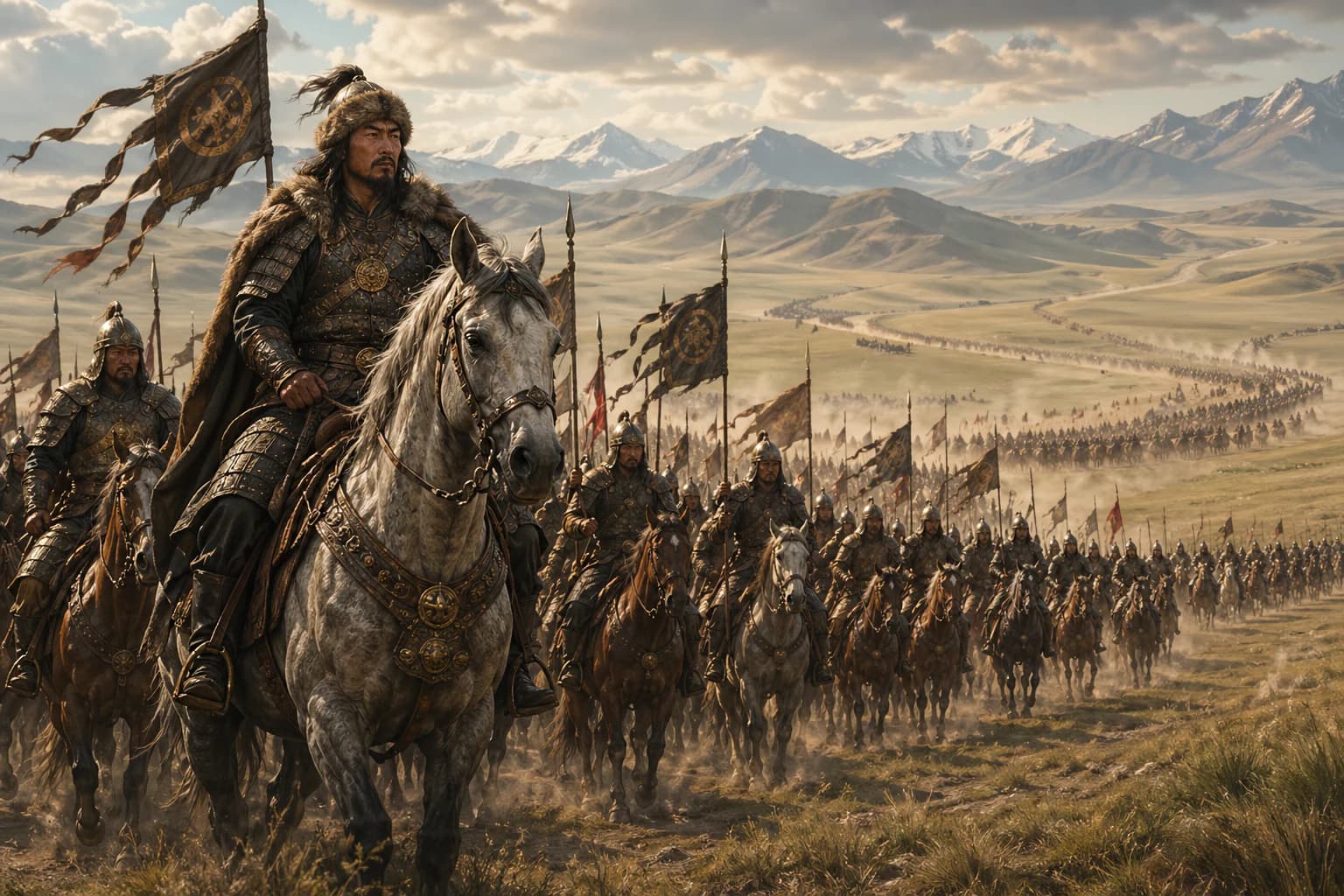
Once the steppe was unified, Genghis Khan turned against neighboring powers, including the Tangut-led Western Xia and the Jurchen Jin dynasty in northern China. These campaigns forced the Mongols to adapt beyond open grassland warfare. They learned siegecraft, used engineers and absorbed specialists from conquered peoples. Mongol armies moved with exceptional speed, coordinated through disciplined units, scouts, signal systems and spare horses. They also used terror deliberately. Cities that resisted could face massacre; those that surrendered might be spared and taxed. This combination of mobility, intelligence, pragmatism and psychological warfare made the Mongol army far more than a mounted horde. It was an expanding imperial machine.
Military success validated the systems he built and encouraged wider ambition.
1219–1223
Westward push
The invasion of the Khwarazmian Empire from 1219 was one of the decisive campaigns of medieval history. It followed a diplomatic and commercial crisis in which a Mongol trade mission was seized and envoys were killed or humiliated. Genghis Khan answered with overwhelming force across Central Asia. Cities such as Bukhara, Samarkand and Urgench were taken amid severe destruction and mass killing, though the scale reported in some sources may be exaggerated by fear and literary convention. The campaign shattered a major Islamic power and opened routes deep into western Eurasia. It also revealed the Mongol method at full scale: intelligence gathering, divided columns, operational speed, incorporation of specialists and punishment designed to make future resistance collapse before battle.
Expansion across trade routes turned conquest into a force for wider connectivity.
1220s
Empire at height
By the 1220s Genghis Khan ruled a vast and still-growing empire stretching from the Mongolian heartland into north China and Central Asia. Conquest on that scale required systems. The Mongols developed relay stations for communication, protected merchants and envoys when it suited imperial interest, and drew administrators, scribes and engineers from conquered populations. Genghis Khan was not a sedentary bureaucrat, but he understood that empire needed information, taxation, law and predictable command. He also practiced religious pragmatism, using and protecting different traditions when they served order. The result was not gentle rule. It was a disciplined imperial structure that could turn conquest into continuing control.
Sustaining power required systems as strong as the conquests themselves.
1226–1227
Final campaigns
Genghis Khan's final campaign was against Western Xia, a state that had resisted and, in Mongol eyes, failed in loyalty. He died in 1227 during that campaign. The cause of death is uncertain; later traditions mention falls, wounds, illness or legends shaped by secrecy and reverence. The Mongols concealed the details and returned his body for burial, reportedly in an unmarked grave whose location remains unknown. What matters historically is that his death did not dissolve the empire. Succession had been planned around his sons and the wider Borjigin house, with Ogedei eventually becoming Great Khan. Genghis Khan left behind not simply conquered territory, but a political-military system capable of outliving him.
His drive for expansion defined his leadership until the very end.
After 1227
Lasting legacy
After 1227 Genghis Khan's descendants expanded the Mongol Empire farther than he personally ruled, reaching China, Korea, Iran, Russia, the Caucasus, eastern Europe and the Middle East. His legacy is therefore immense and morally difficult. Mongol conquests destroyed cities, killed large populations, displaced communities and traumatized regions from Central Asia to northern China. They also connected Eurasia through trade, diplomacy, migration, technologies and disease pathways in what historians sometimes call the Pax Mongolica. Genghis Khan was not a modern nation-builder, nor merely a barbarian caricature. He was a steppe ruler of extraordinary political imagination, military organization and ruthlessness. To ask why Genghis Khan was important is to ask how a man from a fractured frontier created systems strong enough to reorder much of the medieval world.
His influence endured because his systems outlived his personal rule.