Complete chronology
Full overview and deeper context for every journey step.
1336–1350s
Steppe beginnings
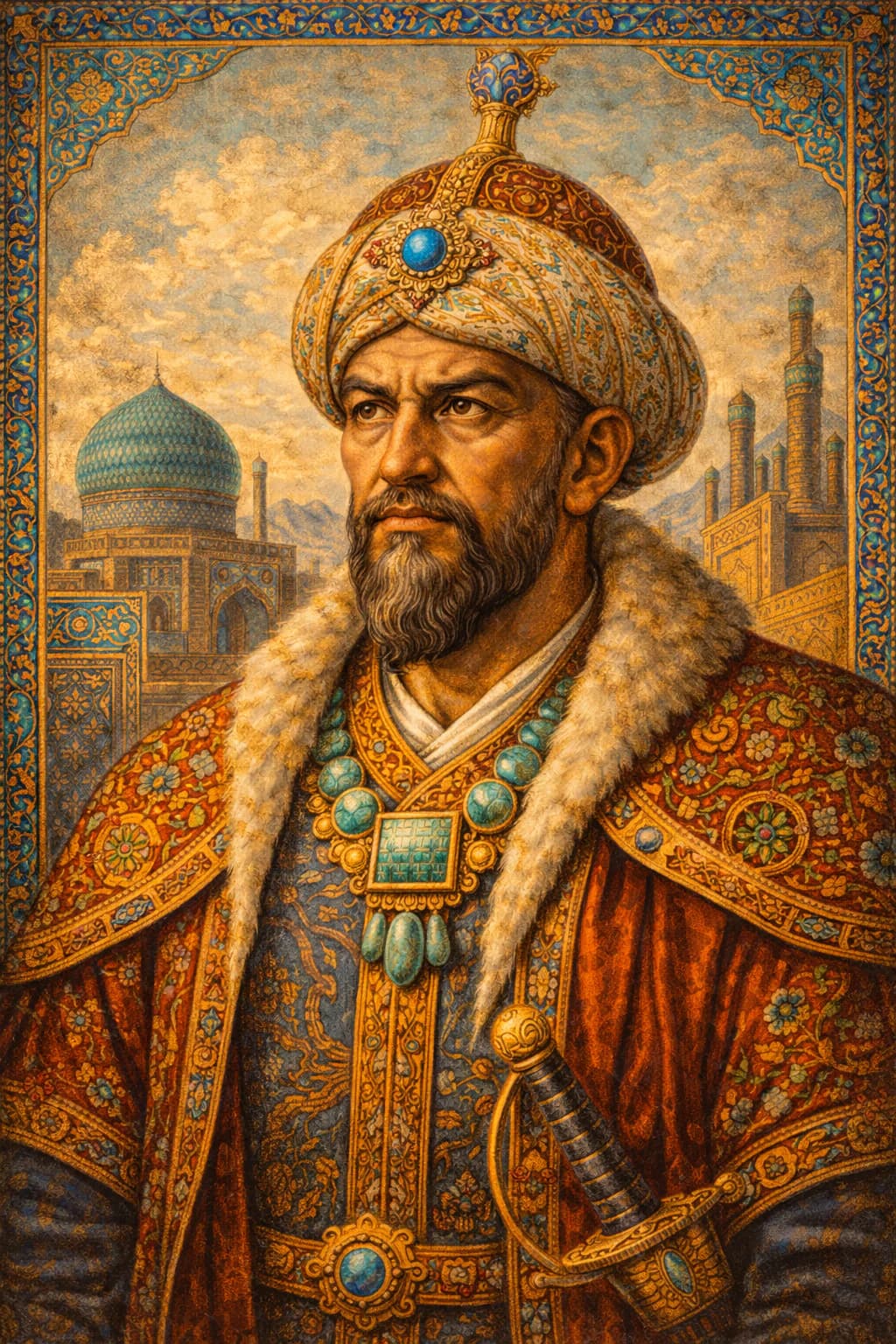
Timur was not a direct descendant of Genghis Khan, and that fact shaped his political life. In the steppe world, Chinggisid blood carried unique legitimacy, so Timur had to rule through a mixture of marriage alliance, puppet khans, Islamic kingship and personal military success. He belonged to the Barlas, a Mongol-origin clan long Turkicised in language and culture. The region around Samarkand was fractured after the decline of the Chagatai Khanate, creating opportunities for ambitious war leaders. Later tradition remembered Timur as lame from injuries, the origin of the European name Tamerlane. Whether romanticised or not, the image fits a man who turned physical limitation into part of a terrifying legend.
Growing up in a fluid power structure taught him that control belonged to those willing to seize it.
1360s
Rising war leader
Timur's rise was a masterclass in opportunism. He served, allied, defected and fought in a landscape where loyalty followed success more than law. His partnership with Amir Husayn helped resist outside domination and consolidate influence in Transoxiana, but two ambitious men could not share supremacy for long. Timur gathered warriors by promising victory, plunder and order after chaos. He also married into Chinggisid lines, using the title guregen, or royal son-in-law, to borrow legitimacy he did not possess by birth. By the end of the decade he had become the strongest force in the region.
He understood early that loyalty follows success, and success must be demonstrated repeatedly.
1370
Seizing Transoxiana
Timur's seizure of power in 1370 did not make him khan in the old Mongol sense. Instead, he installed Chinggisid figureheads while exercising real authority himself. Samarkand became the stage on which he displayed conquest as civilisation: mosques, gardens, palaces, markets and workshops filled with artisans taken from conquered lands. This combination of legal fiction and practical domination was typical of his rule. He respected the symbolic grammar of the steppe while bending it to his own command. With Transoxiana secure, he turned outward, not as a raider alone but as a conqueror building a reputation that could compel submission before battle.
Control of a stable base transformed him from a contender into a ruler with expansion in mind.
1380s
Persian campaigns
Iran and surrounding regions were politically fragmented, making them vulnerable to Timur's mobile armies and ruthless diplomacy. He defeated local dynasties including the Jalayirids, Muzaffarids and Kartids, taking cities whose wealth, craftsmen and strategic position could feed Samarkand and further campaigns. Submission might be rewarded with office; resistance could bring massacre, deportation and towers of skulls meant to instruct the next city. Timur's violence was not random loss of control. It was communicative terror, designed to shorten future campaigns by making fear travel ahead of the army. The cost to urban populations was immense.
He used fear as a deliberate tool, turning reputation into a weapon that extended beyond the battlefield.
1390s
Empire building
Timur's empire was not a bureaucratic state like Ming China or the Ottoman Empire. It was a conquest system held together by his charisma, family appointments, military reward and the movement of wealth toward the centre. He could be a patron of Islamic architecture, scholarship and court culture while devastating the places from which that splendour was extracted. Samarkand's magnificence was built by artisans brought from Iran, India, Syria and beyond. This is the central Timurid paradox: cultural brilliance and mass violence were not separate chapters but connected processes. The capital shone because conquest fed it.
He understood that lasting power required both fear and the visible benefits of stability and prosperity.
1398
Invasion of India
Timur justified the invasion of India in religious and political language, but plunder and prestige were central. The Delhi Sultanate was weakened, and Timur moved with devastating speed. Before the battle near Delhi, large numbers of prisoners were killed to prevent revolt. After victory, the city was sacked, its population subjected to slaughter, enslavement and looting. The campaign brought immense wealth back to Central Asia but did not create durable Timurid rule in India. It was a raid on an imperial scale: spectacular, terrifying and extractive. Centuries later, Babur, founder of the Mughal Empire, would claim Timurid descent and give that legacy a different Indian future.
His expansion into India showed that his ambition extended beyond consolidation into bold, far-reaching ventures.
1402
Clash with Ottomans
The clash with Bayezid showed Timur at the height of his strategic power. The Ottoman sultan had expanded aggressively in Anatolia and the Balkans, alarming both local rulers and European powers. Timur exploited Anatolian grievances, manoeuvred effectively and defeated Bayezid at Ankara. The sultan's capture stunned the Islamic and Christian worlds alike. For the Ottomans, the defeat opened an interregnum of dynastic struggle. For Timur, it confirmed his claim to be the supreme warlord of the age. Yet even this victory was disruptive rather than constructive: Anatolia was rearranged, but not absorbed into a stable Timurid order.
Victory over a strong rival confirmed his supremacy but also exposed the temporary nature of conquest-based power.
1404–1405
Last campaign plans
Timur did not imagine retirement. After decades of campaigning, he prepared to move against Ming China, a target that would have tested even his logistical capacity. The plan reflected ambition, ideology and the momentum of a ruler whose legitimacy depended on continued victory. Winter conditions were severe, and Timur fell ill at Otrar, dying in February 1405 before the campaign began. His death instantly changed the political reality. The empire had been organised around his person more than around durable institutions. Once the conqueror was gone, succession rivalry became unavoidable.
His final ambitions reveal a leader who saw expansion as a continuous process rather than a completed achievement.
1405 onward
Aftermath and memory
Timur's immediate empire could not survive intact because it had been built through personal command, competitive princes and conquest revenue. Yet the Timurid legacy did not vanish. His descendants, especially under Shah Rukh and Ulugh Beg, presided over a brilliant Persianate court culture of architecture, astronomy, manuscript art and scholarship. Samarkand and Herat became centres of refinement after an age of terror. Later rulers, including the Mughals, claimed Timurid ancestry to legitimise empire. Timur's memory therefore remains double-edged: he was a military genius and patron whose splendour was inseparable from mass killing, deportation and devastation.
His legacy endures as a reminder that power achieved through force can leave both lasting achievements and deep scars.