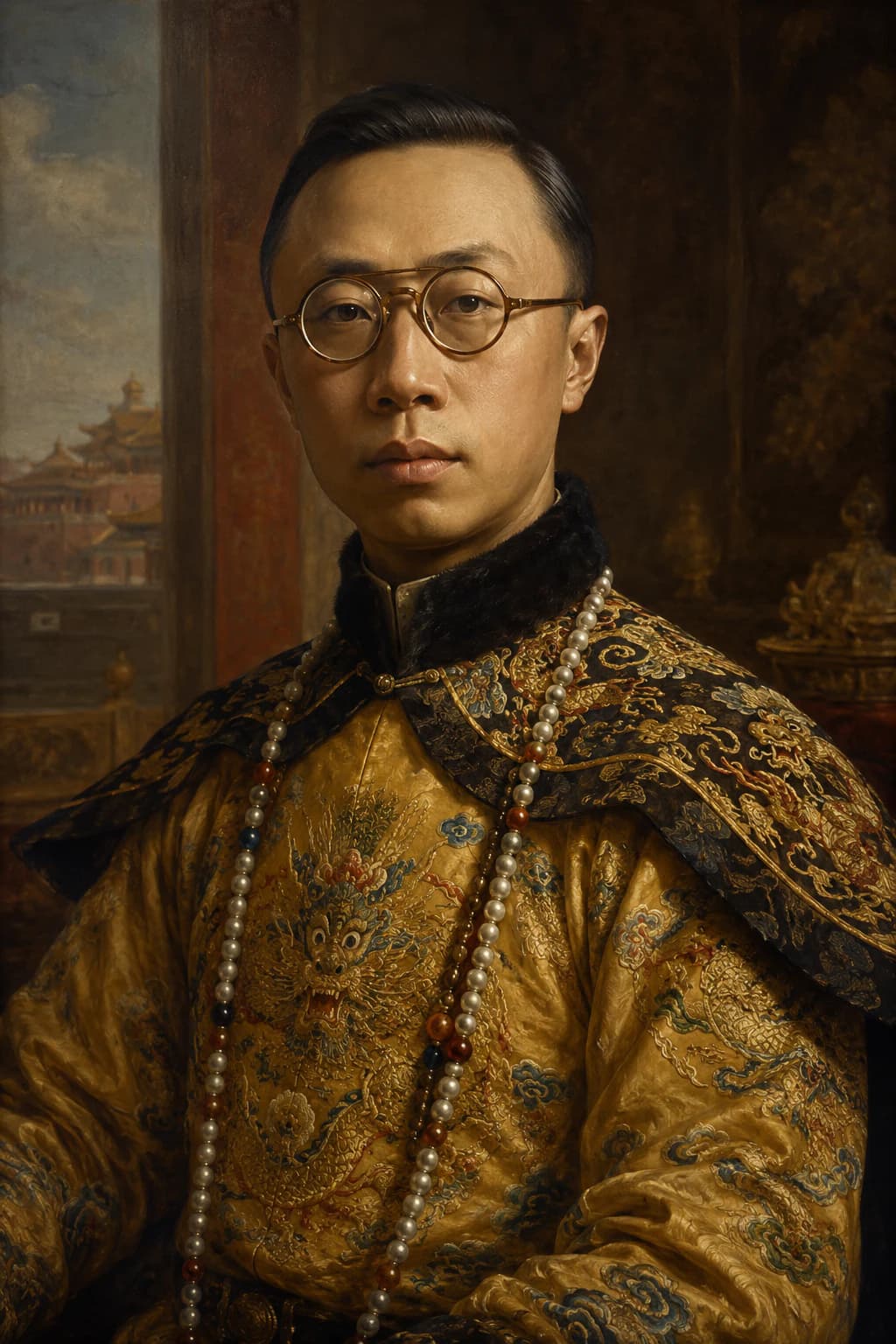
Complete chronology
Full overview and deeper context for every journey step.
1835
Born Yehenara
Cixi was born in 1835 into a Manchu family of the Yehenara clan. Her early life is less securely documented than her later legend, and much hostile writing about her was shaped by court gossip, political blame, and foreign fascination. What is clear is that she entered a Qing world under strain. The Opium War had exposed the dynasty's vulnerability to Western power, while population pressure, corruption, and social unrest challenged imperial authority. Cixi's life would unfold inside the crisis of late imperial China.
Her rise began in a dynasty already struggling to defend its authority.
1850s
Imperial consort
Cixi entered the Forbidden City as a consort of the Xianfeng Emperor. In the hierarchy of the imperial harem, a woman's security depended heavily on rank, favor, alliances, and above all childbirth. Cixi's position changed decisively when she gave birth in 1856 to Zaichun, the emperor's only surviving son. The child became the future Tongzhi Emperor, and Cixi became far more than one consort among many. Motherhood gave her political leverage in a court where succession was the central question of dynastic survival.
By bearing the heir, Cixi moved from palace vulnerability to political relevance.
1861
Coup after Xianfeng
The Xianfeng Emperor died in 1861 while the court was still shaken by the Second Opium War and the flight from Beijing. He left regents to govern for the child emperor, but Cixi, together with Empress Dowager Ci'an and Prince Gong, moved against them in the Xinyou Coup. The regents were removed, and Cixi became one of the central figures of government. This was a bold act in a system that formally placed women behind the curtain of male rule. Cixi mastered that curtain, using regency, seals, audiences, and alliances to exercise authority without sitting on the throne herself.
The 1861 coup made Cixi the decisive survivor of a broken court.
1860s–1870s
Tongzhi Restoration
Cixi's early regency coincided with the suppression of the Taiping Rebellion, one of the deadliest conflicts of the nineteenth century. Qing survival depended heavily on regional Han Chinese commanders such as Zeng Guofan and Li Hongzhang, whose armies restored order while also changing the balance of power within the empire. The so-called Tongzhi Restoration aimed to revive Confucian governance, repair administration, and adopt selected foreign military and technical methods through the Self-Strengthening Movement. Cixi did not personally design every policy, but she presided over the political environment in which cautious recovery became possible.
Her first decades in power were defined by survival after catastrophe.
1875
Guangxu succession
The Tongzhi Emperor died in 1875 without a son, creating a dangerous succession problem. Cixi selected her young nephew Zaitian, who became the Guangxu Emperor. The choice kept power within a manageable family line and allowed Cixi to resume regency. It also broke the normal father-to-son succession pattern, revealing how deeply politics shaped dynastic ritual. By controlling the choice of emperor, Cixi preserved her central role. Critics would later see this as evidence of ambition; supporters could argue that she prevented a succession crisis at a fragile moment.
Cixi's command of succession politics kept her at the center of Qing rule.
1880s–1895
War and weakness
The late nineteenth century brought sharper pressure from imperial powers and a transformed Japan. The Sino-French War and especially the First Sino-Japanese War of 1894–1895 showed that selective self-strengthening had not made the Qing state militarily secure. Defeat by Japan was particularly shocking because Japan had once been seen through a very different regional hierarchy. The loss of influence over Korea and the Treaty of Shimonoseki damaged Qing prestige. Cixi's responsibility for these failures remains debated, but she ruled within the system that failed to respond fast enough.
Foreign defeat turned Qing weakness from a warning into a public humiliation.
1898
Hundred Days' Reform
In 1898, the Guangxu Emperor, influenced by reformers including Kang Youwei and Liang Qichao, launched the Hundred Days' Reform. The program aimed to remake education, administration, military structures, and state institutions at speed. To Cixi and conservative officials, the movement threatened established power and perhaps the throne itself. She intervened, ended the reforms, and confined the emperor. The episode has often been cast as reaction crushing progress, and that is partly true. Yet it was also a struggle over pace, authority, and who had the right to transform the state.
The reform crisis showed that late Qing China needed change but could not agree who should control it.
1900–1901
Boxer crisis
The Boxer Uprising brought Cixi's rule to its most dangerous international crisis. Anti-foreign and anti-Christian violence spread in north China, and Cixi eventually supported war against foreign powers. The decision proved disastrous. The Eight-Nation Alliance invaded, Beijing was occupied, and the Qing court fled to Xi'an. The Boxer Protocol imposed a crushing indemnity and further humiliation. Cixi survived politically, but the dynasty's authority was badly damaged. The crisis exposed the peril of trying to use popular anti-foreign anger as state policy when the military balance was overwhelmingly unfavorable.
The Boxer crisis left the Qing dynasty alive but visibly weakened.
1901–1908
Late reforms and death
After returning to Beijing, Cixi supported the New Policies, a reform program that went further than earlier cautious efforts. The Qing moved toward military modernization, administrative change, educational reform, and eventually constitutional preparation. The civil service examinations, central to elite life for centuries, were abolished in 1905. These reforms were significant, but they came late and created new expectations the dynasty could not easily satisfy. Cixi died on 15 November 1908, one day after the Guangxu Emperor. Before her death, the child Puyi was selected as successor. Within four years, the Qing dynasty had fallen.
Cixi's final reforms could not undo decades of crisis or restore confidence in imperial rule.