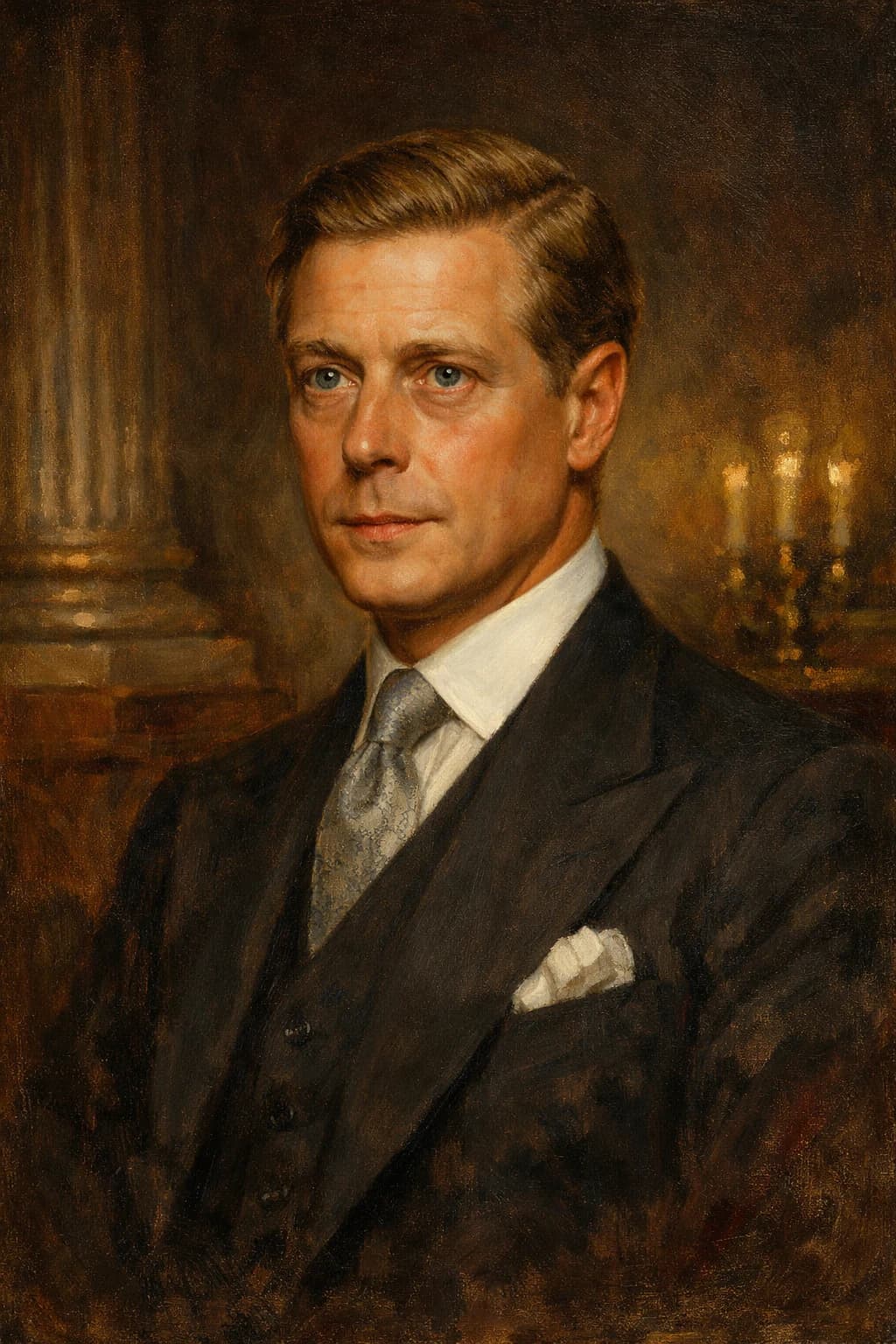
Complete chronology
Full overview and deeper context for every journey step.
1841–1860s
Victoria's disappointment
Albert Edward, the future Edward VII, was born in November 1841 as the eldest son of Queen Victoria and Prince Albert. His parents had high and specific ambitions for the heir to the British throne: Albert in particular designed an educational programme of unusual intensity, intending to create a model constitutional monarch who combined political wisdom with intellectual seriousness. The experiment failed. Edward showed no particular aptitude for the subjects his tutors pressed on him, developed a love of pleasure, company, and physical sensation, and became something that his parents found deeply uncomfortable: a person who preferred people to principles. His mother blamed him, throughout her life and beyond, for contributing to his father's death in 1861 by the stress his dissolute behaviour caused.
Being measured against a parent's ideal of what you should be can produce a child who excels at being entirely something else.
1860s–1890s
Marlborough House set
Excluded from any real political or governmental role by his mother — Victoria believed he could not be trusted with state papers — Edward developed an alternative empire of social influence. Marlborough House in London became the centre of a court within a court, where the heir and his Princess Alexandra presided over a social world that mixed aristocratic tradition with new commercial wealth, sporting enthusiasm, and a rather more relaxed morality than official Victorian culture professed. The Marlborough House set was influential, fashionable, and genuinely open to talent from various sources, including Jewish bankers like the Rothschilds who would previously have been excluded from aristocratic London. Edward's social world was more cosmopolitan and less purely aristocratic than any previous version.
A man excluded from official power tends to build an alternative source of it, which can prove more personally satisfying than the excluded kind.
1870s–1890s
Scandals and social life
Edward appeared in the witness box twice in high-profile legal proceedings, once in the Mordaunt divorce case of 1870 and once in the Tranby Croft baccarat cheating case of 1890. Neither was definitively damaging, but both fed the image of a prince whose private life was conducted at considerable distance from the moral standards Victoria was believed to represent. His long affair with Alice Keppel and various other attachments were widely known. The combination of visibility, proximity to scandal, and obvious human enjoyment of the pleasures that Victorian public culture officially disapproved of made him both popular with a public that recognised its own appetites and uncomfortable for an establishment that needed the monarchy to represent something more elevated.
A public figure's visible human appetites can make them simultaneously more relatable and more vulnerable.
1863 onwards
Princess Alexandra
Edward married Alexandra of Denmark in March 1863 in a ceremony that drew enormous public enthusiasm. Alexandra was beautiful, gracious, and genuinely charming in ways that her husband also was, and the combination made them the most visible royal couple of the late Victorian age. The marriage survived Edward's numerous infidelities — Alexandra's attitude toward them combined resignation, dignity, and occasional pointed comment — and produced five children. Alexandra's popularity with the public was independent of her husband's: she was associated with charitable work, accessible warmth, and a natural kindness that the more reserved Victoria could not project. Her longevity — she lived until 1925 — meant that she was the dowager queen for the majority of the twentieth century's first quarter.
A marriage that accommodates rather than resolves its difficulties can still be genuinely successful by most measures that matter.
1901
Accession
Victoria died on 22 January 1901 at Osborne House, and Edward came to the throne at fifty-nine, the longest-serving heir apparent in British history to that point. His first act was to announce that he would be known as Edward rather than Albert Edward, establishing his own identity rather than the Albert-focused dynastic continuity his mother had preferred. He immediately opened up the court: state rooms that had been closed were reactivated, Buckingham Palace was renovated, and the social machinery of monarchy resumed after years of semi-dormancy. His mother had governed from withdrawal; he governed from engagement. The difference in style was striking and was immediately noticed.
A new reign can feel like a reopening simply by doing what the previous one had stopped doing.
1901–1910
Diplomatic energy
Edward VII's role in British foreign policy is a subject of legitimate debate. His personal relationships with European monarchs — most of whom were his relatives — gave him access that professional diplomats lacked, and his 1903 visit to Paris contributed to the improvement in Anglo-French relations that culminated in the Entente Cordiale of 1904. Whether the King made the policy or simply embodied it is debated, but contemporary Europeans credited him with considerable influence, which itself had diplomatic value. His relationship with his nephew Kaiser Wilhelm II was notoriously poor, which may have contributed to the Anglo-German antagonism that complicated his later reign. He has been called the uncle of Europe, a description that captured both his familial connections and the extent to which personal diplomacy and dynastic politics still overlapped.
Personal relationships between rulers can grease the wheels of formal diplomacy, though they cannot substitute for it.
1909–1910
Constitutional crisis
The Lords' rejection of Lloyd George's People's Budget in November 1909 created a constitutional crisis that had no recent precedent. The government argued that an unelected chamber had no right to reject a Finance Bill; the Lords argued that the scale of the proposed taxation and social change required a new election. Edward, constitutionally bound to work with the government he had, was pressed by Asquith to agree to create sufficient new peers to overcome Lords opposition. He was deeply reluctant and asked for assurances that the government would first call a general election. He died in May 1910 before the crisis was resolved, leaving his son George V to face the question directly. The constitutional settlement produced by the Parliament Acts of 1911 would not have been possible without the threat of mass peer creation that both monarchs ultimately held over the Lords.
A monarch's death at a constitutional hinge point shifts the burden to their successor without reducing its weight.
May 1910
Death
Edward VII died at Buckingham Palace on 6 May 1910, aged sixty-eight, from bronchitis and heart failure. His mistress Alice Keppel was brought to his bedside at the end at Queen Alexandra's instruction, a gesture of dignified magnanimity that told observers much about both women. His horse Witch of the Air won at Kempton Park on the day of his death. He had been king for nine years and nine months, a brief reign after the longest wait in British dynastic history. His popularity at death was considerably greater than at any other point in his life, suggesting that what the public wanted from him — accessibility, warmth, a sense that the monarchy was reconnected to ordinary pleasures — he had provided more fully than his reputation for dissolution had allowed contemporaries to recognise.
A reputation built on perceived self-indulgence can coexist with genuine public affection if the person is found to give something back.
Post-1910
The Edwardian era
Edward VII's nine-year reign has acquired in retrospect a quality of warmth and ease that the reality of 1901–1910 — marked by labour unrest, imperial anxiety, Irish crisis, and brewing European conflict — only partially justified. The image of the Edwardian era as a golden afternoon of comfort and confidence was constructed after the fact, in the shadow of what came next. Edward himself contributed to this image by being visibly human, enthusiastic about pleasure, and genuinely engaged with the social world of his time rather than presiding over it from a distance. Whether this constitutes a legacy or merely a mood is a reasonable question. He had modernised the monarchy's public function without altering its constitutional position, which was probably the most sustainable contribution available to him.
An era's reputation is partly built by what follows it, and what followed Edwardian England made even its real difficulties look like peace.