Complete chronology
Full overview and deeper context for every journey step.
1239
Royal birth
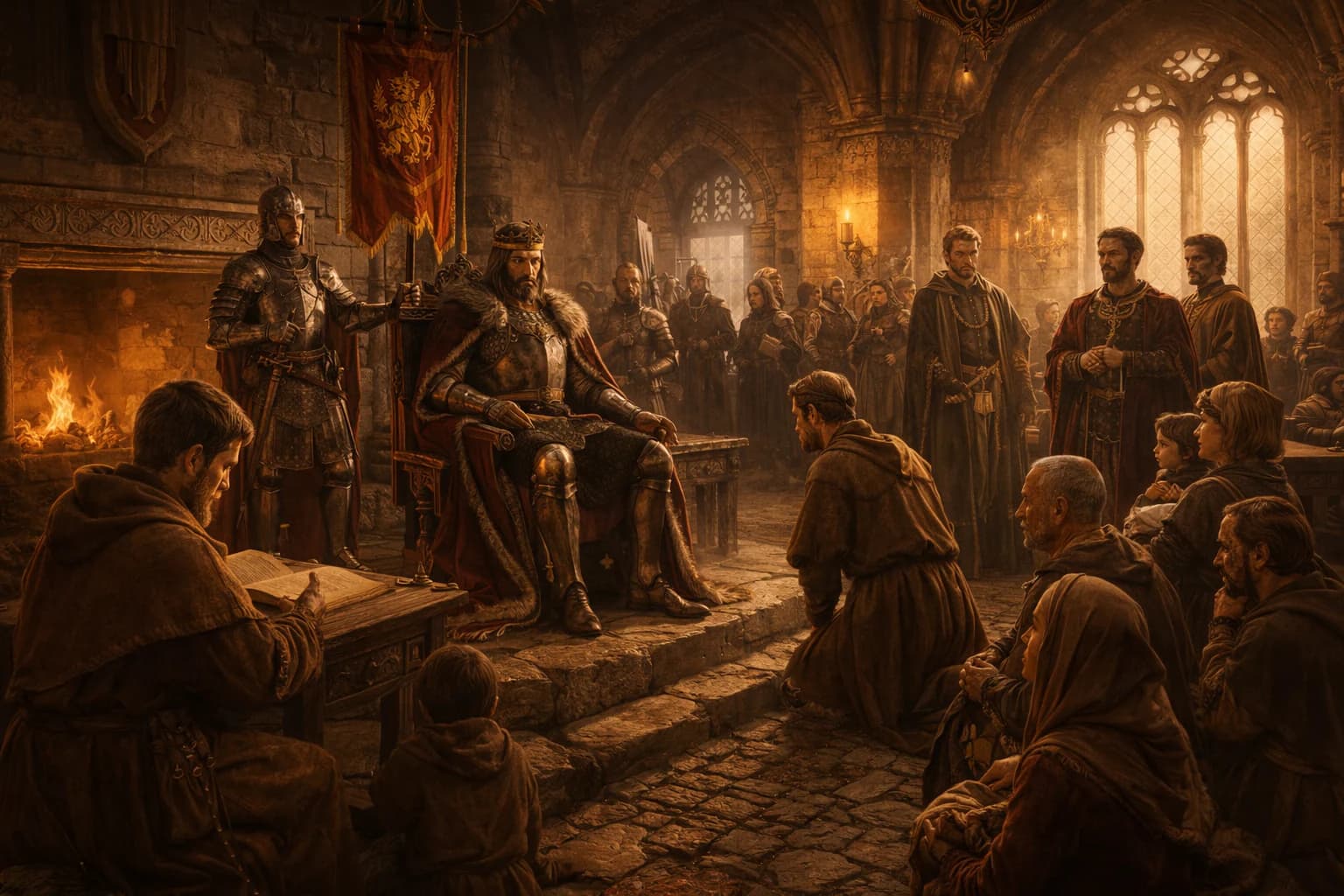
Edward was born at Westminster on 17 June 1239, heir to a dynasty still recovering from the turbulence of King John's reign and Magna Carta. His father, Henry III, possessed deep religious conviction and an expensive vision of monarchy, but he often failed to manage the magnates whose cooperation he needed. Edward grew up in a court where royal authority looked grand in ceremony yet fragile in practice. Foreign favourites, heavy taxation, failed continental ambitions, and baronial demands for reform all shaped the political air around him. He learned early that kingship was not simply inherited dignity. It had to be defended, financed, negotiated, and made visible in law.
Early exposure to political instability can drive a leader toward stricter control later in life.
1264–1265
Barons' War
The Second Barons' War turned Edward from heir into political actor. Simon de Montfort and his allies sought to bind Henry III to a programme of aristocratic reform, and in 1264 they defeated the royalists at Lewes. Edward was taken hostage, a humiliation that taught him how quickly a king's son could become a bargaining chip. His escape in 1265 changed the campaign. Rallying royalist forces with speed and discipline, he helped crush Montfort at Evesham, where the rebel leader was killed and royal authority restored. Edward never forgot that civil war had grown from weak government, disputed counsel, and magnates confident enough to discipline a king. His later rule would show an almost relentless determination to prevent that balance of power from returning.
Conflict within a nation often shapes a ruler’s future approach to power and discipline.
1270–1272
Crusader journey
Edward's crusade did not transform the fortunes of the Latin East, but it mattered to his own image and experience. He set out in 1270 with the seriousness expected of a great Christian prince, first joining the wider crusading movement associated with Louis IX of France and then continuing to Acre. The expedition was small and achieved little strategically, yet Edward showed personal stamina and survived an attempted assassination by an assailant with a poisoned blade, an episode later folded into the legend of his toughness. While he was still overseas, Henry III died in November 1272. Edward did not rush home in panic. The succession was accepted, a sign that the monarchy he inherited was more stable than the one he had defended in youth.
Experiences abroad can reshape a leader’s perspective before they assume full authority.
1272
Becoming king
Edward was crowned at Westminster Abbey in August 1274 after a long journey home through Italy and France. He arrived with a clear sense that royal authority needed repair, not just display. One of his first major actions was the Hundred Rolls inquiry, an investigation into local rights, abuses, franchises, and claims of authority across England. This was not antiquarian curiosity. It was a king asking where power had leaked away and how it might be recovered. Edward's government used courts, records, statutes, taxation, and assemblies of the realm to make rule more systematic. He could be brutally forceful, but he was not merely a warlord. His strength lay in turning monarchy into a machine that could investigate, legislate, tax, summon, and punish.
A stable beginning can allow a ruler to focus on long-term structural change.
1270s–1280s
Legal reforms
Edward I earned his reputation as a lawmaker because his reign produced a sequence of statutes that reshaped English governance. The Statute of Westminster I addressed criminal justice, local abuses, and public order. The Statute of Gloucester strengthened royal scrutiny of aristocratic franchises. Mortmain tried to prevent land from passing permanently into church hands without royal licence. Westminster II refined legal remedies, while Quia Emptores in 1290 changed the logic of land transfers by preventing subinfeudation and preserving obligations to existing lords. These measures were not modern reform in a liberal sense. They served royal power, social order, and the interests of landholding elites. Yet they mattered because they made government more textual, procedural, and durable. Edward's England was a place where authority increasingly travelled through written law.
Lasting power often comes from systems that outlive individual rulers.
1277–1283
Conquest of Wales
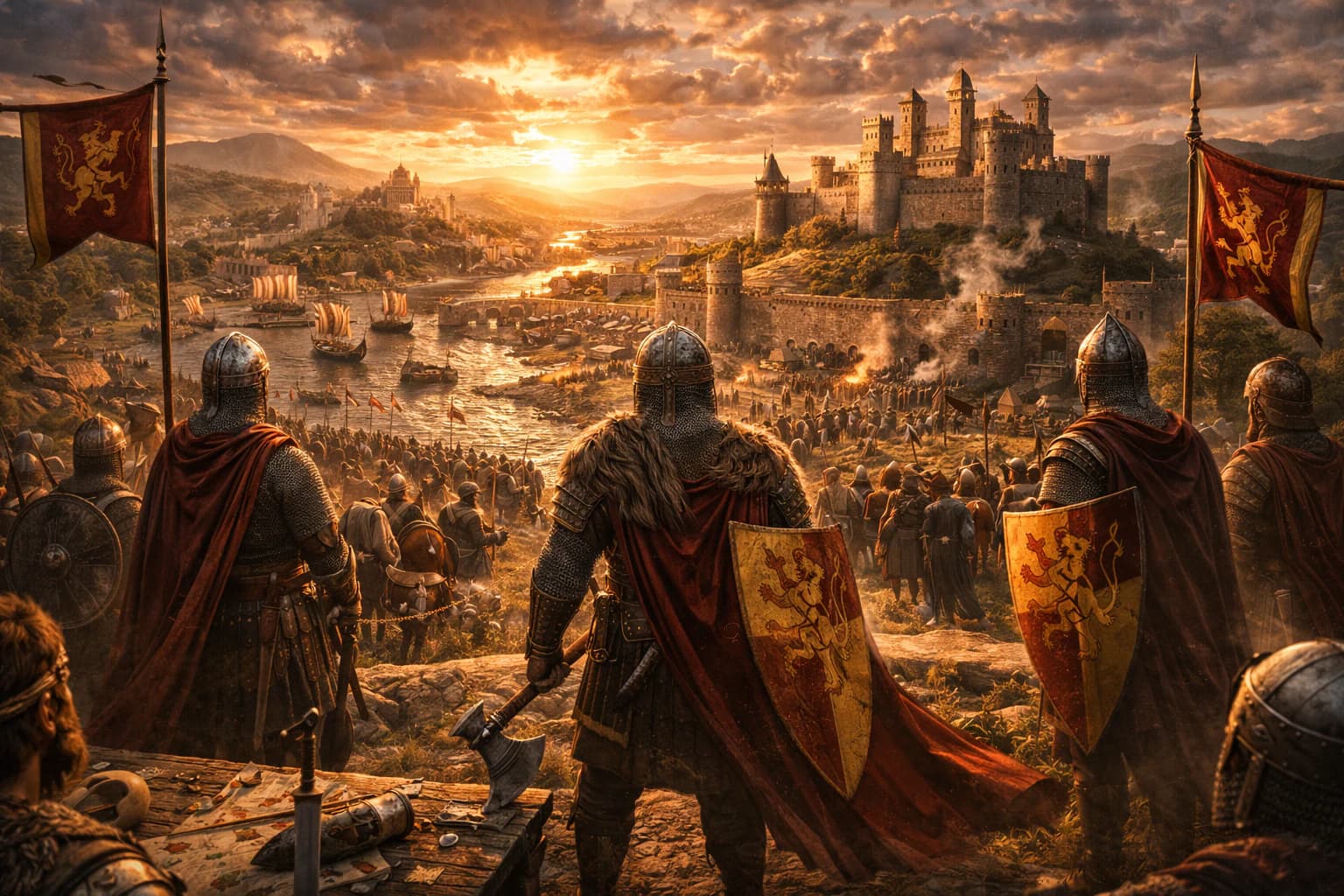
Wales was the clearest demonstration of Edward's ability to convert victory into occupation. His first campaign in 1277 forced Llywelyn ap Gruffudd to accept reduced authority, but renewed conflict in 1282 became a war of conquest. Llywelyn was killed, his brother Dafydd captured and executed, and the independent principality of Wales was broken. The Statute of Rhuddlan in 1284 imposed English administrative structures over much of the conquered territory. Edward then poured resources into one of the most formidable castle-building programmes of the Middle Ages. Caernarfon, Conwy, Harlech, and later Beaumaris were not just fortresses. They were statements in stone, designed to dominate landscapes, house garrisons, and announce that English power had become permanent. For the Welsh, this was conquest and dispossession; for the English crown, it was a model of imperial rule inside the British Isles.
Territorial expansion requires both victory in battle and systems to maintain control afterward.
1296–1305
Scottish conflict
Scotland proved far harder to master than Wales. Edward was invited to arbitrate the Great Cause after the death of Margaret, Maid of Norway, left the Scottish succession disputed. He used the opportunity to press claims of English overlordship, eventually recognising John Balliol as king but treating him as a subordinate. When Balliol resisted English demands, Edward invaded in 1296, took Berwick, defeated Scottish forces, removed the Stone of Scone, and stripped Balliol of power. It looked like a swift conquest. It was not. Resistance gathered under William Wallace and Andrew Moray, whose victory at Stirling Bridge in 1297 exposed the vulnerability of English occupation. Edward answered with victory at Falkirk in 1298 and the execution of Wallace in 1305, but Scotland remained unresolved. Robert Bruce's seizure of the Scottish crown in 1306 reopened the struggle just as Edward's health was failing.
Even powerful rulers encounter limits when facing determined resistance.
1306–1307
Last campaigns
Edward's final years show both the reach and the harshness of his kingship. War required money, and money required political negotiation, pressure, and increasingly sophisticated taxation. His parliaments mattered because consent, grievance, and finance became entangled. His reign also carried a darker legacy in the 1290 expulsion of the Jews from England, after years of restrictive legislation, exploitation through royal finance, and growing Christian hostility. The expulsion removed a vulnerable minority that the crown had long used financially and then abandoned politically. Meanwhile Scotland consumed Edward's energy. Even old and ill, he pushed north against Robert Bruce, unwilling to leave the work unfinished. He died at Burgh by Sands near the Scottish border on 7 July 1307, still campaigning, still trying to impose a settlement that would outlive him.
Relentless ambition can drive leaders forward even when circumstances begin to limit them.
1307 onward
Enduring legacy
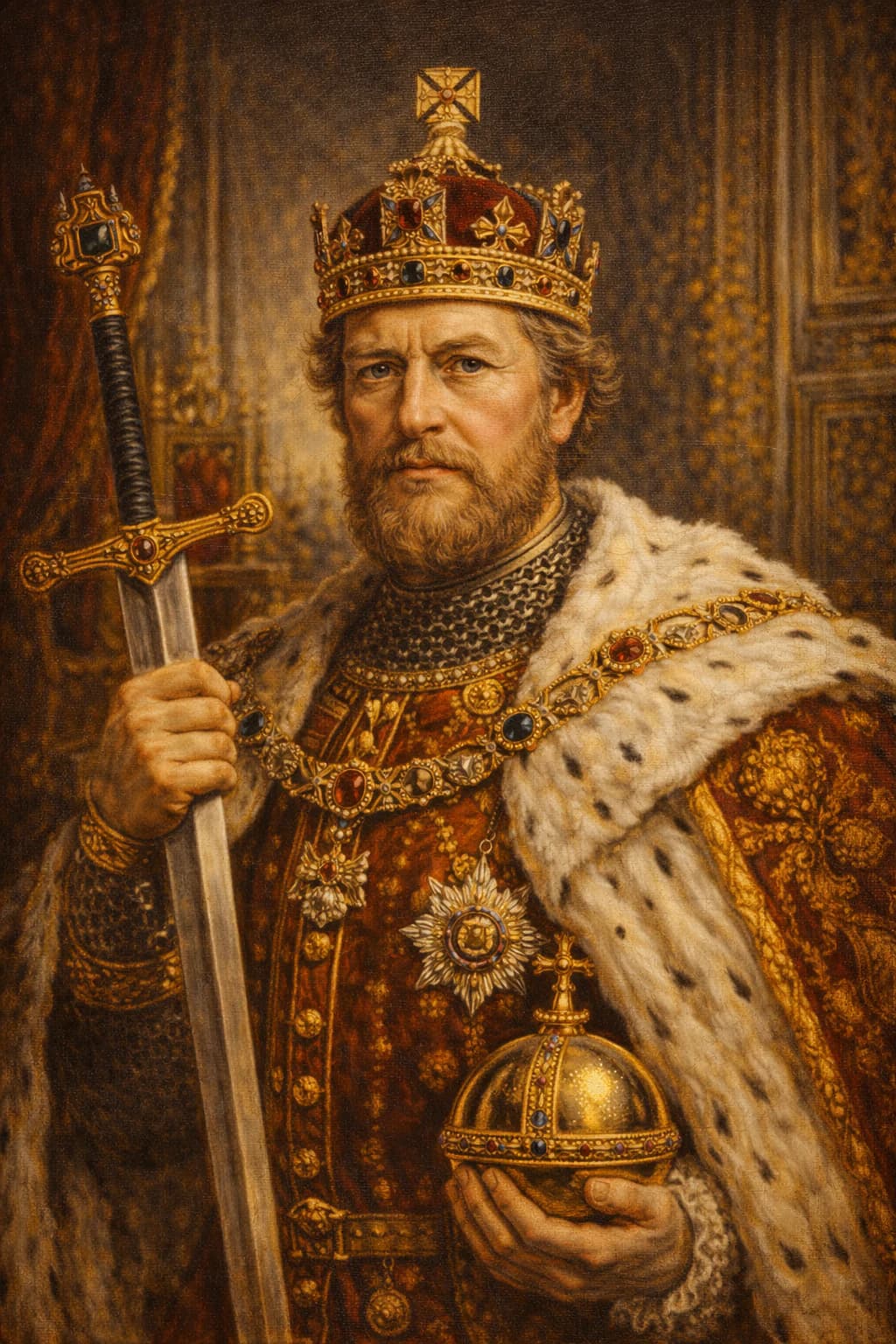
Edward I's importance lies in the combination of state-building and coercion. He strengthened royal justice, produced major statutes, used parliament more regularly, and gave English kingship a harder administrative edge. He conquered Wales so thoroughly that English rule there became embedded in castles, counties, and law. Yet the same reign also expelled the Jews from England, intensified fiscal pressure, and launched a Scottish policy that failed to produce obedience while creating a long memory of resistance. Later tradition called him Longshanks and the Hammer of the Scots, names that capture only part of the story. He was one of medieval England's most capable kings, but capability is not the same as benevolence. His reign made the English crown stronger, and the consequences of that strength were felt most sharply by those brought under it.
A powerful legacy can unite administrative success with unresolved conflict.