Complete chronology
Full overview and deeper context for every journey step.
c. 1500
Birth in Empire
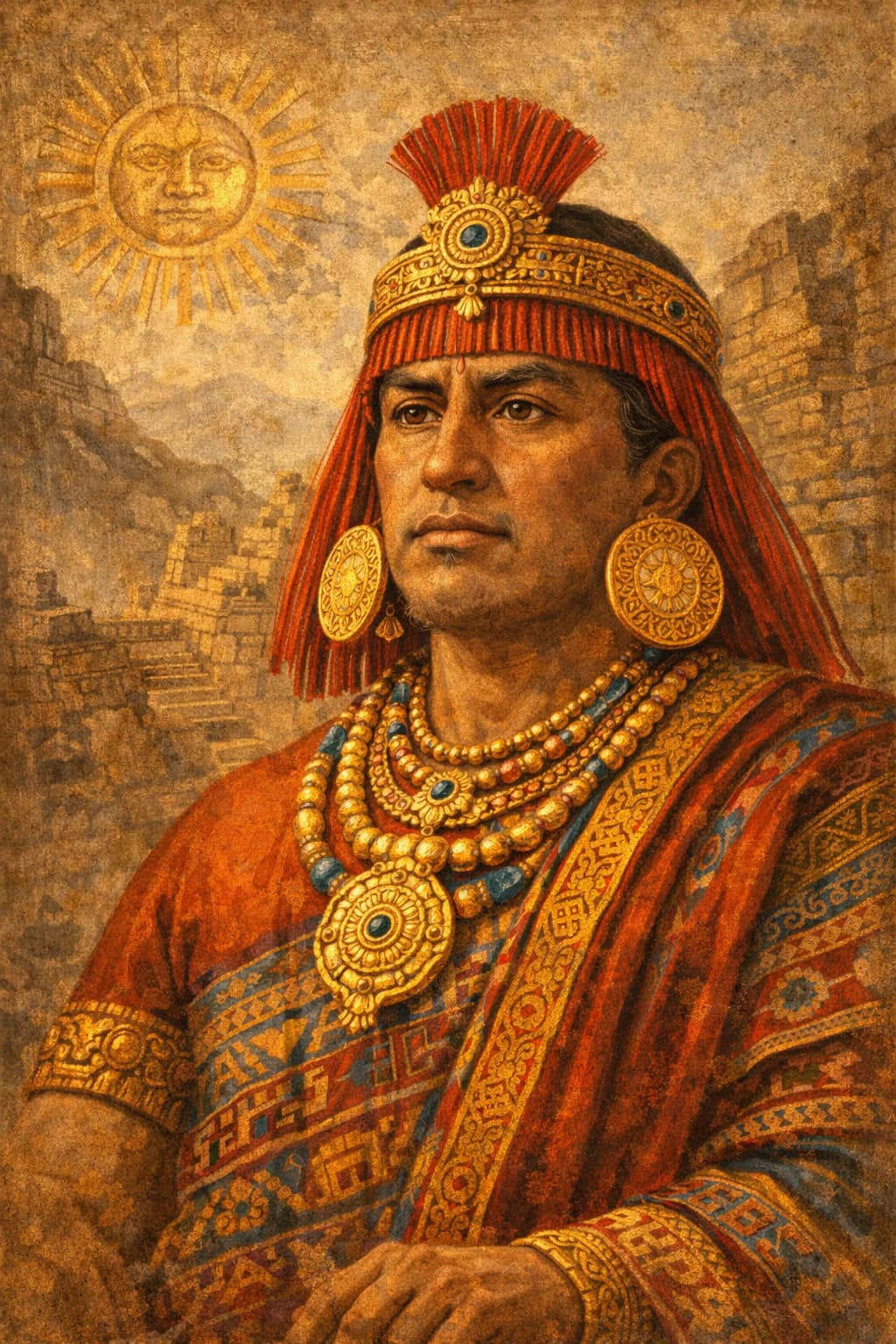
Atahualpa was born into the royal world of Tawantinsuyu, the Inca Empire, probably around 1500, though exact details of his birth and childhood remain debated. The empire stretched along the Andes, binding together coastal valleys, highland communities, roads, storehouses, labor obligations, and sacred authority centered on the Sapa Inca. Atahualpa was a son of Huayna Capac, one of the empire's greatest rulers, and grew up in a political culture where divine kingship, military command, and kinship politics were inseparable. His life must be understood through Andean structures, not simply through the Spanish chronicles that later described him. He inherited a world of impressive administration and deep internal hierarchy, where power depended on lineage, ritual legitimacy, military backing, and the ability to command loyalty across enormous distances.
His early life placed him inside a system where power required both birthright and strength.
1520s
Northern Command
Atahualpa's power base lay in the north, especially around Quito and the armies stationed there after Huayna Capac's campaigns. This mattered because the Inca Empire was not a simple centralized machine that obeyed instantly from Cuzco. It was a vast imperial system held together by roads, officials, noble lineages, military settlements, religious obligations, and negotiated loyalties. In the north, Atahualpa built relationships with experienced commanders such as Chalcuchimac, Quizquiz, and Ruminahui. These generals gave him something more valuable than a claim: organized military force. When succession became disputed, Atahualpa was not merely a prince with ambition. He was the leader of a hardened northern coalition with soldiers who had fought far from the old imperial heartland. That base gave him leverage against his half-brother Huascar in Cuzco.
Control of a strong regional base gave him the leverage needed to challenge for supreme power.
1529–1532
War with Huáscar
The succession crisis followed the deaths of Huayna Capac and his designated heir, probably during an epidemic that spread ahead of or alongside European contact. That disaster destabilized the royal line before the Spanish invasion reached the imperial center. Huascar ruled from Cuzco, while Atahualpa commanded loyalty in the north, and rivalry hardened into civil war around 1529. This was not a minor family quarrel. It divided elite lineages, armies, provinces, and sacred claims to legitimacy. Spanish accounts often frame the conflict in terms familiar to European dynastic politics, but Inca succession was shaped by royal kin groups, military prestige, and control of the deceased ruler's estates and memory. The war consumed resources, embittered factions, and left wounds that Francisco Pizarro's expedition would soon exploit. Atahualpa won power at the exact moment unity mattered most.
The internal struggle weakened the empire at the very moment it needed unity.
1532
Triumph Over Rival
Atahualpa's forces defeated Huascar's armies after a brutal sequence of campaigns, and Huascar himself was captured. The victory made Atahualpa the dominant claimant to the imperial title, but it did not instantly heal the empire. Cuzco's elites had been humiliated, rival kin groups had been targeted, and terror followed the victorious armies south. Atahualpa was near Cajamarca when the Spanish arrived, not because he was weak but because he had just emerged from a major internal war and was consolidating victory. His situation was paradoxical. He had military superiority within the Andean world, but his authority rested on a recently won and still unstable settlement. The civil war also meant that some local groups and factions had reasons to cooperate with the Spanish later, not because they understood Spanish imperial ambitions, but because Inca rule itself had enemies.
His victory gave him power, but not a fully stable empire to govern.
1532
Meeting the Spanish
Francisco Pizarro's expedition entered the Andes with fewer men than any Andean ruler would have considered an army, but the Spaniards brought steel weapons, horses, firearms, war dogs, interpreters, experience from earlier conquests, and a ruthless willingness to gamble everything on seizing a ruler. Atahualpa had reason to feel confident. He commanded tens of thousands nearby and had just won an imperial civil war. He may have viewed the Spaniards as strange, dangerous, but manageable visitors rather than an existential threat. Communication was filtered through interpreters and through assumptions neither side fully shared. Spanish chroniclers later shaped the story to justify conquest, while Andean perspectives survive more indirectly. What followed at Cajamarca was therefore not simply naivety meeting technology. It was a collision of political worlds, with each side misreading what the other intended and what rules, if any, applied.
He faced a new kind of opponent whose methods did not fit established patterns of conflict.
1532
Seizure at Cajamarca
On 16 November 1532, Atahualpa entered Cajamarca with a large ceremonial retinue but without the kind of battle formation that might have overwhelmed the Spaniards. Pizarro had hidden his men around the square. After a tense encounter involving the friar Vicente de Valverde, a Christian message, and disputed accounts of Atahualpa's response to a book or breviary, the Spaniards attacked. Horses, steel, gunfire, surprise, and panic turned the square into a massacre. Atahualpa was seized alive because the Spanish understood that control of the ruler could outweigh numbers. The capture shocked the Inca command structure. In a political system where the Sapa Inca's person carried sacred and administrative authority, imprisonment created paralysis. The Spanish had not defeated the empire in battle; they had struck its center of command.
The loss of a single leader revealed how dependent the empire was on centralized authority.
1532–1533
The Ransom Attempt
In captivity, Atahualpa offered the famous ransom: a room filled with gold and additional rooms with silver. The offer revealed the empire's extraordinary capacity to move precious objects across distance, but it also revealed a fatal mismatch. For Atahualpa, the transfer may have seemed a negotiated payment within a political crisis. For the Spaniards, it became proof of wealth and a reason to keep pressing. Temples, royal stores, and elite objects were stripped and melted into bullion, transforming sacred and political materials into portable treasure. Atahualpa also ordered Huascar killed while imprisoned, probably fearing that the Spanish might use his brother as an alternative ruler. The ransom did not buy freedom because the Spanish objective had moved beyond payment. They needed security, legitimacy, and control, and a living Atahualpa was both useful and threatening.
The failed ransom revealed a fundamental gap in trust and understanding between cultures.
1533
Execution
Atahualpa was tried by the Spanish on charges shaped by conquest politics rather than impartial justice, including accusations of idolatry, rebellion, and responsibility for Huascar's death. He was executed at Cajamarca on 26 July 1533 after accepting baptism, which changed the method of execution from burning to strangulation by garrote according to Spanish accounts. His death removed the last sovereign Inca ruler before Spanish domination took decisive form. It also gave Pizarro space to install puppet rulers and march toward Cuzco. Yet Atahualpa's execution did not mean instant Spanish control of the Andes. Resistance, negotiation, alliance, and adaptation continued for decades, including the neo-Inca state at Vilcabamba. His death was nonetheless a catastrophic rupture. The Spanish had converted captivity into conquest by killing the man whose body symbolized imperial order.
His death accelerated the breakdown of an empire already weakened by internal and external pressures.
After 1533
End of an Era
Atahualpa's legacy sits at the hinge between Inca sovereignty and Spanish colonial rule. He was not the last Inca claimant, and Andean resistance did not end with him, but he was the last ruler who held the empire as an independent imperial power. His fall cannot be explained by Spanish technology alone. Civil war, epidemic disease, local grievances against Inca rule, Spanish violence, tactical deception, and the political centrality of the Sapa Inca all interacted. Later memory has made Atahualpa a symbol of betrayal, imperial collapse, and the beginning of a new and devastating Andean order. His biography matters because it resists simple lessons. He was a victor who inherited a fractured empire, a captive who tried to negotiate with enemies whose aims he could not fully know, and a ruler whose death opened one of the most consequential transformations in the history of the Americas.
His fate reflects how swiftly a dominant power can collapse when disrupted at its center.