Complete chronology
Full overview and deeper context for every journey step.
c. 1370 BC
Royal origins
Akhenaten's biography begins inside one of the most prosperous courts of the ancient world. Born Amenhotep IV, he was a son of Amenhotep III and Queen Tiye, rulers of an Egypt rich from empire, diplomacy, gold, agriculture, and sacred prestige. The old religious order was not a decorative background. Temples controlled land, labor, ritual authority, and political influence, especially the great cult of Amun at Thebes. The young prince grew up in a world where kingship depended on harmony with the gods and on visible support for traditional worship. Yet the Aten, the visible disc of the sun, had already gained prominence under Amenhotep III. Akhenaten did not create interest in the Aten from nothing; he radicalized an existing current. That distinction matters. His later revolution was shocking, but it emerged from tensions already present in Egyptian royal religion.
Radical change often develops quietly beneath the surface of inherited tradition.
c. 1353 BC
Early reign
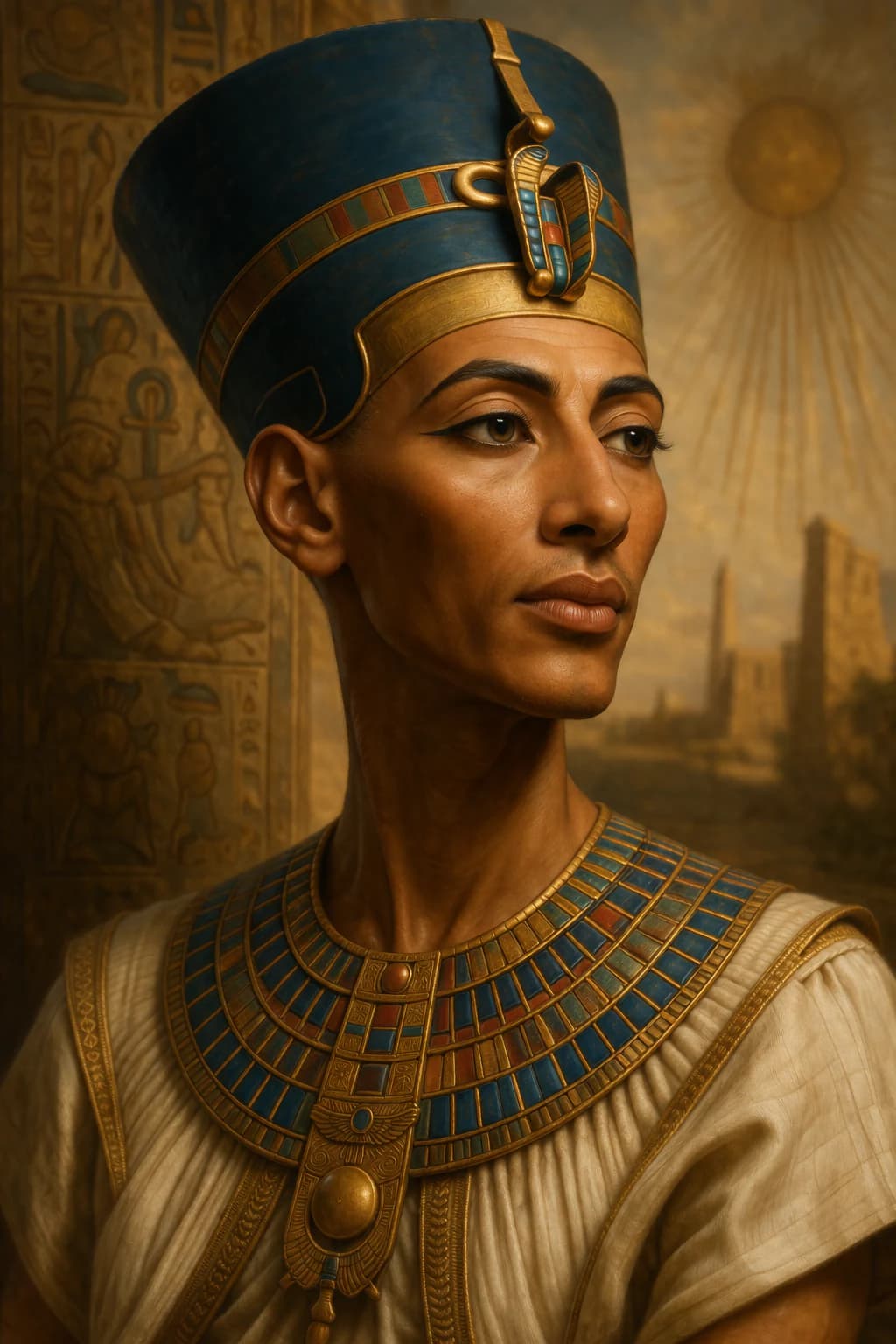
Amenhotep IV did not announce a complete revolution on his first day as king. Early in the reign, older forms still appeared, and the machinery of Egyptian government continued to function. But the direction of travel was visible. The Aten received increasing royal attention, and new building projects at Karnak promoted the solar disc with unusual energy. Art changed too. Royal images became more elongated, intimate, and experimental, departing from the balanced idealism of earlier pharaohs. Scholars continue to debate what these bodies meant: theological symbolism, court style, medical reality, or a deliberate rejection of convention. Whatever the explanation, the visual break prepared the viewer for a political and religious break. Akhenaten's reign was becoming a statement that Egypt's relationship with the divine would pass through the king in a new and far more exclusive way.
Transformative rulers often signal their intentions through small aesthetic shifts before large structural ones.
c. 1348 BC
The Aten revolution
Around the middle of his reign, Amenhotep IV became Akhenaten, usually understood as 'effective for the Aten' or 'servant of the Aten.' The change was not cosmetic. He increasingly presented the Aten as the only legitimate focus of worship and attacked the old divine order, especially Amun. Names and images of Amun were removed from monuments, temple wealth was redirected, and religious life was reordered around the royal family as the privileged channel to the sun disc. Whether this should be called true monotheism remains debated. The Aten was universal, singular, and exclusive in ways that look strikingly different from normal Egyptian religion, yet the system still centered on the king and queen as necessary mediators. What is clear is that Akhenaten did not merely prefer one god. He attempted to rewire the relationship between state, cosmos, priesthood, and people.
Monopolising divine access is one of the most powerful — and most dangerous — tools of political authority.
c. 1346 BC
Building Akhetaten
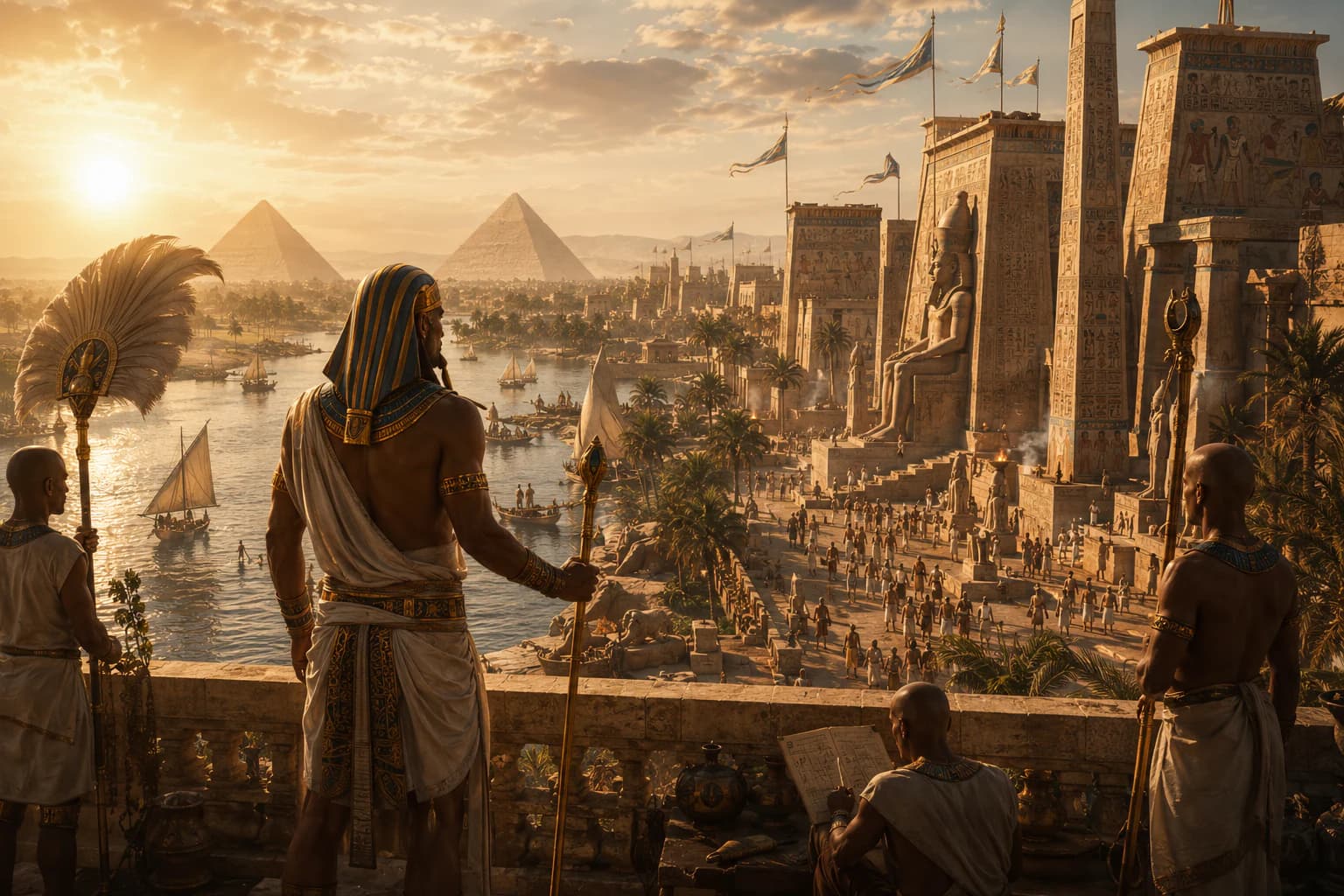
Akhenaten did what radical rulers often do when inherited institutions resist them: he moved the center. He chose a site in Middle Egypt that he described as belonging to no god or goddess before the Aten and named it Akhetaten, the 'Horizon of the Aten.' The city, now known as Amarna, was planned at speed. Its temples were open to sunlight rather than enclosed in shadow, its boundary stelae proclaimed the king's sacred purpose, and its palaces, workshops, houses, and administrative buildings pulled the court away from Thebes. This was urban theology. The city made the Aten's light unavoidable and made loyalty to the new order visible. Yet building a capital from scratch demanded labor, resources, forced relocation, and administrative strain. Akhetaten was both a dazzling statement of belief and a risky withdrawal from the old centers that had helped hold Egypt together.
Creating a new space can be as powerful as reforming an old one — a new capital is a statement about what the old one represented.
c. 1345 BC–1340 BC
Peak of power
The Amarna period produced images that still feel startling: Akhenaten, Nefertiti, and their daughters beneath the rays of the Aten; informal family scenes; elongated bodies; full lips; narrow shoulders; swelling forms; and royal intimacy displayed as sacred proof. Nefertiti appears with unusual prominence, sometimes performing roles that seem almost kingly. The art was not simply personal taste. It expressed a theology in which divine life flowed through the Aten to the royal family and from them to Egypt. But the brilliance of Amarna culture should not hide the cost of the experiment. Suppressing Amun damaged powerful temple economies. Officials had to navigate a court where access to the king and the new cult mattered intensely. The Amarna Letters, diplomatic tablets from foreign rulers and vassals, suggest that Egypt's influence in parts of Syria-Palestine faced pressure while the court's energy was turned inward.
A revolution that transforms the centre can weaken the periphery without its architects noticing.
c. 1340 BC–1336 BC
Signs of strain
The final years of Akhenaten's rule are shadowed by gaps in the evidence. The Amarna Letters show vassal rulers pleading for help, accusing rivals, and warning that Egyptian influence was weakening. These letters should be read carefully; client kings often exaggerated danger to obtain support. Even so, they reveal a diplomatic world that required attention, money, and force. At home, the religious revolution had likely alienated priests, administrators, and communities attached to older cults. The royal family also entered a period of uncertainty. Several princesses died young, Nefertiti's later role is debated, and names such as Smenkhkare and Neferneferuaten complicate the succession. Akhenaten's project depended heavily on his personal authority. As that authority weakened or ended, the old order waited with enormous institutional memory.
Ideological focus does not exempt a ruler from the practical demands of governance.
c. 1336 BC
Death and succession
Akhenaten died around 1336 BC, though the exact circumstances are unknown. The succession that followed remains one of the most difficult puzzles of New Kingdom history. Smenkhkare, Neferneferuaten, and Tutankhaten appear in the record in ways that scholars still debate, and the young Tutankhaten soon became Tutankhamun as Amun was restored. That name change tells the story of the counter-revolution in miniature. The Aten cult had not replaced Egypt's religious world in the hearts of the population; it had been imposed through court power. Once the central will behind it disappeared, officials, priests, and successors moved toward repair. Akhetaten was abandoned, its buildings quarried, its temples dismantled. The new regime did not simply disagree with Akhenaten. It treated his reign as a wound to be closed.
A revolution without popular roots rarely survives the death of its originator.
c. 1330 BC–1300 BC
Systematic erasure
The erasure of Akhenaten was systematic because his successors understood the danger of leaving his example intact. Under Tutankhamun, Ay, and especially Horemheb, the old cults were restored, temples were repaired, and the Amarna interlude was treated as a disruption. Akhenaten's name was hacked from monuments. Blocks from his buildings were reused as construction fill, accidentally preserving fragments that modern archaeologists would later recover. Official king lists skipped him and sometimes his immediate successors, creating an artificial continuity from Amenhotep III to Horemheb. This was politics through memory. To remove a king's name in Egypt was to attack his afterlife and deny his place in cosmic order. The fact that Akhenaten required such treatment shows how deeply he had unsettled the religious and political imagination of the state.
To erase a ruler from the record is to acknowledge how much they disrupted the world they left behind.
After 1336 BC
Rediscovery and legacy
Akhenaten's modern legacy is unusually unstable because the evidence invites competing stories. Some writers have cast him as the first monotheist, a spiritual pioneer who saw beyond the crowded divine world of Egypt. Others see a ruler whose theology served political centralization by weakening Amun's priesthood and making the king the only effective mediator of divine favor. Some emphasize artistic originality and family intimacy; others stress coercion, neglect, and the fragility of a reform that collapsed almost immediately after his death. The truth may not fit a single label. Akhenaten was both sincere and political, imaginative and destructive, a creator of beauty and a ruler whose revolution narrowed religious life around himself. His importance lies in the scale of the question he forces: what happens when a king tries to remake not only government, but reality itself?
Figures erased by their own civilisation sometimes find their fullest audience in a later one entirely.