Related Moment
Trinity: The First Atomic Explosion
At 5:29 in the morning, the desert became daylight.
On 16 July 1945, the first atomic explosion lit the New Mexico desert and opened the nuclear age.
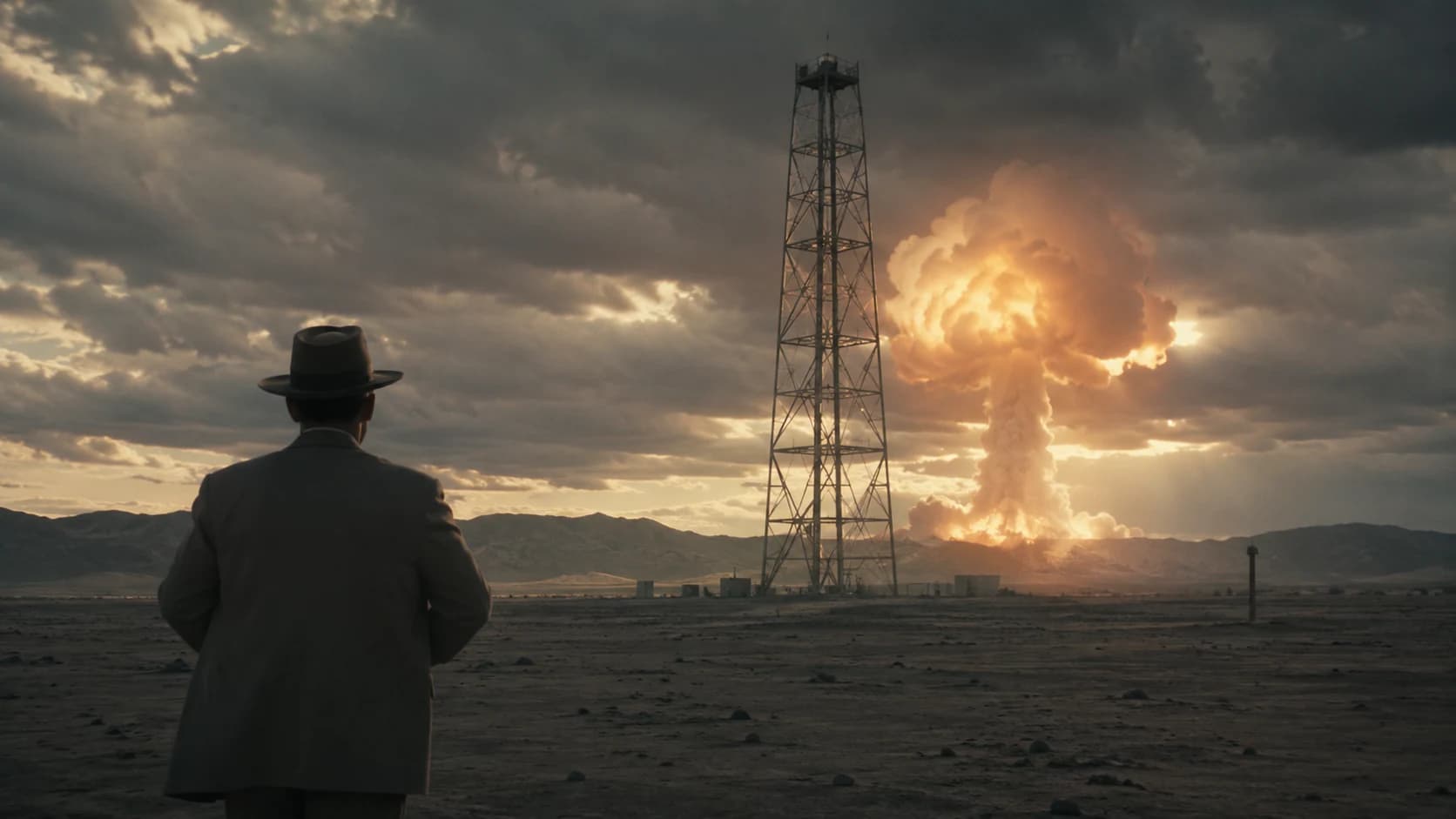
At 5:29 in the morning, the desert became daylight. For a fraction of a second, the was no longer dark, silent, or earthly. A fireball climbed from the New Mexico sand, brighter than the sun, boiling upward in colors no human eye had ever seen from a human-made device.
Some of the men watching laughed. Some fell silent. One thought of scripture. Another thought of the end of the world.
By July 1945, the Second World War was nearing its final, exhausted stage. Germany had fallen. Japan fought on. Across the United States, hidden behind secrecy, urgency, and fear, the had gathered scientists, soldiers, engineers, and laborers into one immense purpose: to build an atomic bomb before anyone else did.
The test site lay in the New Mexico desert, far from cities and questions. The device was nicknamed the Gadget, a strangely harmless name for a machine designed to release the force inside the atom.
No one knew exactly what would happen. The physics suggested success, but confidence is not certainty, and this was the first time theory would meet the real world.
Rain had swept across the desert during the night. Lightning threatened the test. Scientists worried about failed circuits, scattered fallout, and the possibility that the weapon might detonate under the wrong conditions. In bunkers miles away, observers crouched behind dark glass and blast walls.
Then came the countdown. At zero, the desert vanished. The explosion did not simply make light; it seemed to invent a new kind of light. The tower was gone. Sand below fused into greenish glass. A shockwave rolled across the plain, striking the bunkers seconds later.
The fireball rose and folded into itself, becoming the shape the world would soon learn to fear: the mushroom cloud.
In that moment, triumph and dread were inseparable. The scientists had proved their weapon worked. They had also proved that humanity had crossed a threshold it could never uncross.
The test was a success. Within weeks, atomic bombs would be dropped on Hiroshima and Nagasaki. Japan would surrender. The Second World War would end, but a new age would begin almost immediately.
At , the witnesses understood something had changed. Some celebrated the technical achievement. Others felt horror settling in. The bomb had not merely destroyed a tower in the desert. It had altered the future.
The world did not know it yet, but history had split in two: before the atomic bomb, and after.