Related Moment
The Day the Door Closed Behind Anne Frank
A summons arrived. A family disappeared into a hidden set of rooms.
In July 1942, Anne Frank's family went into hiding in occupied Amsterdam after Margot Frank was ordered to report for forced labor.
The call came without warning. One moment, was a thirteen-year-old girl in , worrying about school, friends, and the restrictions tightening around her life. The next, her family was told they could no longer wait.
A summons had arrived. 's older sister, , had been ordered to report for a German labor camp. The Frank family understood what that could mean. Within hours, they began disappearing.
By the summer of 1942, the Netherlands had been under German occupation for more than two years. What had begun as military control was becoming something far darker for the country's Jewish population.
Jews were steadily pushed out of public life. They could no longer attend many schools, enter parks, visit cinemas, or travel freely. Businesses were confiscated. Rights vanished one by one.
For , the changes arrived gradually enough to seem almost normal. She recorded many of them in the diary she had received for her thirteenth birthday. Yet beneath the routines of family life, danger was growing.
had already begun preparing for the possibility that the family might need to hide. Behind his business premises on 's Prinsengracht canal stood a concealed set of rooms in the rear of the building.
The plan was unfinished. The family hoped they would not need it immediately. Then the summons for arrived. Waiting was no longer an option.
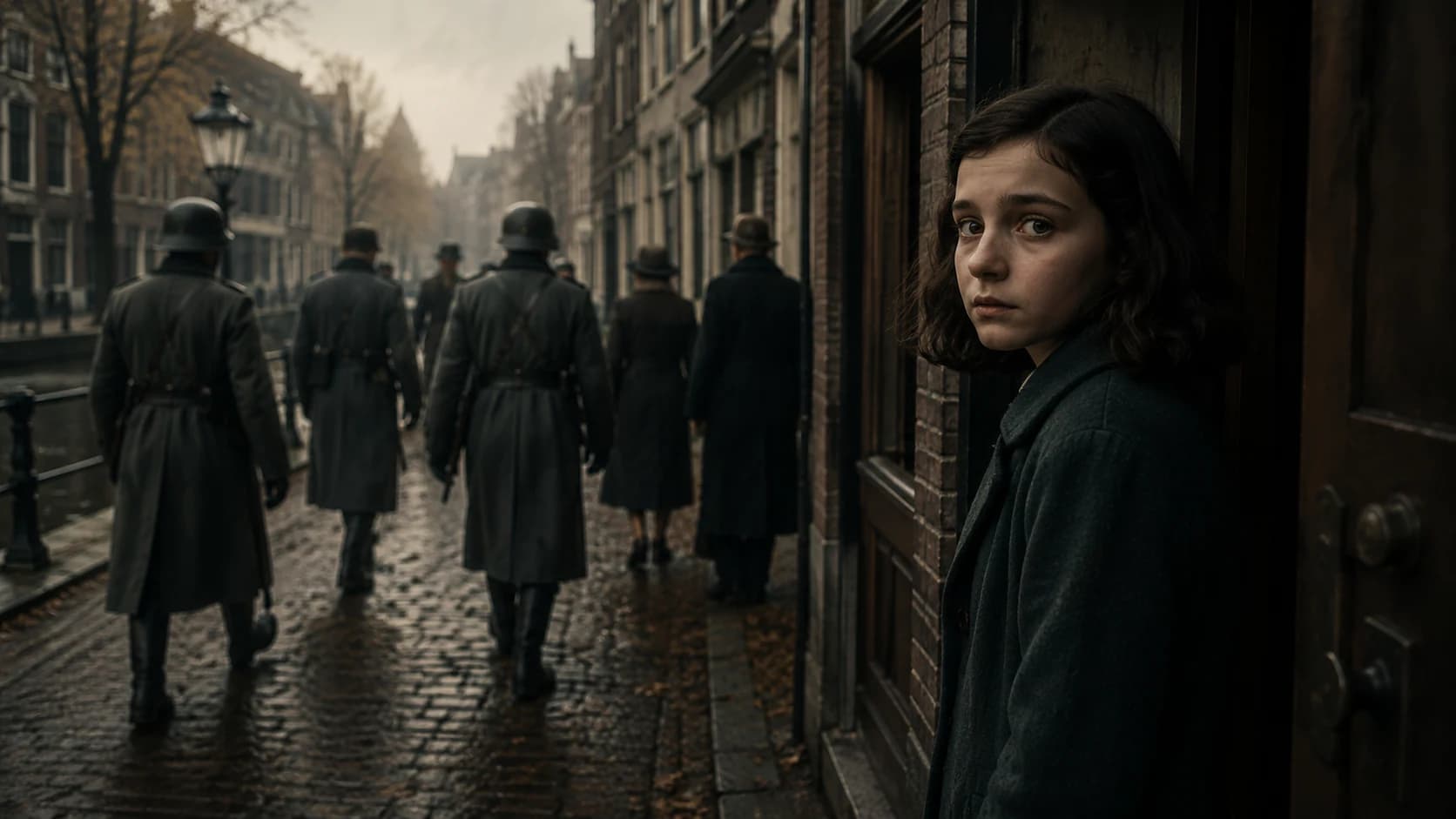
On the morning of 6 July 1942, the Frank family left their apartment. They did not carry suitcases, because suitcases attracted attention. Instead, they layered clothes upon clothes, wearing as much as they could carry.
Coats despite the season. Extra dresses. Shirts piled over shirts. Anything that could not fit into hiding places had to be worn on their bodies.
The walk through was quiet and tense. Outside, life continued: bicycles crossing bridges, shops opening doors, people moving through the streets. For the Franks, every step carried enormous weight.
If they succeeded, they would disappear from public life. If they failed, the consequences could be catastrophic.
The destination was the behind 's office building. Reaching it was only the beginning.
The hiding place was not a secret bunker buried underground. It was part of an ordinary city building. Workers occupied the front offices during the day. Warehouses operated below. Deliveries arrived constantly.
The hidden rooms survived on invisibility. A movable bookcase eventually concealed the entrance. Behind it lay a cramped collection of rooms where the Franks would live alongside others also seeking refuge from deportation.
The space was small. Windows had to remain covered. Voices had to remain low. During business hours, movement itself became dangerous.
A dropped object, a creaking floorboard, or a burst of laughter could potentially reveal their presence to workers below. Only days earlier, had been a schoolgirl moving through the city. Now she was effectively imprisoned inside a handful of rooms.
Yet brought something with her into hiding that would ultimately outlive the building itself: her diary.
At first, it was a companion, a place to record frustrations, fears, arguments, and hopes. She wrote about the people around her, the claustrophobic conditions, and the emotional strain of confinement.
As weeks became months and months became years, the diary evolved into something larger. was not merely recording events. She was documenting what it felt like to live through persecution while still believing in the future.
Outside the , the war intensified. Across Europe, millions of Jews were being deported, imprisoned, and murdered in the Holocaust. News filtered into the hidden rooms in fragments, and every report reinforced the danger of discovery.
Yet life inside the continued in its strange suspended state. There were lessons to study, birthdays to mark, arguments over food, moments of laughter, and moments of despair.
The occupants existed in a world measured not by freedom but by silence. Day after day. Month after month. Year after year.
The Frank family remained hidden for more than two years. Their survival depended on a small network of helpers who supplied food, news, and practical support despite enormous personal risk.
For a time, the hiding place worked. Then, on 4 August 1944, it ended. German authorities and Dutch collaborators arrived at the and arrested its occupants.
The precise circumstances that led to the discovery remain debated by historians, and no definitive explanation has ever been universally accepted. What is certain is that , , , and the others were taken into custody. The hidden world behind the bookcase vanished in a single day.
The family was eventually separated within the Nazi camp system. and were transported to , where conditions were catastrophic and disease spread rapidly.
Both sisters died there in early 1945, only weeks before the camp was liberated. Of the eight people who had hidden in the , was the sole survivor.
When returned to after the war, he received something extraordinary. 's diary had been preserved.
The day went into hiding was not a military battle, a political revolution, or a dramatic act of resistance. Yet it became one of the most significant moments in the historical memory of the Holocaust.
The transformed an immense human catastrophe into a deeply personal story. Through 's writing, readers encounter the Holocaust not as an abstraction of statistics and governments, but through the eyes of a teenager trying to understand a world collapsing around her.
Millions were persecuted and murdered by Nazi Germany. 's diary endures because it reveals the individual life behind that vast tragedy.
The decision to step through the hidden doorway in July 1942 was an attempt to survive. Instead, it left behind one of history's most powerful testimonies to human resilience, hope, and loss.