Related Moment
The Battle of Muye
The dawn the Shang never saw.
In 1046 BCE, the Zhou victory at Muye broke Shang power and gave Chinese political thought one of its most enduring ideas: the Mandate of Heaven.
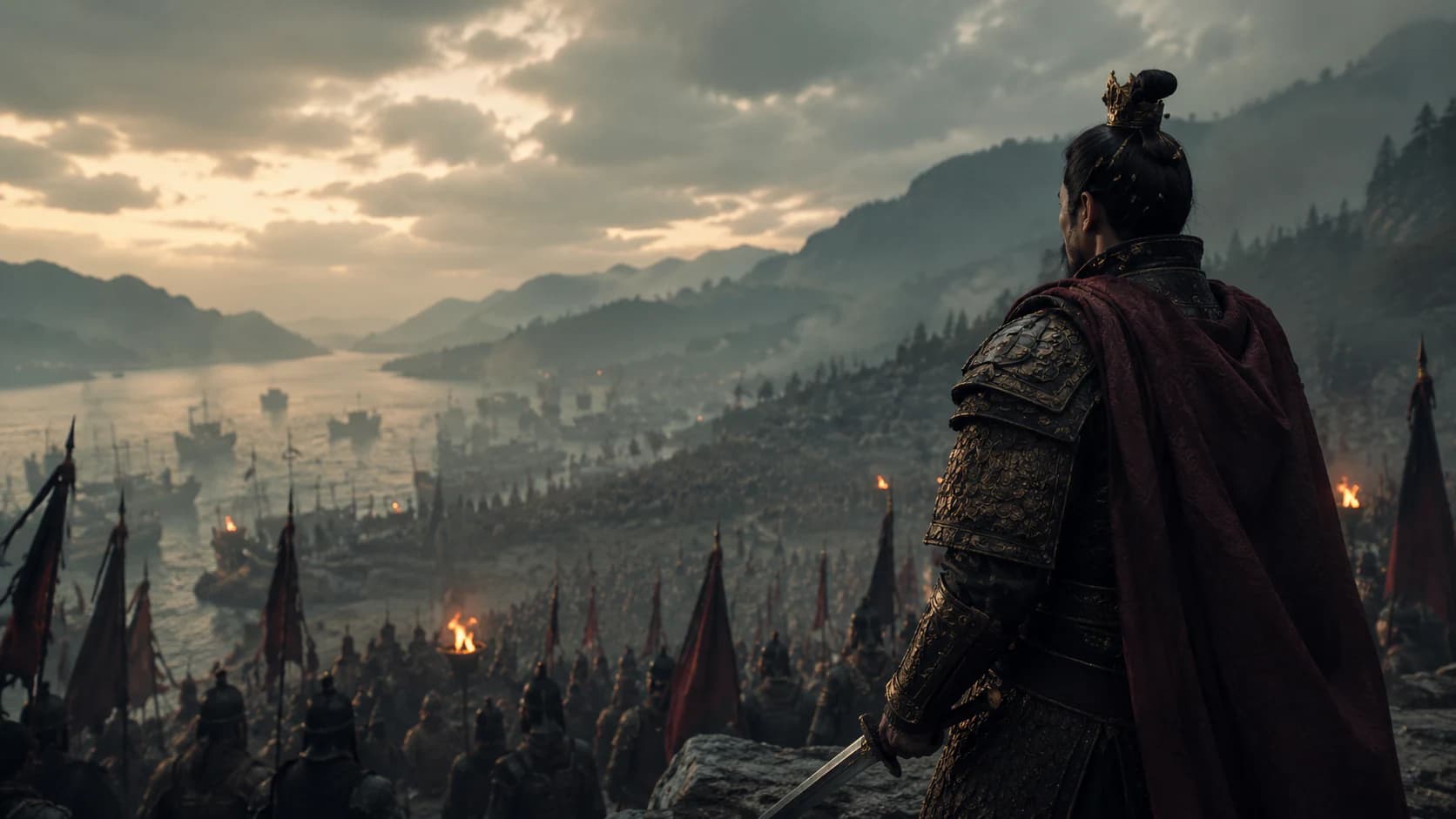
The army waited in the gray light before sunrise. Across the plain at , banners snapped in the cold wind while bronze spearheads glimmered beneath a sky still dark with night. The Shang king had assembled a force so large that later chroniclers struggled to describe it without exaggeration.
And yet many of the men standing there had no intention of fighting. When the battle began, some lowered their weapons. Others turned them around entirely, holding spear shafts backward as a silent refusal to serve. By the end of the day, one of the oldest ruling houses in Chinese history was collapsing in flames.
By the eleventh century BCE, the Shang dynasty had ruled northern China for centuries. Its kings governed from fortified cities along the Yellow River basin, commanding armies equipped with bronze weapons that were among the most advanced in the ancient world.
Shang rulers oversaw rituals, warfare, agriculture, and communication with royal ancestors through oracle bones: heated animal bones and turtle shells whose cracks were interpreted as messages from the spirit world.
But by the reign of King , the last Shang ruler, the dynasty had become dangerously unstable. Later Chinese historians portrayed him as cruel, extravagant, and paranoid. Some accounts were likely exaggerated by the dynasty that replaced him, but unrest had spread through the Shang realm.
To the west, another power was rising. The Zhou people had once been subordinate allies of the Shang. Their leader, King Wen of Zhou, carefully expanded his influence while presenting himself as morally disciplined and politically restrained.
After King Wen's death, leadership passed to his son , known to history as . King Wu inherited more than an army. He inherited an argument: the Shang had become corrupt, Heaven no longer supported them, and a king who governed unjustly could be replaced.
Ancient sources describe the Zhou as badly outnumbered, though the figures are almost certainly inflated. The central reality remains clear: everything depended on morale. The Shang forces included trained warriors, but many troops had reportedly been conscripted slaves or prisoners forced into service.
When the battle opened, the fragile structure holding the Shang army together began to fail almost immediately. According to traditional accounts, sections of the Shang line refused to advance. Some soldiers defected outright. Others symbolically reversed their spears rather than attack the Zhou forces.
Then the Zhou army surged forward. Bronze weapons crashed against shields. Chariots drove into collapsing formations. The battle may not have lasted long. What mattered was not tactical brilliance alone, but psychological collapse. The Shang king no longer commanded belief.
King fled back to his capital at Yin. There, as Zhou forces closed in, the last Shang ruler reportedly gathered treasures inside his palace and set the building ablaze. Rather than surrender, he died in the fire.
Whether every detail is true remains uncertain. Ancient dynastic histories often mixed fact with political storytelling. But the larger truth is undeniable: after , Shang power was broken beyond recovery. A dynasty that had ruled for centuries vanished in a single campaign.
entered the Shang capital not merely as a conqueror, but as the founder of a new moral order. The Zhou rulers understood that military victory alone was not enough. They needed legitimacy powerful enough to unite former Shang territories and justify rebellion against an ancient royal house.
The became that justification. Heaven granted authority to just rulers, but could remove it from tyrants. Natural disasters, rebellion, famine, and military defeat could all be interpreted as signs that a dynasty had lost Heaven's support.
Across history, empires often appear invincible until the moment belief collapses. At , the Shang dynasty did not lose merely because another army arrived at its gates. It lost because too many people no longer believed the king deserved to rule.
