Related Moment
The Assassination that Started World War One
The car had already escaped once.
On 28 June 1914, two shots in Sarajevo killed Archduke Franz Ferdinand and Sophie, turning a Balkan assassination into the spark for world war.
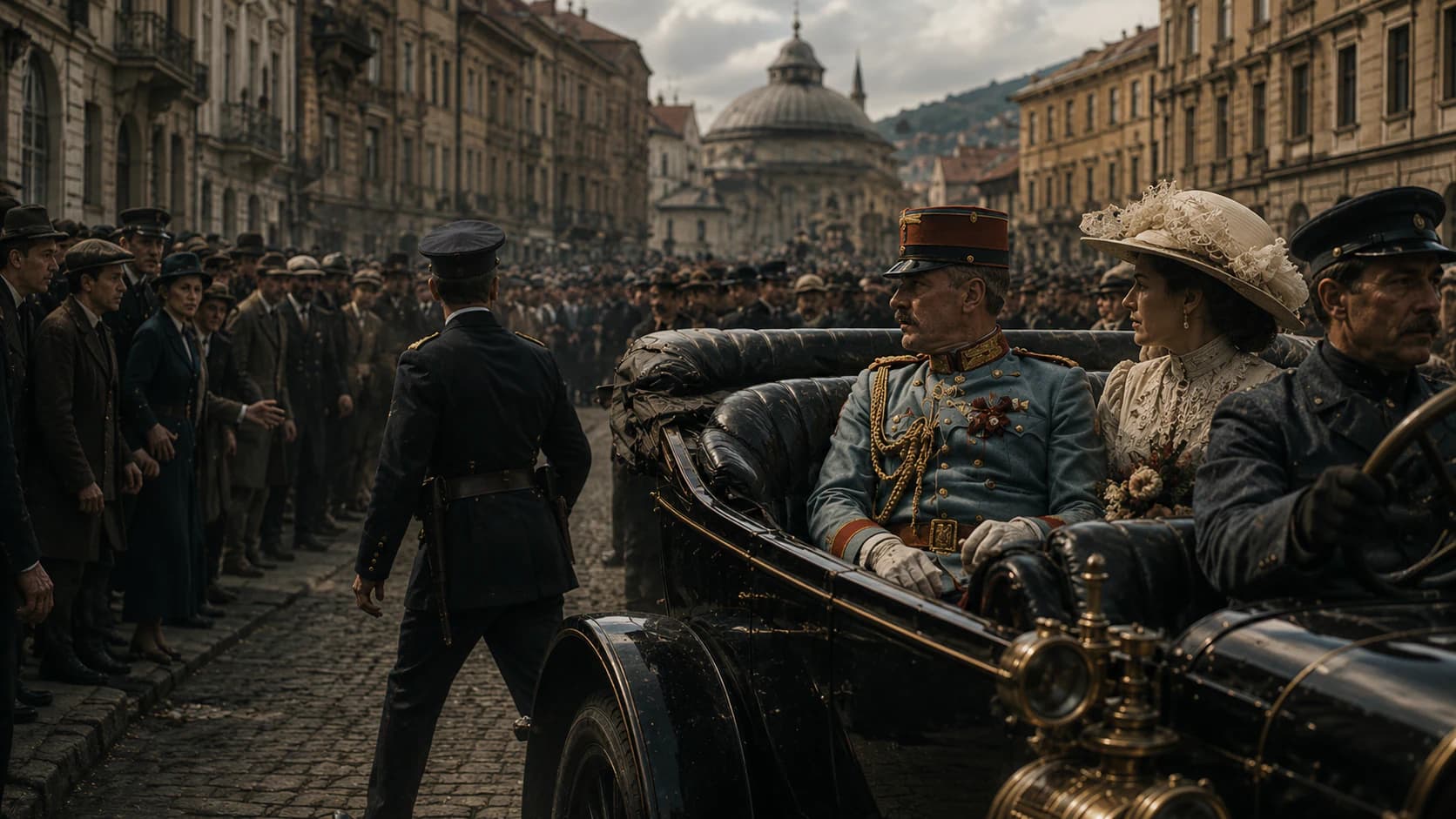
The car had already escaped once. Moments earlier, a bomb had exploded beneath another vehicle in the royal convoy, shredding metal and hurling soldiers into the street. Smoke drifted through as crowds scattered in panic.
should have left the city immediately. Instead, a wrong turn brought his open-topped car to a stop directly in front of a thin, nervous nineteen-year-old standing beside a delicatessen.
In the summer of 1914, Europe looked powerful, wealthy, and stable from a distance. Beneath the surface, it was dangerously tense. The continent was divided into rival alliances, massive armies had been built over decades, and nationalism was surging across borders.
Nowhere was more volatile than the Balkans. Austria-Hungary ruled a patchwork empire that included millions of Slavic people, while neighboring Serbia dreamed of uniting South Slavs into one state. Vienna viewed Serbian nationalism as an existential threat. Serbian radicals viewed Austria-Hungary as an occupying empire.
sat directly on that fault line. Austria-Hungary had annexed Bosnia in 1908, enraging Serbian nationalists who believed the territory should join a Slavic state. Into this atmosphere arrived , heir to the Austro-Hungarian throne.
Waiting for him was a group of young Bosnian Serbs, armed and trained with support linked to Serbian nationalist networks. They spread themselves along the motorcade route with pistols, grenades, and cyanide capsules. Most were barely adults.
The assassination plot almost collapsed immediately. As the convoy rolled through , the first conspirators lost their nerve. Then Nedeljko Cabrinovic hurled a bomb at 's car.
The driver saw it coming and accelerated. The explosive bounced off the folded roof of the Archduke's vehicle and detonated beneath the next car in the convoy. The blast wounded officers and civilians, tore open the street, and filled the avenue with chaos.
Even after the attack, the visit did not end. decided to visit the wounded in hospital. Officials planned a new route, but communication broke down. The lead driver mistakenly turned onto a side street near the Latin Bridge. Someone shouted that the route was wrong. The car stopped and began reversing slowly.
Standing nearby was . Only minutes earlier, he had assumed the operation had failed. Suddenly, by astonishing coincidence, the Archduke's vehicle halted directly in front of him. Princip stepped forward and fired two shots from a Belgian-made FN Model 1910 pistol.
One bullet struck in the neck. The other hit Sophie in the abdomen. Within minutes, both were dead. Princip was tackled by the crowd before he could kill himself, then dragged away by police as furious bystanders beat him in the street.
Across Europe, news of the assassination spread rapidly. At first, many leaders treated it as a regional crisis, another Balkan outrage in a continent already accustomed to political violence. They were catastrophically wrong.
Austria-Hungary did not merely want justice. Powerful figures in Vienna saw an opportunity to crush Serbia permanently. Germany encouraged a hard response with the support later known as the blank cheque. Austria-Hungary issued Serbia an ultimatum designed to be nearly impossible to accept completely.
On 28 July 1914, exactly one month after the assassination, Austria-Hungary declared war on Serbia. Russia mobilized to support Serbia. Germany declared war on Russia, then France. German armies invaded Belgium. Britain declared war on Germany after Belgian neutrality was violated.
The assassination of did not cause World War One by itself. Europe was already unstable, militarized, and divided by rival ambitions. But became the spark that ignited a system primed for explosion.
What happened in was not just the murder of a royal heir. It was the opening crack in the twentieth century.