Complete chronology
Full overview and deeper context for every journey step.
1856
Southern upbringing
Wilson was the son of a Presbyterian minister and spent his childhood in Virginia, Georgia and the Carolinas while the Civil War and Reconstruction transformed the South. He saw wounded Confederate soldiers, heard the language of defeat and grew up inside a white southern worldview that shaped his later blind spots. His mind loved order, hierarchy and moral purpose. That combination could produce reforming energy, but it also made him susceptible to certainty and paternalism. Wilson's biography cannot be separated from this inheritance: he spoke the language of democracy on the world stage while tolerating, and in federal offices advancing, racial segregation at home.
Growing up amid upheaval encouraged him to seek order through structured political ideas.
1870s–1890s
Academic path
Wilson studied at Princeton, the University of Virginia and Johns Hopkins, where he earned a doctorate in political science. His scholarship criticised the separation of powers for producing drift and praised parliamentary-style leadership for clarity and responsibility. He wanted government to be energetic, morally directed and led by figures able to speak for the whole people. As a teacher and writer, he became one of America's best-known academic interpreters of politics. The strength of that background was intellectual coherence. The weakness was a tendency to treat disagreement as obstruction by lesser minds rather than as a democratic condition to be worked through patiently.
Intellectual preparation gave him a clear vision, though not always practical solutions.
1900s
University leadership
Wilson's Princeton presidency made him nationally visible. He reorganised teaching through the preceptorial system and sought to make undergraduate life more intellectually serious. He also tried to curb the social power of eating clubs and proposed a graduate college arrangement that brought him into conflict with trustees, alumni and the powerful dean Andrew Fleming West. The battles revealed Wilson's gifts and limitations. He could articulate reform with rare force, but compromise did not come naturally when he believed principle was at stake. Princeton gave him administrative experience, a reformer's reputation and a record of conflict that foreshadowed his presidency.
Leadership in practice revealed the limits of ideas formed in theory alone.
1910
Entry into politics
New Jersey Democrats initially saw Wilson as a respectable academic who could be managed. He surprised them. As governor, he pushed through primary reform, anti-corruption measures, utility regulation and workers' compensation, presenting himself as a public servant independent of machine politics. His success came quickly enough to make him a presidential contender in 1912. Wilson understood that Progressive voters wanted government strong enough to discipline concentrated economic power without surrendering to socialism. He turned academic authority into political credibility by showing he could fight bosses and win.
A clear reform message can quickly elevate a newcomer in political life.
1912
Presidential election
The 1912 election gave Wilson his opening. Theodore Roosevelt's Progressive campaign split Republicans from Taft, allowing Wilson to win with a plurality. His New Freedom promised tariff reduction, banking reform and antitrust action aimed at restoring competition. Wilson was not a populist in the Bryan mould, though William Jennings Bryan became his Secretary of State. He believed moral leadership from the presidency could rally Congress and the nation behind reform. The victory put a theorist of executive leadership into the office he had studied for decades. Now theory had to meet Congress, courts, party pressures and world events.
His rise showed how ideas can translate into power when aligned with public demand for change.
1913–1916
Domestic reforms
Wilson's domestic record was substantial. The Underwood Tariff lowered duties and introduced a graduated federal income tax under the new Sixteenth Amendment. The Federal Reserve Act created a central banking system that reshaped American finance. The Federal Trade Commission and Clayton Antitrust Act expanded federal tools against unfair business practices. Later, Wilson backed labour and farm measures as he sought reelection. Yet the same administration allowed federal departments to segregate workplaces, harming Black civil servants and legitimising Jim Crow practices in national government. Wilson's progressivism was real, but it was racially bounded. That contradiction is central, not incidental, to his legacy.
Reform can strengthen systems, but it often raises new questions about authority and balance.
1917–1918
World War I leadership
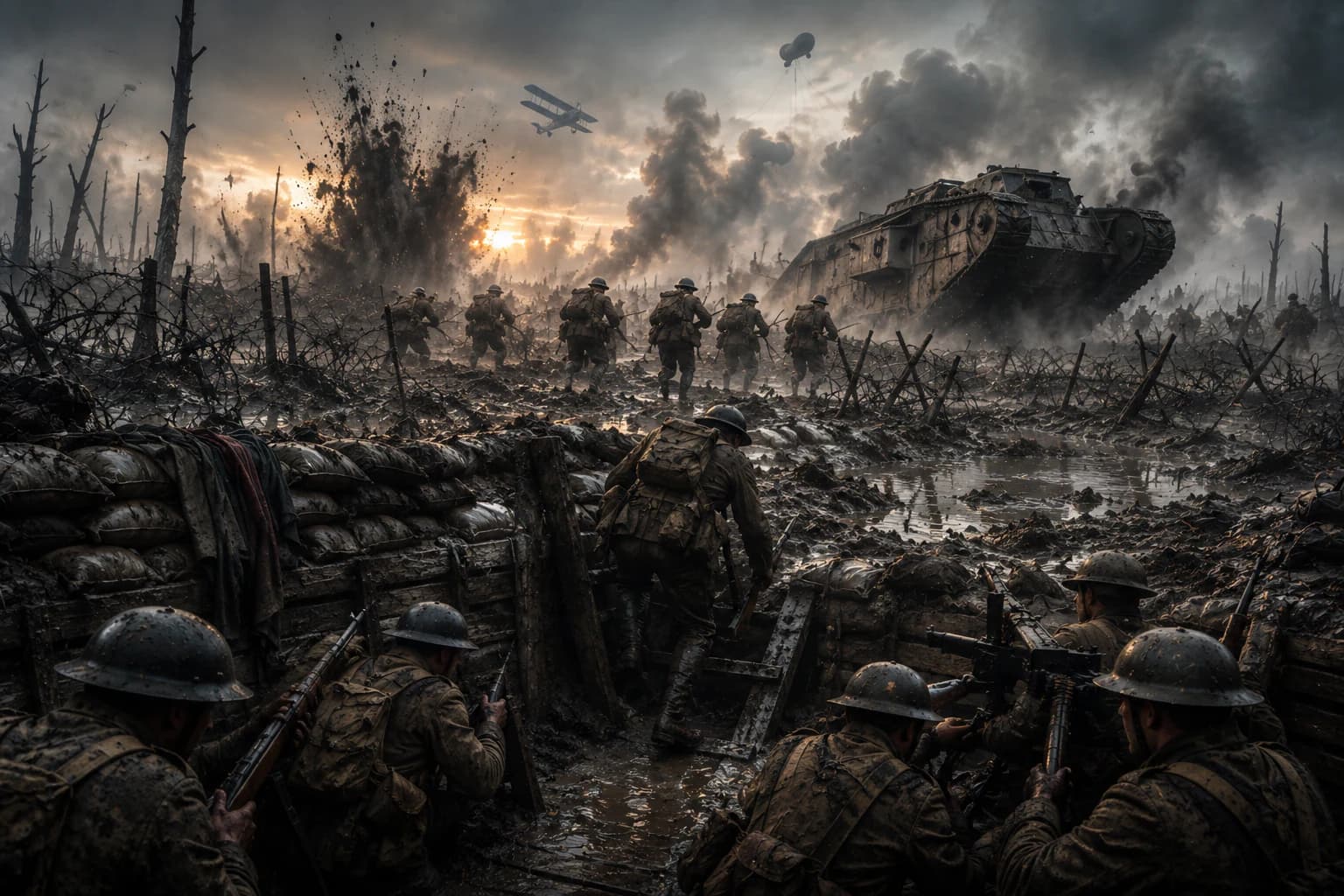
Wilson tried to maintain neutrality after war began in Europe in 1914, but neutrality became harder as German submarine warfare threatened American ships and loans tied the United States economically to the Allies. Germany's resumption of unrestricted submarine warfare and the Zimmermann Telegram pushed Wilson toward intervention. In April 1917 he framed the war as a fight to make the world safe for democracy. Mobilisation was rapid and vast: conscription, industrial coordination, propaganda and wartime controls. It also brought repression, including the Espionage and Sedition Acts, used against dissenters, socialists and antiwar voices. Wilson's democratic war was fought with coercive tools at home.
Decisions made under pressure can redefine a nation’s place in the world.
1918–1919
Vision for peace
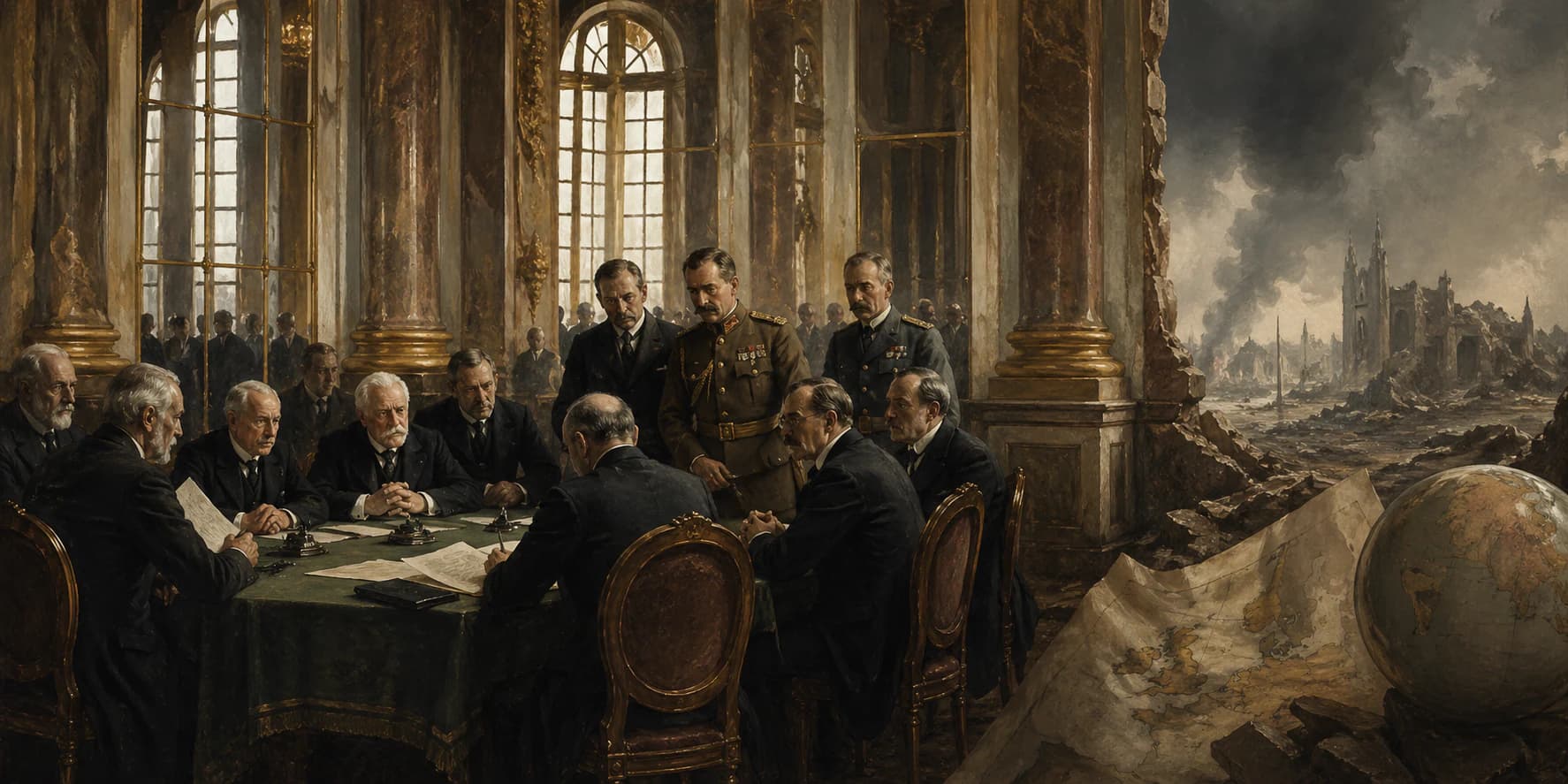
Wilson arrived at the Paris Peace Conference as a global celebrity, but moral authority did not give him control. The Fourteen Points promised open diplomacy, freer trade, self-determination and collective security. European allies, especially France and Britain, wanted security, reparations and imperial adjustments after devastating war. Wilson compromised to preserve the League of Nations, accepting a treaty that disappointed many national groups and critics of imperialism. The League was his great institutional hope: a forum where collective action might prevent another catastrophe. It was visionary, flawed and politically fragile, depending on American participation he had not yet secured.
Ambitious visions can inspire change, even when they are only partially achieved.
1919–1924
Final years and legacy
Wilson refused to compromise effectively with Senate Republicans led by Henry Cabot Lodge, who wanted reservations to protect congressional authority and national sovereignty. Instead, Wilson took his case to the public on a gruelling speaking tour and suffered a severe stroke in October 1919. For months, the extent of his incapacity was hidden while Edith Wilson and close advisers controlled access. The Senate rejected the treaty, and the United States never joined the League. Wilson won the Nobel Peace Prize, but his central project failed at home. His legacy remains one of the most divided in American history: major Progressive reformer, architect of internationalist ideals, wartime civil-liberties violator and president whose racism damaged lives and institutions.
His life illustrates the tension between visionary leadership and the realities of political acceptance.